

Local Government
Claremont
Region
Metropolitan

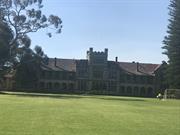
50 Goldsworthy Rd Claremont
Edith Cowan University Claremont Campus
UWA Claremont
Claremont
Metropolitan
Constructed from 1901 to 1980
| Type | Status | Date | Documents | More information |
|---|---|---|---|---|
| Heritage List | Adopted | 27 Jun 2023 | ||
| State Register | Registered | 28 Jan 2021 |
Register Entry Assessment Documentation |
Heritage Council |
| Type | Status | Date | Documents |
|---|---|---|---|
| (no listings) |
| Type | Status | Date | Grading/Management | More information | |
|---|---|---|---|---|---|
| Category | Description | ||||
| Local Heritage Survey | Adopted | 27 Jun 2023 | HP - Category 1 |
HP - Category 1 |
|
| Register of the National Estate | Permanent | 11 Aug 1987 |
|
Heritage Council | |
| Classified by the National Trust | Classified | 06 Oct 1969 |
|
Heritage Council | |
| Survey of 20th Ctry Architecture | Completed | 01 Mar 1988 |
|
Heritage Council | |
| Municipal Inventory | Adopted | 31 Dec 1995 |
|
Heritage Council | |
Claremont Teachers’ College (fmr) is of State heritage significance for its historical, aesthetic, social and representative values as Western Australia’s first purpose-built teacher training institution, established in 1902. The place demonstrates the development of public education in the State and the increasing professionalisation of teacher training in response to rapid population growth following the late nineteenth-century gold boom. It remained the State’s principal teacher training facility for over fifty years and continued in educational use into the late twentieth and early twenty-first centuries.
The place is of outstanding architectural significance as a prominent and largely intact example of Federation-era Scholastic Gothic architecture, designed by the Public Works Department under Hillson Beasley. The original College Building is distinguished by its landmark three-storey crenellated central tower, limestone and Donnybrook sandstone construction, arcaded verandahs, and finely detailed Gothic elements, forming a visually dominant and highly accomplished institutional composition. The building’s scale, symmetry and architectural expression convey its importance as a major public building of the period.
The place has strong aesthetic and landmark value, enhanced by its expansive parkland setting, including the former lawn (now sports oval), which preserves significant axial views to the principal façade. The landscaped grounds, including the turning circle, mature trees, and early memorial elements, contribute to a cohesive institutional setting of high visual quality.
The rows of trees are significant for age and rarity as continuous rows of very large trees in a suburban setting. They have landmark status and are associated with the original boundary treatment of the campus.
The complex also has historical and social significance for its long and continuous association with education, including its use during World War II by the Australian Women’s Armed Services and later as part of tertiary education institutions including Edith Cowan University and the University of Western Australia. The site reflects changing approaches to education, including post-war expansion and later institutional consolidation.
As a complex, including early ancillary structures such as the water tower, cricket pavilion, prefabricated classrooms and later additions, the place demonstrates the evolution of an educational campus over more than a century, illustrating changing educational practices, architectural responses and landscape planning.
Overall, Claremont Teachers’ College (fmr) is a place of exceptional cultural heritage significance that embodies the historical development of education in Western Australia, exhibits distinguished architectural qualities, and remains an important institutional landmark within the Claremont locality.
Claremont Teachers’ College (fmr) comprises a substantial educational complex set within expansive grounds, dominated by the original College Building (1901) and supplemented by later institutional buildings and landscape elements. The complex retains a strong visual relationship with the former lawn (now sports oval) to the north, across which there are uninterrupted views to the principal elevation, reinforcing the prominence of the original structure within a parkland setting.
The College Building (1901), extended 1908 and 1924, is a commanding two‑storey structure constructed in limestone with Donnybrook sandstone dressings, surmounted by a terracotta tiled roof (replacing the original slate roof in 1952). The building is designed in a Scholastic Gothic style, with a symmetrical composition centred on a prominent three‑storey crenellated tower that projects forward from the main façade. The tower terminates in a battlemented parapet with a small turret to one corner, forming a dominant vertical element within the composition.
The principal entrance is located at the base of the tower and is defined by a Tudor-arched opening with moulded detailing and clustered columns, above which is an oriel window with stone mullions and transoms, supported on decorative corbelling and finished with battlements. Flanking the tower, the façade is articulated by repetitive window groupings, including three-light windows set beneath small gables, and projecting bays finished with parapets and crenellations, reinforcing the Gothic character.
The wings extend symmetrically from the central tower and incorporate arcaded ground-floor verandahs, formed by a series of stone piers and arches, with corresponding open balconies above. The façade is further enriched by corbelled kneestones, loop-hole style ventilators, and expressed gable ends, providing texture and depth to the elevations. A secondary entrance on the eastern side was treated in a picturesque half-timbered porch form.
Internally, the building was designed to accommodate both educational and residential functions, including classrooms, lecture spaces and dormitories, with finishes comprising plastered masonry walls and decorative ceilings, consistent with the institutional character of the building.
The broader site includes the former Water Tower (1901), a timber-framed Cricket Pavilion (1914), prefabricated timber classrooms (c.1917), and a range of mid- to late‑twentieth century educational buildings (1950s–1980s). The setting also retains important landscape features, including the formal front turning circle, mature trees, and a war memorial (c.1920).
The site of the former Claremont Teachers’ College is located within the traditional lands of the Whadjuk Noongar people, part of the Mooro region, prior to European settlement. Following the establishment of the Swan River Colony in 1829, the Claremont area developed gradually, with more intensive subdivision and suburban settlement occurring from the late nineteenth century in response to improved transport infrastructure and population growth.
Claremont Teachers’ College was established at a time when Western Australia was undergoing significant social and economic expansion, particularly following the gold rushes of the 1890s. The rapid growth in population placed increasing demands on the education system, leading Inspector General of Education Cyril Jackson to recognise the need for a dedicated training institution to improve the quality and supply of teachers in the State.
Construction of the College commenced in 1900, following the acceptance of a tender from William Henry Deague for £12,187 2s 9d. The building was designed by the Public Works Department under the direction of Hillson Beasley, then Assistant Chief Architect, who later became Chief Architect of Western Australia in 1905. The College formally opened in 1902 as the first purpose-built teacher training college in Western Australia, with an initial enrolment of forty-one students, the majority of whom were women. The first principal was Cecil Andrews, a graduate of St John’s College, Oxford.
The original College Building is a substantial and architecturally distinctive two-storey limestone structure featuring a prominent three-storey crenellated central tower with decorative Donnybrook sandstone detailing. Designed to serve both academic and residential functions, the building incorporated classrooms, a lecture theatre and dormitory accommodation on the upper floor. It occupied an elevated site within expansive grounds, with views across Freshwater Bay, and included a formal entry arrangement with a turning circle.
The College operated in conjunction with the nearby East Claremont Practising School (established 1905), where trainee teachers undertook practical teaching experience. As demand for teacher training increased, the College expanded through a series of additions and new buildings, including dormitory and science room additions in 1908 and a dining room in 1925. Additional structures, including prefabricated timber classrooms dating from c.1917, were progressively introduced to accommodate growing student numbers.
By 1918, the College was able to meet the State’s full demand for trained teachers, reflecting its central role in the development of Western Australia’s education system. A war memorial was erected on the grounds in the early 1920s to commemorate former students and staff who served in the First World War.
The College experienced temporary closure between 1931 and 1934 due to a surplus of trained teachers. During the Second World War, the site was requisitioned in 1942 by the Australian Women’s Armed Services, necessitating the relocation of teaching activities to the University of Western Australia. The College resumed operation in 1944.
Following the war, enrolments increased significantly, supported by the Commonwealth Rehabilitation Training Scheme for returned servicemen and women. This growth resulted in the addition of further buildings, including demountable and prefabricated structures constructed between the 1950s and 1970s.
In 1964, a comprehensive landscape plan was prepared by John Oldham, landscape architect for the Public Works Department, introducing formal lawns, plantings and pathways that reinforced the parkland setting of the campus. By the early 1970s, the landscaped grounds were recognised as a key feature of the place.
Institutional changes occurred in the later twentieth century. In 1967, the establishment of a secondary teachers’ training college at Nedlands allowed Claremont to focus on primary teacher education. In 1981, the College became part of the Western Australian College of Advanced Education (WACAE), leading to modernisation works and the construction of new buildings.
The College ceased operating as a teacher training institution in 1989, reflecting broader changes in tertiary education. In 1991, WACAE became Edith Cowan University, which utilised the site until 2003. The place was entered into the State Register of Heritage Places in 1992, recognising its historical and architectural significance.
Since 2005, the site has been managed by the University of Western Australia, continuing its use for educational purposes. As at 2026, Claremont Teachers’ College remains an important educational precinct, illustrating over a century of continuous educational use and development, and retaining strong associations with the evolution of teacher training and public education in Western Australia.
| Name | Type | Year From | Year To |
|---|---|---|---|
| Hillson Beasley | Architect | 1900 | 1902 |
| Library Id | Title | Medium | Year Of Publication |
|---|---|---|---|
| 9232 | Western Australian teacher soliders of World War I 1914 - 1918 | Book | 2009 |
| 896 | Edith Cowan University : Claremont campus buildings 6,7 and 8 : timber framed classrooms | Report | 1995 |
| 38 | Claremont Training College Block A, Edith Cowan University, Claremont Campus: conservation plan. | Heritage Study {Cons'n Plan} | 1991 |
| 6674 | Edith Cowan University, Claremont campus (fmr Claremont Teacher's College), Goldsworthy Road, Claremont : conservation plan. | Heritage Study {Cons'n Plan} | 2003 |
Individual Building or Group
| Epoch | General | Specific |
|---|---|---|
| Present Use | EDUCATIONAL | Tertiary Institution |
| Original Use | EDUCATIONAL | Tertiary Institution |
| Style |
|---|
| Federation Gothic |
| Type | General | Specific |
|---|---|---|
| Wall | STONE | Limestone |
| Roof | TILE | Terracotta Tile |
| General | Specific |
|---|---|
| SOCIAL & CIVIC ACTIVITIES | Education & science |
This information is provided voluntarily as a public service. The information provided is made available in good faith and is derived from sources believed to be reliable and accurate. However, the information is provided solely on the basis that readers will be responsible for making their own assessment of the matters discussed herein and are advised to verify all relevant representations, statements and information.