Local Government
Kojonup
Region
Great Southern
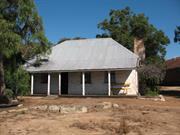
Barracks Pl Kojonup
Lot 21 on Deposited Plan 102325
Kojonup Military Barracks
Kojonup Museum
The Old Barracks
Kojonup
Great Southern
Constructed from 1845
| Type | Status | Date | Documents |
|---|---|---|---|
| (no listings) |
| Type | Status | Date | Documents |
|---|---|---|---|
| RHP - To be assessed | Current | 14 May 2021 |
| Type | Status | Date | Grading/Management | |
|---|---|---|---|---|
| Category | ||||
| Register of the National Estate | Permanent | 21 Mar 1978 | ||
| Classified by the National Trust | Classified | 04 Jun 1963 | ||
| Municipal Inventory | Completed\Draft | 03 Oct 2015 | Exceptional | |
| Municipal Inventory | Adopted | 22 Sep 1997 | ||
The old Barracks building has architectural, historical and social significance. The style of the stone building is similar to many of the crofts of Scotland and is typical of the constructions built throughout Western Australia by the early pioneers. The history of the building reflects the development of the districts. In its time it has been a barracks, meeting hall, dance and social centre, church, school, school-teacher's residence and private residence and now the headquarters for the historical society who run the building as a museum. The Barracks is the oldest surviving building in the district.
The four roomed building is constructed of stone, with a hipped corrugated iron roof and a verandah across the front elevationunder a broken-backed roof. The original shingles can still be seen on the verandah and in the two back rooms. Timber posts support the verandah. The front door if off-centre and the three front windows are heavily barred. Inside there are four rooms. The main room is approximately 7m long and has the original fireplace and pressed tin ceilings. The three smaller rooms lead off the main room. An upstairs loft, accessed by timber and metal steps, was possibly used as a sleeping quarters by the early soldiers. The front of the building is screened by two old peppermint trees planted in the late 19th Century by a school teacher. Close by is the Spring Haven Lodge (Aged Peoples Homes) designed and built sensitively, considering the close proximity of the historical Barracks.
The Barracks is located close to the freshwater spring which was so significant in the early development of Kojonup. The original Barracks were built in 1837, and replaced by this building in 1845. The Barracks building is the only remaining building of the barracks complex. In 1963 it was purchased by the Kojonup Shire Council and given in trust to the Kojonup Historical Society as a museum. Opposite the Barracks is a log mounted "as a tribute to the early Aborigines who on the 28th February 1837 directed Surveyor Alfred Hillman's party to a nearby freshwater spring which they called Kojonup". The log represents a demonstration of Aboriginal methods of climbing a tree by means of notches cut into the trunk for each step, the intention being in this case to raid a beehive built in the hollow at the top of the tree
Integrity - Low Authenticity - Medium Modifications: Wooden floors replaced earthen floors in 1869. Shingles replaced 1869. Shingles overlaid with corrugated iron.
Good
| Ref ID No | Ref Name | Ref Source | Ref Date |
|---|---|---|---|
| Bignell, Merle "First the Spring" |
Individual Building or Group
| Epoch | General | Specific |
|---|---|---|
| Present Use | MILITARY | Barracks |
| Original Use | MILITARY | Barracks |
| Style |
|---|
| Victorian Georgian |
| Type | General | Specific |
|---|---|---|
| Roof | METAL | Corrugated Iron |
| Wall | STONE | Granite |
| Roof | TIMBER | Shingle |
| General | Specific |
|---|---|
| PEOPLE | Aboriginal people |
| DEMOGRAPHIC SETTLEMENT & MOBILITY | Racial contact & interaction |
| DEMOGRAPHIC SETTLEMENT & MOBILITY | Settlements |
| SOCIAL & CIVIC ACTIVITIES | Religion |
| SOCIAL & CIVIC ACTIVITIES | Education & science |
| DEMOGRAPHIC SETTLEMENT & MOBILITY | Exploration & surveying |
| PEOPLE | Famous & infamous people |
| DEMOGRAPHIC SETTLEMENT & MOBILITY | Aboriginal Occupation |
| PEOPLE | Early settlers |
| SOCIAL & CIVIC ACTIVITIES | Law & order |
This information is provided voluntarily as a public service. The information provided is made available in good faith and is derived from sources believed to be reliable and accurate. However, the information is provided solely on the basis that readers will be responsible for making their own assessment of the matters discussed herein and are advised to verify all relevant representations, statements and information.