Local Government
Gosnells
Region
Metropolitan
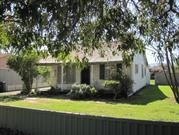
208 & 210 Hicks St Gosnells
Lots (208) 286 and (210) 287 on Plan 2569
Gosnells
Metropolitan
Constructed from 1931
| Type | Status | Date | Documents |
|---|---|---|---|
| (no listings) |
| Type | Status | Date | Documents |
|---|---|---|---|
| (no listings) |
| Type | Status | Date | Grading/Management | |
|---|---|---|---|---|
| Category | ||||
| Municipal Inventory | Adopted | 13 Sep 2016 | Category 3 | |
The two McNess Housing Trust Houses (fmr) have historic value for their associations with the well-known philanthropist Sir Charles McNess. The houses have historic value as they represent the early recognition by the government and the community of the need for public housing particularly in this example, for widowed women. The two houses are rare examples of modest timber homes built in the Gosnells district in the inter-war period.
The two small former housing trust cottages are located on the south eastern side of Hicks Street forming a pair of simple inter-war period cottages. The timber framed and weatherboard cottages are both single storey with symmetrical façades. The central entrance door is flanked by casement windows with No. 208 boasting a bay window. The gabled roofs are clad with short sheet corrugated iron, with the front section of the roof sweeping down to create the verandah canopy. The verandahs were constructed as open verandahs with no balustrade but No. 210 has added a fibre cement sheet balustrade positioned inside of the timber columns. Both houses have rear verandahs with the canopies being the continuation of the main roof albeit with a broken pitch. The original weatherboards of south eastern elevation of No. 210 have been replaced with a deeper Hardiplank style board. Both houses are set back from the front boundary behind planted gardens, No. 208 has a lawn to the front garden whilst No. 210 has a large area of hard stand.
Sir Charles McNess established a successful tinsmith and ironmonger business (forerunner of the modern hardware store) in Hay Street Perth in 1881, and was well known in later life for his philanthropic endeavours, especially during the Depression years. He supported the YMCA, Legacy, RSL, St John Ambulance Association and the Presbyterian, Wesleyan and Congregational churches. His gifts included generous donations to the State Government to provide employment in the development of the national park at Yanchep, and for the upkeep of the State War Memorial and Royal Perth Hospital, and £90,000 for the McNess Housing Trust to provide homes for needy families. The McNess Housing Trust built houses on land bought from Gosnells Estate Limited in 1931. The McNess Housing Trust was the forerunner of the State Housing Commission which provided public housing and continues as the Department of Housing. Sir Charles McNess was knighted in 1931, and died in 1938. In his will he left a further £32,000 to charities, institutions and churches. His name, and that of his wife, Annie Poncy McNess, are commemorated in a number of memorials around Perth, including the McNess Memorial (Presbyterian) Hall in Pier Street, Lady McNess Drive, and the McNess Memorial (fountain), which stood for many years in the middle of Stirling Gardens, Perth. The McNess Housing Trust house on Lot 286 (No 208) in the Gosnells Estate was occupied by Mrs Agnes Pages who came from an old Gosnells family, originally from Spain. Mrs Pages was left destitute with five children when her husband, who had fought in the Spanish Civil War, failed to return to Australia. Mrs Pages was given this McNess Housing Trust home until her youngest child became independent. In 1939 Mrs Violet Hoare, a widow, became the new tenant. When her youngest child was approaching independence, Mrs Hoare borrowed £200 to purchase the property. The home was owned by her family until the early 1980s. At the time the Hoare family lived at the property the external weather boards were oiled not painted. In the back yard were several fruit trees and the toilet on the back fence to enable the weekly collection of 'night soil'. There was no hot water and a copper or the kitchen stove provided hot water when needed. Later a toilet was built adjacent to the rear of the house and a covered walkway was another later addition. The Hoare family sold the property in the 1970s and since that time the exterior has been painted and a bay window inserted into the front elevation. Previously it had the same elevation as the adjacent property at 210 Hicks Street. No information is currently available for the residence at 210 Hicks Street. Its form and scale indicate that its origin is consistent with the adjacent property at 208 Hicks Street.
Integrity: High degree Authenticity: Moderate to high degree
Poor to Fair
| Ref ID No | Ref Name | Ref Source | Ref Date |
|---|---|---|---|
| Information from Margaret Lefevre | |||
| "Australian Dictionary of Biography, Vol. 10, 1891-1939". |
Individual Building or Group
| Epoch | General | Specific |
|---|---|---|
| Present Use | RESIDENTIAL | Single storey residence |
| Original Use | RESIDENTIAL | Single storey residence |
| Type | General | Specific |
|---|---|---|
| Wall | TIMBER | Weatherboard |
| Roof | METAL | Corrugated Iron |
| General | Specific |
|---|---|
| SOCIAL & CIVIC ACTIVITIES | Community services & utilities |
This information is provided voluntarily as a public service. The information provided is made available in good faith and is derived from sources believed to be reliable and accurate. However, the information is provided solely on the basis that readers will be responsible for making their own assessment of the matters discussed herein and are advised to verify all relevant representations, statements and information.