Local Government
Pingelly
Region
Wheatbelt
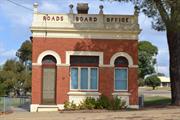
21 Park St Pingelly
Agriculture Protection Board Office
CALM
Pingelly
Wheatbelt
Constructed from 1909
| Type | Status | Date | Documents |
|---|---|---|---|
| (no listings) |
| Type | Status | Date | Documents |
|---|---|---|---|
| (no listings) |
| Type | Status | Date | Grading/Management | |
|---|---|---|---|---|
| Category | ||||
| Municipal Inventory | Adopted | 28 Nov 1996 | Category 2 | |
The place has aesthetic value for its use of decorative structural elements that are common features of the exuberance of the architecture typical of the period. The place has historic value, demonstrating the ascendancy of Pingelly over Mourambine, as the administrative centre of the district.
The simple building is rectangular in plan and fcuilt to the building line of Fark Street. The walls of the building are red brick laid in stretcher bond, tuck-pointed to the street elevation, and built on a rendered plinth. The street elevation features a rendered parapet that bears the name of the building, 'Road Board Office'. The parapet is divided into four fcays with pilasters each topped with a rendered bail on a pedestal. The parapet hides the roof which features a ial! tuck-pointed brick chimney with a rendered top. The street elevation is symmetrical about a central three-light window, with a square headed fanlight with leaded and stained glass. An entrance doorway and window are either side. The two end openings have semi-circular fanlights. The end opening has a leaded and stained glass fanlight, a double-hung sash window and a rendered sill. A rendered moulding extends across the front elevation highlighting the shape of the openings. The entrance is approached by a stone step with a fimber panelled door.The rear and east elevation have double-hung sash windows with brick arched heads. The interior of the building has rendered walls, pressed metal ceilings, and timber floors now covered with carpet. The fibro-cement clad addition extends the rear of the building. The central window of the street elevation now has casement sashes. Some patching of brickwork has been carried out on the east elevation.
When first installed, the Board met periodically at the residence of Mr C. Smith. By 1902, the membership had increased to seven. Inconvenience was experienced in holding meetings in diverse places such as the hotel, the ante-room of the Agricultural Hall, and a room adjoining Nicholson's store. There fore, members began to agitate for the construction of Road Board Offices. In 1909, Mr Black moved that the secretary obtain plans and specifications from an architect for the new offices. It is thought that the architect was Mr G. G. Lavatar.1 The building was completed during 1909, at a cost of £256. The building was officially opened on 2 October 1909, before the business of a meeting. In July 1961, with the passing of the Local Government Act 1960, the 'Road Board' as such ceased to exist and became known as Pingelly Shire Council. At the same time, new Council offices were built which were officially opened by the Minister for Works the Hon. G. P. Wild on 6 July, 1961.
High
Good
| Name | Type | Year From | Year To |
|---|---|---|---|
| G. G. Lavatar | Architect | - | - |
| Ref ID No | Ref Name | Ref Source | Ref Date |
|---|---|---|---|
| AN 136, Acc 1012 - Minute Book. | Battye Library |
| Ref Number | Description |
|---|---|
| 02243 | Heritage Place No. |
Individual Building or Group
| Epoch | General | Specific |
|---|---|---|
| Present Use | COMMERCIAL | Office or Administration Bldg |
| Original Use | Transport\Communications | Road: Office or Administration Bldg |
| Type | General | Specific |
|---|---|---|
| Wall | BRICK | Common Brick |
| Roof | METAL | Corrugated Iron |
| General | Specific |
|---|---|
| SOCIAL & CIVIC ACTIVITIES | Community services & utilities |
This information is provided voluntarily as a public service. The information provided is made available in good faith and is derived from sources believed to be reliable and accurate. However, the information is provided solely on the basis that readers will be responsible for making their own assessment of the matters discussed herein and are advised to verify all relevant representations, statements and information.