Local Government
Bridgetown-Greenbushes
Region
South West
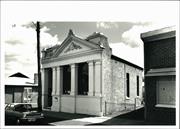
17 Steere St Bridgetown
Bridgetown Chiropractic Clinic
Nelson Roads Board
Private medical suite
Bridgetown-Greenbushes
South West
Constructed from 1908
| Type | Status | Date | Documents |
|---|---|---|---|
| Heritage List | Adopted | 18 Mar 1983 | |
| Heritage List | Adopted | 28 Nov 2019 | |
| State Register | Registered | 17 Apr 2018 | HCWebsite.Listing+ListingDocument, HCWebsite.Listing+ListingDocument |
| Type | Status | Date | Documents |
|---|---|---|---|
| (no listings) |
| Type | Status | Date | Grading/Management | |
|---|---|---|---|---|
| Category | ||||
| Municipal Inventory | Adopted | 29 Mar 2018 | Management Category B | |
| Municipal Inventory | Adopted | 28 Jun 2001 | Category 1 | |
the place is a fine intact and ornate example of a Roads Board building in the Federation Free Classical style and was reportedly the most elaborate and substantial Roads Board Office in the south-west when completed in 1908; the place was designed by well known architect P. W. Harrison and is a fine example of his design work in the Federation Free Classical style, and, the place was built in 1908, and is associated with the development of the Bridgetown district which was flourishing due to the growth of the timber trade and fruit growing industry following the opening of the railway in 1898.
Bridgetown Roads Board Office (fmr) is a single storey Roads Board Office building of brick construction with an iron roof in the Federation Free Classical style designed by architect P. W. Harrison in 1908. The facade is dominated by a richly rendered parapet wall decorated with a number of classical elements. The dominant feature of the asymmetrical front façade is a pedimental motif with a deeply moulded cornice supported by pairs of fluted pilasters at each end and a single central pilaster. Ionic capitals cap the pilasters. The timber framed windows are original although they have been modified to a single large pane of fixed glass. The entrance to the porch on the left side creates an asymmetrical element, with the entablature and cornice of the pediment continuing over with a frieze of balusters above and supported on a single pilaster.
On 31 January 1908, a meeting of Nelson Roads Board decided to ‘take steps to purchase land and construct a Roads Board Office’, and appointed W. G. Stephens, A. and H. Doust as a committee to inquire as to where land could be purchased’ and to consider taking over the block of land purchased from the old show grounds. They reported that a block in Steere Street and one in Hampton Street were well positioned for the purpose. The Board agreed to purchase ‘Block No. 1 Steere St.’ (Lot 1) from the Nelson Agricultural Society at a cost of £100. After reviewing a draft plan by John Hurst, the Board decided to call tenders for competitive plans for a building to cost no more than £300 to submit to ratepayers, which was advertised in March. The Board considered Hurst’s plan unsuitable and after examining proposals from architects F. W. Steere, of Bunbury, and P. W. Harrison, of Perth, decided in favour of Harrison and provisionally accepted his plan for the proposed Roads Board Offices at a cost not to exceed £350. In early December 1908, the Roads Board Office was completed and occupied for its intended purpose. The Druids Lodge was granted use of the Board Room for its fortnightly meetings at the same cost as the Oddfellows. The Agricultural Society congratulated the Board ‘on the splendid office provision’ and voiced appreciation for the use of the place for Society meetings. On 30 December, a large number of people, attended the official opening of the ‘handsome Roads Board office’. H. Layman, MLA praised the Roads Board’s achievement and having travelled over much of the State in the past two years, he ‘knew of no Board with more commodious or up to date offices.’ The place was known as Nelson Roads Board Offices until 1917, when it became known as Bridgetown Roads Board, and accordingly it became Bridgetown Roads Board Office.
Individual Building or Group
| Epoch | General | Specific |
|---|---|---|
| Original Use | GOVERNMENTAL | Town, Shire or District Hall |
| Present Use | HEALTH | Other |
| Style |
|---|
| Federation Free Classical |
| Type | General | Specific |
|---|---|---|
| Other | METAL | Pressed Metal |
| Other | TILE | Tessellated Tile |
| Wall | BRICK | Rendered Brick |
| Roof | METAL | Tin |
| General | Specific |
|---|---|
| DEMOGRAPHIC SETTLEMENT & MOBILITY | Settlements |
| SOCIAL & CIVIC ACTIVITIES | Community services & utilities |
| TRANSPORT & COMMUNICATIONS | Road transport |
| SOCIAL & CIVIC ACTIVITIES | Government & politics |
This information is provided voluntarily as a public service. The information provided is made available in good faith and is derived from sources believed to be reliable and accurate. However, the information is provided solely on the basis that readers will be responsible for making their own assessment of the matters discussed herein and are advised to verify all relevant representations, statements and information.