Local Government
Greater Geraldton
Region
Midwest
Tardun
Greater Geraldton
Midwest
Constructed from 1920
| Type | Status | Date | Documents |
|---|---|---|---|
| Heritage List | Adopted | 15 Dec 2015 |
| Type | Status | Date | Documents |
|---|---|---|---|
| RHP - Does not warrant assessment | Current | 25 Nov 2016 |
| Type | Status | Date | Grading/Management | |
|---|---|---|---|---|
| Category | ||||
| Municipal Inventory | Adopted | 24 Jun 2014 | Category 2 | |
• The place is associated with the growth and subsequent decline in population of Tardun, especially through its construction in 1932, and additions, including a Supper Room, in 1951.
• The place has value for its role in the social and recreational lives of the Tardun community.
• The place is representative of simple, unadorned community halls constructed in rural areas in the interwar period.
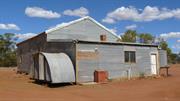
Tardun Hall is located in Tardun on the eastern side of the railway set back from Drummond Road in a low bushland setting. This simple rectangular hall is a timber framed, corrugated iron clad building on brick stumps, with a corrugated iron gable roof. There is a lean-to to the northern end (rear), as well as a water tank and a small semi-circular shed. The building has three double timber doors while the windows are aluminium framed. There is a small brick ablution block to the east.
Tardun was the siding for many of the Wongoondy and Mendel settlers. Originally called Undatarra, the townsite was gazetted in 1913 in advance of the opening of the Wongan Hills to Mullewa line on 5 April 1915. However, in 1925 the Railway Department asked the Mullewa Roads Board to change the name to Tardun to avoid confusion with another siding. Lots at Tardun were surveyed in 1927. In 1927 the Christian Brothers, who ran Clontarf Orphanage in Victoria Park, decided to extend the scope of the institution by drafting boys from the orphanage to the farm at Tardun. The intention was to train them in up-to-date farming methods, with the view to their developing land in the northwest Wheatbelt. The buildings were designed by priest and architect John Cyril Hawes. In 1928 two farmers, Mr Ogden and Mr Murphy, took up land in the Tardun district and by late 1929 they had 2,000 acres planted with wheat. This led to the development of Tardun townsite as a hub for wheat farmers in the district. Many of the wheats sown in the district were experimental varieties and included Noongar, Merredin, SHJ, and Geeralying, with Gluyas Early sown as a control. Early indications were that Noongar was the best of these varieties, capable of producing a good yield, even with low rainfall. A general store, which also operated as a newsagent, bank and post office, was established by Michael Hynes around 1928. By April 1929, it could be reported that ‘Tardun is going ahead rapidly’. A progress association had been formed ‘for the purpose of generally pushing the district forward’, and to get a public hall erected. A site for the hall had already been secured by this date. In July 1929, a meeting convened by W. Jenkins to form a tennis club was well attended. The same meeting saw the call for a committee to devise schemes for raising the necessary cash for a hall, which was ‘badly needed’. In October 1929, the Hall Committee was formed to manage the erection of the hall, and it was proposed to borrow £400 from the Government. Committee members, including J. Saunders, Michael Hynes, J. Eakins and J. T. Odgers, agreed to act as guarantors for the loan. Interpretive signage at Tardun states that the hall opened in August 1932. Although no documentary evidence has been uncovered during the writing of this report to confirm this, the date is consistent with other information. An undated plan for Tardun Hall shows that it was a small (30’ x 20’/9m x 6m) timber framed building with a simple open gable roof. There were also two earth closets located separately from the main building. Although the materials are not specified for the hall on the plan, it was almost certainly covered with CGI. By 1933 Tardun had expanded with the addition of a bakery and the hall, with about a dozen ‘comfortable homes’. By 1938 the population of the Tardun township was 23 adults, including eleven railwaymen. Within 8 km of Tardun the adult population was about 50. At this stage Tardun was mostly perceived as a railway settlers’ camp. An undated plan, probably 1951, drawn up by estate agents McCombes and Edwards shows the size of the hall tripling to 56’ x 30’ (17m x 9m). This involved doubling the size of the hall and adding a lean-to supper room, together with a ladies’ dressing room at the rear with a brick chimney for the stove. These plans appear to be consistent with the extant hall in 2016. In December 1951, David Brand, then Minister for Works and later Premier, opened the additions to Tardun Hall. The subsequent history of Tardun remains difficult to determine, although it appears that the general store was converted to a tavern, and the town may have started to decline from the 1970s with residences being slowly removed, possibly to be relocated elsewhere. With the closure of the farm school in 2009 (and subsequent revelations of abuse of the students), there would have been no function for Tardun as a small service town. In 2016, Tardun has very few buildings remaining, although the old general store and Tardun Hall remain in situ.
Individual Building or Group
| Epoch | General | Specific |
|---|---|---|
| Original Use | SOCIAL\RECREATIONAL | Other Community Hall\Centre |
| Present Use | SOCIAL\RECREATIONAL | Other Community Hall\Centre |
| Type | General | Specific |
|---|---|---|
| Wall | METAL | Corrugated Iron |
| Roof | METAL | Corrugated Iron |
| General | Specific |
|---|---|
| SOCIAL & CIVIC ACTIVITIES | Sport, recreation & entertainment |
This information is provided voluntarily as a public service. The information provided is made available in good faith and is derived from sources believed to be reliable and accurate. However, the information is provided solely on the basis that readers will be responsible for making their own assessment of the matters discussed herein and are advised to verify all relevant representations, statements and information.