Local Government
Claremont
Region
Metropolitan
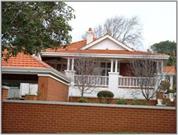
3 Grange St Claremont
Claremont
Metropolitan
Constructed from 1926
| Type | Status | Date | Documents |
|---|---|---|---|
| Heritage List | Adopted | 07 Jul 2015 |
| Type | Status | Date | Documents |
|---|---|---|---|
| (no listings) |
| Type | Status | Date | Grading/Management | |
|---|---|---|---|---|
| Category | ||||
| Municipal Inventory | Adopted | 05 Aug 2014 | HA - Category 2 | |
| Municipal Inventory | Adopted | 31 Dec 1995 | ||
25832 Grange Street Heritage Area
Grange Street Heritage Area is significant for the cohesive aesthetic demonstrated by the Inter-War style that also shows Federation influences during the overlap period. The story of historical development in Grange Street is still mainly intact within the streetscape although there has been some alteration to some places.
The single storey, asymmetrical, face brick residence is elevated on a face brick and rendered foundation. The hipped roof is clad with Marseille tiles and features a contrasting half-timbered gable infill over a bay window on the front verandah. The verandah is detailed with pairs of square timber posts on roughcast pillars, and a vertical spaced timber balustrade. Windows on the front are sets of four casements with fanlights above. Hipped tiled double carport with brick wall, and brick front fence.
The First World War and its immediate aftermath was a period of relative stagnation in the Town of Claremont’s development. Between 1915 and 1921 the population fell from 7,000 to 5,500 and only one hundred houses were built. The majority of these houses were built in brick, none in stone, and a few in timber. They were built mainly in the Federation, Inter-war and California Bungalow styles. Nos. 6, 9a, 11, 14 & 16 Grange Street, Claremont constructed in 1916 fall between two major development periods in the Town. From 1921 Claremont started to recover with significant growth into the 1930s. The main areas of development were in the western parts of the town and have left Claremont with a legacy of brick Inter-war, California, Queen Anne and Arts and Crafts Bungalows. Grange Street is very much a product of the development that occurred in Claremont during the ‘Inter-War’ period and the style of houses in the street reflects this. Where Grange Street is located was originally part of Swan Location 702 which was owned by James Morrison. The northern section of Grange Street, originally called Henry Street, was subdivided in 1896. The eastern side of the southern section was subdivided sometime after 1903. Grange Street does not appear in the Claremont rate books until 1913 so it is most likely to have been subdivided around this time. The southern section of Grange Street still contains eight places built between 1914 and 1917 and seven places built during the ‘Inter-War’ period (1921-1939).
Level contributory significance: Considerable Contribution
Individual Building or Group
| Epoch | General | Specific |
|---|---|---|
| Original Use | RESIDENTIAL | Single storey residence |
| Present Use | RESIDENTIAL | Single storey residence |
| Type | General | Specific |
|---|---|---|
| Wall | BRICK | Common Brick |
| Roof | TILE | Other Tile |
This information is provided voluntarily as a public service. The information provided is made available in good faith and is derived from sources believed to be reliable and accurate. However, the information is provided solely on the basis that readers will be responsible for making their own assessment of the matters discussed herein and are advised to verify all relevant representations, statements and information.