Local Government
Albany
Region
Great Southern
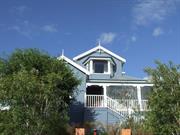
14 Rowley Street Albany
14 (Lot 1) Rowley Street Albany
Kinjarling
Albany
Great Southern
Constructed from 1890 to 1915
| Type | Status | Date | Documents |
|---|---|---|---|
| Heritage List | Adopted | 27 Oct 2020 |
| Type | Status | Date | Documents |
|---|---|---|---|
| (no listings) |
| Type | Status | Date | Grading/Management | |
|---|---|---|---|---|
| Category | ||||
| Local Heritage Survey | Adopted | 27 Oct 2020 | Some/moderate | |
The place at 14 Rowley Street has cultural heritage significance for the following reasons: The place is a fine yet simple example of a timber and iron Federation Bungalow, and its use of timber relatively rare for residences in the historic townsite particularly the western side of the town which is dominated more by brick and stone construction. The house has landmark value with its two-storey form combined with it being situated on the high side of the street and overlooking the townsite and harbour. The place is part of a local streetscape comprising a number of similar residences which typify the type and style of construction in Albany at the end of the 19th century. The place was built at the time of Albany's growth as a result of the construction of the Great Southern Railway and when it was still Western Australia’s major port.
Some of the notable features of this place include: • Elevated position • Two storey timber weatherboard clad residence • Strong streetscape value • Timber weatherboard apron • Timber joinery for doors and windows • Barge boards and finials in gables • Asymmetrical façade with projecting gable • Decorative bracketing and barges to verandah • Oriel window to second storey Some obvious modifications include: • External colour scheme • Addition to roof – second storey
The place at 14 Rowley Street was built on original Lot 446. By 1890 the Lot was subdivided to create smaller Lots with 14 Rowley Street located on Lot 1 of 446. In 1949, Albany Council adopted a by-law across designated areas of the central townsite requiring that all dwellings, shopsI and warehouses be built only of brick, stone or reinforced concrete, thereby not permitting timber to be used as the primary building material for external wall cladding. This by-law was not an uncommon one and adopted by most local councils in both metropolitan and regional areas owing to the hazards of timber mainly in relation to fire. However, this later policy makes the timber houses still extant in Rowley Street an important part of its historic and eclectic mix of building materials.
Integrity: High Authenticity: Moderate
Good
| Ref ID No | Ref Name | Ref Source | Ref Date |
|---|---|---|---|
| Municipal Heritage Inventory Review List | City of Albany | 2000 |
Individual Building or Group
| Epoch | General | Specific |
|---|---|---|
| Present Use | RESIDENTIAL | Two storey residence |
| Original Use | RESIDENTIAL | Single storey residence |
| Style |
|---|
| Federation Bungalow |
| Type | General | Specific |
|---|---|---|
| Wall | TIMBER | Weatherboard |
| General | Specific |
|---|---|
| DEMOGRAPHIC SETTLEMENT & MOBILITY | Land allocation & subdivision |
This information is provided voluntarily as a public service. The information provided is made available in good faith and is derived from sources believed to be reliable and accurate. However, the information is provided solely on the basis that readers will be responsible for making their own assessment of the matters discussed herein and are advised to verify all relevant representations, statements and information.