Local Government
Claremont
Region
Metropolitan
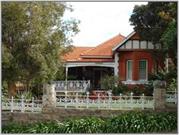
3 Saladin St Swanbourne
Claremont
Metropolitan
Constructed from 1904
| Type | Status | Date | Documents |
|---|---|---|---|
| Heritage List | Adopted | 27 Jun 2023 |
| Type | Status | Date | Documents |
|---|---|---|---|
| (no listings) |
| Type | Status | Date | Grading/Management | |
|---|---|---|---|---|
| Category | ||||
| Municipal Inventory | Adopted | 31 Dec 1995 | ||
| Local Heritage Survey | Adopted | 27 Jun 2023 | HP - Category 2 | |
Saladin Street Heritage Area demonstrates a cohesive group of similar style examples of Federation Queen Anne residences defined by 3 Saladin Street built in 1904, followed by the others in 1907, and exemplified by the two storey timber residence at No.11. In elevated positions and setback in gardens, the group is consistent in setback, scale, and configuration and street frontage providing a quality heritage aesthetic in the streetscape. The repetitive configuration of dominant feature gables and return verandahs, with mostly tiled roofs, tall decorative chimneys and front fences, at Nos. 3, 5, 7, and 9, two of which evidence original limestone construction, all contribute to the significance of this discrete cultural environment of Federation Queen Anne residences. 11 Saladin Street is a fine and rare example of a two-storey weatherboard Federation Queen Anne residence set in landscaped gardens of a double lot site, redesigned by John Oldham in the 1960s. It was the long-term residence of prominent landscape architect John Oldham, and his wife journalist and author Ray Oldham, and their daughter Jan Oldham, cookery editor, writer and illustrator.
Single storey with tuckpointed face brick, rendered quoined corners and sill detail. Prominent bay window detail that features multi-paned green glazing in the upper sashes, and contrasting timber detail on the gable. The return verandah has a flat arched valance and turned timber posts, and a timber floor. Decorative lace balustrades are likely not original. The original clay tiled roof remains in situ. The elevated position shows the limestone foundation and curved concrete staircase. The front fence is the original limestone with later additions of decorative wrought iron.
Servetus, Otway, Rob Roy, Australind and Saladin Streets were all named after Western Australian coastal steamships and they may have all been created around the same time. Swan Location P1070, from which Saladin Street resulted, was subdivided prior to 1898. In 1903, when the Town of Claremont Rate Books commence, there were three houses recorded in Saladin Street. By the end of the ‘Consolidation’ period, a period of vigorous growth in Claremont, which saw a housing increase from 428 in 1903 to 1240 in 1915, there were nine houses in Saladin Street. This indicates that nearly half of the development in the street occurred during the ‘Consolidation’ period. A further five houses were built in the street during the ‘Inter-War’ period, another significant period in the Town’s development.
| Ref ID No | Ref Name | Ref Source | Ref Date |
|---|---|---|---|
| Town of Claremont Thematic History | A Heritage Reference Framework | ||
| Claremont Rate Books |
Level contributory significance: Considerable Contribution
Individual Building or Group
| Epoch | General | Specific |
|---|---|---|
| Original Use | RESIDENTIAL | Single storey residence |
| Present Use | RESIDENTIAL | Single storey residence |
| Type | General | Specific |
|---|---|---|
| Roof | TILE | Other Tile |
| Wall | BRICK | Common Brick |
This information is provided voluntarily as a public service. The information provided is made available in good faith and is derived from sources believed to be reliable and accurate. However, the information is provided solely on the basis that readers will be responsible for making their own assessment of the matters discussed herein and are advised to verify all relevant representations, statements and information.