Local Government
Bridgetown-Greenbushes
Region
South West
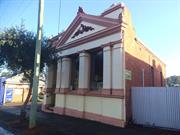
17 Steere St Bridgetown
Bridgetown Chiropractic Clinic
Nelson Roads Board
Private medical suite
Bridgetown-Greenbushes
South West
Constructed from 1908
| Type | Status | Date | Documents |
|---|---|---|---|
| Heritage List | Adopted | 18 Mar 1983 | |
| Heritage List | Adopted | 28 Nov 2019 | |
| State Register | Registered | 17 Apr 2018 | HCWebsite.Listing+ListingDocument, HCWebsite.Listing+ListingDocument |
| Type | Status | Date | Documents |
|---|---|---|---|
| (no listings) |
| Type | Status | Date | Grading/Management | |
|---|---|---|---|---|
| Category | ||||
| Municipal Inventory | Adopted | 29 Mar 2018 | Management Category B | |
| Municipal Inventory | Adopted | 28 Jun 2001 | Category 1 | |
The Bridgetown Roads Board Building (fmr) is of historic and aesthetic significance as the first purpose built offices for the Nelson (Bridgetown) Roads Board. Aesthetic Value One of the few buildings in the district with Neo-Classical detailing. Even though the original front windows have been replaced, the aesthetics of the building as a whole has seen this building remain a landmark in the commercial section of Steere Street. Historic Value The Bridgetown Roads Board building (fmr) has a high level of historic value for its role in the development and maintenance of not only what is now the Bridgetown-Greenbushes Shire, but to the wider District it once served, from Donnybrook to the southern coast and from Capel and Nannup to Kojonup. The place is of additional historic value for its association with the management of Italian POWs and the important role this service played in providing farmworkers in the Blackwood districts when local men were away at war in the mid 1940’s. Research Value NA Social Value The Nelson (Bridgetown) Roads Board Office was held in high regard as a place of authority, a meeting point for the discussions and subsequent decisions regarding road construction and maintenance in the district(s).
The former Bridgetown Roads Board building was constructed of rendered masonry and iron. It features elaborate neo-classical detailing including ornate stucco modelling on the pediment and a row of six classical pilasters across the façade. The building consists of three rooms and has not been extended. There are original tessellated tiles in the entry porch, original pressed metal ceilings and an original fireplace surround. Atop the building, three small finial bases can still be seen, which once supported a moulded ball on each. It is not known when these were removed. The original front windows were replaced with large glazed panels in c.1950, which detracts from the authenticity of the building.
The Nelson Roads Board was constituted in 1887. Prior to this, the Blackwood Roads Board Committee functioned under the Bunbury Roads Board (1874 - 1887). The Blackwood Roads Board meetings of 1874 - 1875 were recorded as being held at the Farmer’s Home Hotel (Scott’s Tavern). The Nelson Roads Board used the Mechanics Institute from 1887, until the purpose built Nelson Roads Board building was constructed in 1908. In 1901 the Greenbushes Roads Board was excised and gazetted. In 1917 the board was renamed the Bridgetown Road Board and its area reduced and divided into wards. The Bridgetown Roads Board moved into the newly built Bridgetown Civic and Community Centre in 1936. After that time the former Bridgetown Roads Board building was used as the town library but this was soon moved to larger premises. The building was then left vacant until 1943 when 19 Steere Street was occupied by the Army for use as the Bridgetown Prisoner of War Control Centre (one of 27 PWCC opened in WA in 1943-1946). This office managed the allocation of Italian POWs as farm workers in the Bridgetown district, commencing with 100 Italian POWs in May 1944, increasing to 200 in 1945. The number of farms assisted in this manner rose to a peak of 137 in February 1945, helping to offset the enrolment of local men in the armed services. The Army office closed in May 1946 and the place has since been used for a variety of office purposes over time. On 1 July 1961, Bridgetown and Greenbushes Roads Boards became the Shire of Bridgetown and Shire of Greenbushes, following changes to the Local Government Act. In 1970, the two shires were merged as the Shire of Bridgetown-Greenbushes.
Low to moderate The building is no longer used for its original purpose, but that use can still be interpreted through its design. Medium There have been minor alterations with much original fabric remaining.
Good
| Name | Type | Year From | Year To |
|---|---|---|---|
| P.W. Harrison | Architect | - | - |
| Ref ID No | Ref Name | Ref Source | Ref Date |
|---|---|---|---|
| Bridgetown POW Control Center, WA During WW2 | |||
| The West Australian | 10/07/1943 | ||
| Fran Taylor | Bridgetown The Early Years | ||
| Southern Times (Bunbury) | 30/07/1908 | ||
| Contemporary newspaper reports (trove.nla.gov.au/newspaper) | |||
| (http://www.ozatwar.com/pow/w1bridgetown.htm) |
| Ref Number | Description |
|---|---|
| No.B36 | MI Place No. |
| A5979 | Assess No (Shire Ref) |
Individual Building or Group
| Epoch | General | Specific |
|---|---|---|
| Original Use | GOVERNMENTAL | Town, Shire or District Hall |
| Present Use | HEALTH | Other |
| Style |
|---|
| Federation Free Classical |
| Type | General | Specific |
|---|---|---|
| Other | METAL | Pressed Metal |
| Other | TILE | Tessellated Tile |
| Wall | BRICK | Rendered Brick |
| Roof | METAL | Tin |
| General | Specific |
|---|---|
| DEMOGRAPHIC SETTLEMENT & MOBILITY | Settlements |
| SOCIAL & CIVIC ACTIVITIES | Community services & utilities |
| TRANSPORT & COMMUNICATIONS | Road transport |
| SOCIAL & CIVIC ACTIVITIES | Government & politics |
This information is provided voluntarily as a public service. The information provided is made available in good faith and is derived from sources believed to be reliable and accurate. However, the information is provided solely on the basis that readers will be responsible for making their own assessment of the matters discussed herein and are advised to verify all relevant representations, statements and information.