Local Government
Northam
Region
Avon Arc
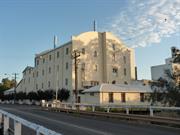
334 Fitzgerald St East Northam
The Flour Mill is also along Gairdner Street
Flour Mill
Northam
Avon Arc
Constructed from 1867 to 1945
| Type | Status | Date | Documents |
|---|---|---|---|
| Heritage List | Adopted | 21 Feb 2020 |
| Type | Status | Date | Documents |
|---|---|---|---|
| RHP - Assessed - Consultation (Preliminary) | Current | 25 Sep 2015 |
| Type | Status | Date | Grading/Management | |
|---|---|---|---|---|
| Category | ||||
| Municipal Inventory | Adopted | 25 Feb 1998 | 2. Considerable significance | |
• Northam Flour Mill has been in continuous use as a mill since its construction in 1897 and has significance as a pioneer industry in the Northam district.
• The place has historical significance to the town and shire of Northam as it symbolises the importance of agriculture, especially wheat to the region.
• The place is a major landmark in the town of Northam and contributes to the community’s sense of place.
• The place is one of only two large historic mills still in operation in the State.
• The place has scientific value as a demonstration of roller flour milling and related processes.
Situated alongside the main Avon Bridge, the Northam Flour Mill is a large complex comprising several buildings of different sizes and construction types. Two prominent structures are the four-storey building with a curved roof and the nine tall grain storage silos.
The first mill constructed on the site of Northam Flour Mill was built by Joesph Lockyer in 1849. This mill was superseded by the construction of Wilding’s Mill in 1867, which then became Northam Co-operative Steam Flour Milling Co (1873-77). In 1883, under the management of James Byfield, major changes were made, and the production process was modernised. In 1892 Byfield decided to do away with the old stone-grinding flour mill and built a roller mill that could produce high quality flour. The ‘Eclispe Flour Mill’ (later Snowdrop Flour Mill) was opened in March 1900 and was only the second roller mill in the colony, the other being a much smaller operation at Bunbury. The new mill not only had a positive impact on the town, but on the State as a whole, as it put an end to the importation of wheat and flour. As the agricultural production of the district expanded, the mill (now Thomas and Co.’s Standard Flour Mills) was improved and expanded. In 1909 as a result of a fire, a new electric powered plant was installed, making the Mill the first in the state to be powered by electricity. By 1914, the Mill was the largest in the State in 1914, with a capacity of twenty sacks per hour. Over the years, the Mill has changed ownership a few more times and has undergone further reconstruction to adapt to modern production processes. It ranks with Great Southern Roller Flour Mills Limited as the largest in the State.
Individual Building or Group
| Epoch | General | Specific |
|---|---|---|
| Original Use | INDUSTRIAL\MANUFACTURING | Flour Mill |
| Present Use | INDUSTRIAL\MANUFACTURING | Flour Mill |
| Type | General | Specific |
|---|---|---|
| Wall | BRICK | Common Brick |
| General | Specific |
|---|---|
| OCCUPATIONS | Manufacturing & processing |
| PEOPLE | Early settlers |
This information is provided voluntarily as a public service. The information provided is made available in good faith and is derived from sources believed to be reliable and accurate. However, the information is provided solely on the basis that readers will be responsible for making their own assessment of the matters discussed herein and are advised to verify all relevant representations, statements and information.