Local Government
Kojonup
Region
Great Southern
Barracks Pl Kojonup
Lot 21 on Deposited Plan 102325
Kojonup Military Barracks
Kojonup Museum
The Old Barracks
Kojonup
Great Southern
Constructed from 1845
| Type | Status | Date | Documents |
|---|---|---|---|
| (no listings) |
| Type | Status | Date | Documents |
|---|---|---|---|
| RHP - To be assessed | Current | 14 May 2021 |
| Type | Status | Date | Grading/Management | |
|---|---|---|---|---|
| Category | ||||
| Register of the National Estate | Permanent | 21 Mar 1978 | ||
| Classified by the National Trust | Classified | 04 Jun 1963 | ||
| Municipal Inventory | Completed\Draft | 03 Oct 2015 | Exceptional | |
| Municipal Inventory | Adopted | 22 Sep 1997 | ||
The place is rare as an extent building constructed by the British Army in Western Australia, and has historic significance for being purpose-built to house British Army personnel tasked with protecting travellers and mail along the Perth to Albany Road. The siting of the place adjacent to Kojonup Spring (Aboriginal Heritage Place ID17468), demonstrates the importance of reliable water sources to the routing of the Perth to Albany Road, and also the subsequent establishment of a permanent settlement in Kojonup. The place is rare as an extant early colonial residential building, and has historic significance for being the first permanent European (non-Aboriginal) structure built in the Kojonup region. The fabric of the place has potential to reveal information about construction methods and materials used in the early colonial years (before the introduction of convict skill and labour), and may potentially reveal information specific to the skill-set of the British Army soldiers responsible for its construction. The place has historic significance for housing Pensioner Guards and their families assigned to the Kojonup region while construction of their individual Pensioner Guard cottages was underway. The place has importance for being used as the local school from 1863 to 1894, and also being used as a residence for the school teacher. The place has strong social value to the local community who have utilised the building since 1963 as the Kojonup Museum, operated by the Kojonup Historical Society. The place has value as a simple army barracks, of more modest design and scale in comparison to barracks later constructed in Western Australia for the Australian Army.
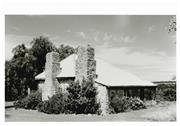
The single-storey building comprises four rooms, plus attic above, constructed of local granite topped with a hipped corrugated iron roof which extends over the front verandah. Timber shingles remain under the corrugated iron roofing. The exterior walls are approximately 53cm thick. The front verandah has a timber floor and timber posts. The front and rear doors are off centre. The windows are timber framed with fixed metal bars for security. The exterior stonework shows evidence of considerable repairs to the stonework and mortar joints of both chimneys and north elevation, north east corner of the building and south elevation where two interior rooms meet. The northern portion of the building is closer to ground level that the south and may be contributing to the stonework and mortar issues. New gutters and drainpipes are evident. The interior is divided into two large rooms and two small rooms, with interior walls measuring at 23cm and 59cm. The two larger rooms – Front Room and Guard Room – both have ireplaces on the north wall. Floor boards are jarrah on both ground and attic level. The two front rooms have ceilings – pressed tin in the Front Room and plasterboard in the Sergeants in Charge Room – and the two rear rooms do not have ceilings and show exposed roof battens and shingles above. Evidence suggests the building may have originally been one room (Front Room or Front Room and Sergeant’s in Charge Rooms combined), with the rear rooms potentially being a verandah, later enclosed. Further investigation of the physical fabric onsite is required to confirm the sequence of development. There are some peppercorn trees to the front of the building that are believed to have been planted in 1902.
The townsite of Kojonup is within the Wagyl Kaip and Southern Noongar Region, and is associated with the Kaneang cultural group. Histories denote the word Kojonup to be derived from the Aboriginal word ‘kodja’ meaning ‘axe’ or ‘the place of the stone of the axe’. The reliable freshwater spring at Kojonup (Aboriginal Heritage Place ID17468 Kojonup Spring) is thought to have been utilised by Aboriginal groups prior to the establishment of the Swan River Colony. Non-Aboriginal settlement in Kojonup occurred from September 1837, when it was chosen as the site for a military outpost, to protect travellers and mail along the Perth to Albany Road. One year prior, in 1836, Surveyor General Alfred Hillman had been led to Konojup Spring by Aboriginal guides while he surveyed the road route and set up camp there. Governor Stirling also camped at Kojonup Spring in April 1837. The initial detachment of one officer – Lieutenant Charles Frederick Armstrong – and seven privates were from the 21st Regiment known as the Royal British Fusiliers, built their first barracks approximately 90metres to the south east of The Old Barracks from nearby trees. By 1840 the Kojonup area was being promoted as fertile land suitable for farming or agriculture, but interest in the district quickly waned. In 1845, Major Irwin, Commanding Officer of the troops in the colony inspected the 1837 timber barracks and declared it unfit for the occupation of troops and incapable of future repair. He approved the erection of a new barracks, and plans were sent to the commanding officer of the district, Lieutenant Warburton, 51st Regiment. This new building was The Old Barracks. The location chosen for the new The Old Barracks was on an elevated site overlooking the Perth to Albany Road below. The soldiers stationed at the barracks were responsible for constructing the building from local granite blocks. It was roofed with timber shingles and had earthen floors. In October 1851, following the introduction of convicts to Western Australia in 1850, the military contingent at Kojonup had been replaced by Pensioner Guards. These men were retired solders of the British Army that had gained free passage to the colony in exchange for their services and assigned 10 acres of land upon arrival. Small Pensioner Guard Villages were established around Perth and in country areas such as Kojonup. The Guards provided a militia service for the area, and were expected to maintain themselves on their pension. Pensioner Guard families assigned to Kojonup were temporarily housed in The Old Barracks while their house was being constructed. All the Pensioner Guard houses were located in close proximity to the barracks. One Pensioner Guard cottage in Kojonup P1300 Elvard’s Cottage – is included in the State Register. After the arrival of the Pensioner Guards and construction of their cottages, The Old Barracks became the nucleus of the town of Kojonup. Towards the end of the 1860s, Kojonup was experiencing a building boom. The town’s first police station was constructed using convict labour, and hotels were being built. The centre of town moved away from the military authority and The Old Barracks on the hill, to a new location closer to the road. From 1863 until 1894, the front room of The Old Barracks was used as a school. For some of this time, the building was also used as a residence for the school teacher. Complaints about the building arose, but as the building belonged to the British Government, these were forward to the Clerk of Works, James Manning. In March 1869, Manning agreed with the dire condition of The Old Barracks and stated that: The state of the building is quite as bad as anyone can represent it. The floor is dirt, the roof is so thoroughly ventilated that it neither keeps out wind or water. A floor and new shingles are absolutely necessary… In 1869, the shingles of The Old Barracks were replaced with new mahogany ones and new six inch floorboards were added. By this time, the school room (Front Room) did not have a ceiling (and presumably neither had an attic storey). The school room at The Old Barracks is also recorded to have been used for weddings in the 1870s. It also hosted community events, such as a bazaar in 1883. It has been suggested that the building was used as a church, however this requires further research to confirm. It is unclear when the ownership of The Old Barracks was transferred from the British government to colonial government. In 1894, a new school room was constructed in town, and The Old Barracks was from that time used as a residence for the school teacher or headmaster. In 1902, the school teachers Mr Young is believed to have planted the peppercorn trees that remain to the front of the residence. In 1916, the Department of Education was willing to handover The Old Barracks with some financial compensation for the value of the building. In 1921 The Old Barracks was sold to private ownership. In 1963, The Old Barracks was purchased by the Kojonup Shire Council and given in trust to the Kojonup Historical Society. Since 1963, the building has been used by the Historical Society as a Museum, with each of the four rooms set up to represent the different phases of the building’s history: • Front Room – displays about the history of Kojonup, Aboriginal histories, Pensioner Guard, immigrant history. • Ammunitions Room – set up as a school room • Guards Room – displays predominantly pre-World War One items. • Sargents In Charge Room – set up as a bedroom, retaining the wallpaper that was left after the building ceased being a private residence in 1963. In 2021, The Old Barracks continues to be used as a local museum, managed by the Kojonup Historical Society.
The place retains much of its original fabric, and the original intent/use of the place is can be clearly understood.
Good.
Individual Building or Group
| Epoch | General | Specific |
|---|---|---|
| Present Use | MILITARY | Barracks |
| Original Use | MILITARY | Barracks |
| Style |
|---|
| Victorian Georgian |
| Type | General | Specific |
|---|---|---|
| Roof | METAL | Corrugated Iron |
| Wall | STONE | Granite |
| Roof | TIMBER | Shingle |
| General | Specific |
|---|---|
| PEOPLE | Aboriginal people |
| DEMOGRAPHIC SETTLEMENT & MOBILITY | Racial contact & interaction |
| DEMOGRAPHIC SETTLEMENT & MOBILITY | Settlements |
| SOCIAL & CIVIC ACTIVITIES | Religion |
| SOCIAL & CIVIC ACTIVITIES | Education & science |
| DEMOGRAPHIC SETTLEMENT & MOBILITY | Exploration & surveying |
| PEOPLE | Famous & infamous people |
| DEMOGRAPHIC SETTLEMENT & MOBILITY | Aboriginal Occupation |
| PEOPLE | Early settlers |
| SOCIAL & CIVIC ACTIVITIES | Law & order |
This information is provided voluntarily as a public service. The information provided is made available in good faith and is derived from sources believed to be reliable and accurate. However, the information is provided solely on the basis that readers will be responsible for making their own assessment of the matters discussed herein and are advised to verify all relevant representations, statements and information.