

Local Government
Pingelly
Region
Wheatbelt

23-25 Parade St Pingelly
Pingelly
Wheatbelt
Constructed from 1938
| Type | Status | Date | Documents | More information |
|---|---|---|---|---|
| (no listings) |
| Type | Status | Date | Documents |
|---|---|---|---|
| (no listings) |
| Type | Status | Date | Grading/Management | More information | |
|---|---|---|---|---|---|
| Category | Description | ||||
| Municipal Inventory | Adopted | 28 Nov 1996 | Category 3 |
Category 3 |
|
The place is an example of an civic building design in the Inter-War Free Classical style. The place has social value for the local community, illustrating the impact World War had on even the smallest of communities.
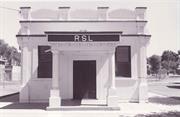
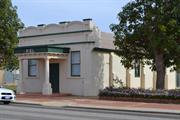
The building is a single-storey civic building domestic in scale in the Inter-War Free Classical style.1 The building is sited at the street alignment in a lawned setting. The street elevation of the building is a symmetrical composition about a central doorway with a double-hung sash window either side. The feature of the building is the slightly raised entrance portico comprising Doric columns with unfluted shafts on rendered pedestals and bases. The soffit is lined with timber boards. The entablature is unclassical and bears the name of the building.
The front elevation is rendered to resemble ashlar stonework, and features a decorative parapet, that conceals the roof and the metal roof vents from the street, and has pilasters at each end of the facade that relieve a simple
exterior. The side elevations are strengthened with engaged piers, five on the northern side and three on the southern side. The side walls are also rendered. A recessed red painted concrete verandah with an entrance has been added to the south elevation. The main roof of the building, supported on timber posts, protects the verandah the entrance. A weatherboard clad structure with a gable roof has been added to the rear elevation. The addition has highlight
windows with metal framed aluminium awning windows.
The front of the building has been paved in concrete. The front windows have been altered. The lower sashes are fixed and louvres have been installed in the upper sashes. The door has been replaced. New toilet facilities have been added to the rear of the site. This brick building does not form part of this assessment.
Overall, the building is in fair to good condition with the exception of the weatherboard clad addition which is in poor condition. Some cracks on the exterior walls have been patched.
High
Good
| Ref ID No | Ref Name | Ref Source | Ref Date |
|---|---|---|---|
| Apperly, R. Irving, R. Reynolds, P. "A Pictorial Guide to Identifying Australian Architecture, Styles and Terms from 1788 the the Present" p158-161 | Angus and Robertson NSW | 1989 |
| Ref Number | Description |
|---|---|
| 05917 | Heritage Place No. |
Individual Building or Group
| Epoch | General | Specific |
|---|---|---|
| Present Use | SOCIAL\RECREATIONAL | RSL Hall |
| Original Use | SOCIAL\RECREATIONAL | RSL Hall |
| Style |
|---|
| Inter-War Free Classical |
| Type | General | Specific |
|---|---|---|
| Roof | METAL | Corrugated Iron |
| Wall | BRICK | Common Brick |
| General | Specific |
|---|---|
| SOCIAL & CIVIC ACTIVITIES | Institutions |
This information is provided voluntarily as a public service. The information provided is made available in good faith and is derived from sources believed to be reliable and accurate. However, the information is provided solely on the basis that readers will be responsible for making their own assessment of the matters discussed herein and are advised to verify all relevant representations, statements and information.