

Local Government
Busselton
Region
South West

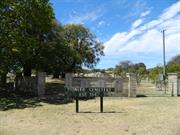
Stanley St, cnr Adelaide St & Marine Tce Busselton
Burial Ground
Marine Terrace Cemetery
Pioneer Cemetery
Busselton
South West
Constructed from 1847 to 1932
| Type | Status | Date | Documents | More information |
|---|---|---|---|---|
| Heritage List | Adopted | 16 Oct 2024 | ||
| State Register | Registered | 15 May 1998 |
Register Entry Assessment Documentation |
Heritage Council |
| Type | Status | Date | Documents |
|---|---|---|---|
| (no listings) |
| Type | Status | Date | Grading/Management | More information | |
|---|---|---|---|---|---|
| Category | Description | ||||
| Municipal Inventory | Adopted | 20 Jun 1996 | Category 1 |
Category 1 |
|
| Local Heritage Survey | YES | 16 Oct 2024 | Category 1 |
Category 1 |
|
| Classified by the National Trust | Classified {HBS} |
|
Heritage Council | ||
| Register of the National Estate | Indicative Place |
|
Heritage Council | ||
| Register of the National Estate | Nominated | 01 Jan 1989 |
|
Heritage Council | |
• The low undulating grassed sandhills, mature trees, and remaining monuments of Old Busselton Cemetery are valued by the community as an aesthetically pleasing cultural landscape.
• A number of the remaining headstones and monuments produced by local and interstate monumental masons are aesthetically significant as examples of late nineteenth and early twentieth century Australian memorial design and carving.
• In its coastal location, the cemetery has aesthetic value as a park-like open space in the townscape of Busselton, and as part of a zone of public open space including adjacent recreational areas and sportsgrounds.
• Old Busselton Cemetery is historically important for its association with the first years of European settlement in the local area and in Western Australia.
• As the ‘burial ground’ identified in the first town plans of Busselton, it is a significant element in the history and growth of the town.
• The Cemetery has historic value as a record and burial place of many early European settlers including members of the Bunbury, Curtis, Forrest, Killerby, Layman, Yelverton and other families prominent in the early history of the area and Western Australia.
• All cemeteries have research and teaching value, and have potential archaeological value in that they are sites which, if it was ever appropriate or necessary to excavate, can yield information on human health and social customs in past times.
• Old Busselton Cemetery is highly valued by the community for social, cultural, educational and religious reasons, and this high level of interest is reflected in the community’s continuous efforts over the years to maintain and interpret the place.
• As part of the town of Busselton from its earliest years, and the burial place of several hundred persons who died between c. 1850 and 1932, many of whom have descendants still living locally, the Cemetery makes an important contribution to the community’s sense of place
Over 250 identified graves are located within Old Busselton Cemetery which consists of just over one hectare of undulating grassed coastal sandhills. There are a number of mature trees but it is not clear how many of these were deliberately planted, as any pattern of paths and plantings has disappeared and many headstones and gravesite
borders and fittings have been lost to vandalism, decay and tidying-up. Many of the graves are now unmarked, and indeed undetectable to the naked eye. In winter when grass is green, the predominant effect is of a park-like landscape dotted with headstones.
The cemetery contains two excellent examples of timber slab monuments. There are also some monuments that were made in other colonies, possibly illustrating either cheaper manufacture in other colonies or cheaper transport from there than from Perth.
All signage is of recent origin, as in the 1980s-90s, the Municipality and community groups have attempted to upgrade the condition of the Cemetery. In addition to modern walling, it has a new 'memorial gate' entrance, interpretative material supplied by the Lions Club and exterior signage designating it 'Pioneer Cemetery Est. 1847'
Old Busselton Cemetery was established in the 1840s on the edge of the town of Busselton. It was first planned in 1839 and with the growth of population and spread of the town‘s boundaries, the cemetery has become one of several open public spaces within the built-up area of Busselton. Burials ceased in the early 1930s by which time over 250 documented interments had taken place. The town of Busselton was proclaimed in 1832. The ‘burial ground’ is included in an 1839 plan of Busselton, but was not officially proclaimed a cemetery until 1856. Local tradition, as expressed in on-site signage, has the cemetery established in 1847, but the exact date of the first interment is unknown. The Western Australian Cemetery Records show the first burial as Alfred Smith, aged eleven, in 1864, but the oldest grave identified in 1996 research (by Marie
Pavy and Leeanne Riordan) was Henry John Yelverton who died in 1854, and it seems certain that his was not in fact the first burial. What is significant is that this is the original burial place for Busselton and the surrounding district, and was in use from the first years of European settlement. By 1900, concern over the water table caused burials to be limited to ‘reunions’ and by 1933 it was decided to close the cemetery. In 1944, the Western Australian Parliament passed the Busselton Cemetery Act which vested the
cemetery in the local government authority as a disused burial ground. Strength of community interest in the cemetery was shown in 1961 when a proposal to abandon it failed after a public meeting was called to express opposition to the idea. Other proposals were put forward in the 1980s but did not proceed
High/High
Good
| Ref ID No | Ref Name | Ref Source | Ref Date |
|---|---|---|---|
| Heritage Council Assessment Documentation |
| Ref Number | Description |
|---|---|
| 100012114 | COB Property ID |
| PN032 | Reference No |
| Library Id | Title | Medium | Year Of Publication |
|---|---|---|---|
| 9342 | Old Busselton Cemetery Marine Terrace, Stanley and Adelaide Streets , Busselton. DRAFT | Heritage Study {Cons'n Plan} | 2009 |
| 9448 | Old Busselton Cemetery. Marine Terrace, Stanley and Adelaide Streets, Busselton. | Heritage Study {Cons'n Plan} | 2009 |
| 6606 | Register of historic burial sites as at June 1988. | Report | 1988 |
Other Built Type
| Epoch | General | Specific |
|---|---|---|
| Present Use | MONUMENT\CEMETERY | Cemetery |
| Original Use | MONUMENT\CEMETERY | Cemetery |
| Type | General | Specific |
|---|---|---|
| Wall | STONE | Limestone |
| General | Specific |
|---|---|
| PEOPLE | Early settlers |
This information is provided voluntarily as a public service. The information provided is made available in good faith and is derived from sources believed to be reliable and accurate. However, the information is provided solely on the basis that readers will be responsible for making their own assessment of the matters discussed herein and are advised to verify all relevant representations, statements and information.