

Local Government
Kojonup
Region
Great Southern

Albany Hwy South Kojonup
Kojonup
Great Southern
Constructed from 1840, Constructed from 1869
| Type | Status | Date | Documents | More information |
|---|---|---|---|---|
| (no listings) |
| Type | Status | Date | Documents |
|---|---|---|---|
| (no listings) |
| Type | Status | Date | Grading/Management | More information | |
|---|---|---|---|---|---|
| Category | Description | ||||
| Municipal Inventory | Adopted | 22 Sep 1997 |
|
||
| Municipal Inventory | Completed\Draft | 04 Oct 2015 | Considerable |
Considerable |
|
Balgarup and its remaining buildings have historic significance as being one of the earliest areas of land to be taken up in Kojonup, a major factor being its proximity to the river, and associated with important early settlers: Symers, Spencer and Egerton- Warburton.
The remnant buildings are indicative of the substantial homestead property that Balgarup was in its prime, and the significance of the agricultural development of Kojonup in the mid 19th century.
The place contains the graves of Joseph Spencer and his two young sons Henry and Hugh.
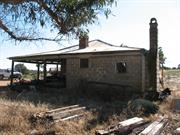
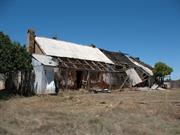
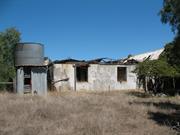
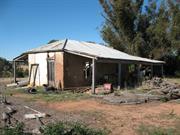
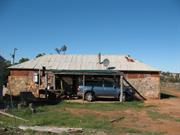
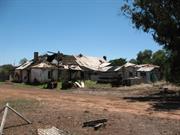
There are two residences. The larger one is in semi-ruinous condition. It is a large building with rendered and painted brick external walls, sprawling iron gabled and hipped roof with shingles evident under the iron sheeting. A deep wrap-around verandah supported by timber pillars is almost collapsed. The other smaller residence is in better condition although still poor. It is constructed of handmade (mud) bricks partially rendered to the original section and cement blocks used for the additions. It has a low pitched broken back hipped roof forming a front verandah on two sides.
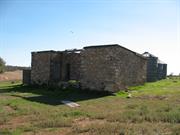
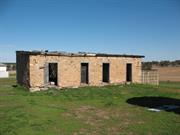
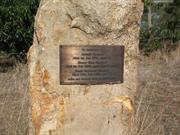
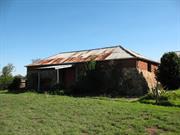
The property also contains an old barn which is a rectangular form with a hipped roof, constructed of random rubble stone and bricks, the courses bricks from lintel upwards and appears to be a later addition. The old barn is semi-renovated and habitable. There is also a U-shaped shearing shed, constructed of random rubble stone and the roof is missing. Scattered rocks and rubble indicate the remains of a former coach house. There is a granite rock acknowledging the graves of the Spencers on the property.
A large granite rock is installed as a memorial with a plaque detailing the Spencers who were buried on the property.
The area around the Balgarup river appeared most promising to the early explorers and surveyors. In 1840 Thomas Lyall Symers, a former sea captain, became the first leaseholder of Kojonup Location 1, known as Balgarup and built the first residence on this land. Plans were made for a townsite nearby. Unfortunately, the area was found to he infested with poisonous plants which killed large numbers of stock. Symers abandoned the house and property around 1840.
In 1860 the Colonial Secretary's Office opened up the land on the Balgarup River comprising 640 acres open to purchase or lease in 1861. By 1862 Joseph Spencer was established at Balgarup (also called Bailyup?). Joseph was son of Richard Spencer, the first Resident Magistrate of Albany (and established Old Farm Strawberry Hill, Albany). Spencer built a new house (15m x 9m) as well as six other buildings, and a flour mill, a fence and yards. There also remained the chimney of Symers original house.
In 1861 S R Toovey applied for a Road-Side Inn licence at Balgarup, on the Balgarup property, and which was parochially referred to as 'the pub paddock'.
In 1881 Spencer advertised for fencing of his property Pastoral Lease 8003 known as Bailyup containing 10,000 acres.
In 1891, Spencer died and in 1894 Balgarup was handed to his nephew Augustus Egerton-Warburton. Joseph Spencer and two of his young sons, Henry and Hugh, were buried on the property. It remained in the Egerton Warburton family until 1928.
In 1928, Balgarup was bought by Major Gilbert Lewis of South Australia.
The pile of rocks near the road is believed to be Toovey's Inn/Store.
Integrity - Medium
Authenticity - Medium
Poor
| Ref ID No | Ref Name | Ref Source | Ref Date |
|---|---|---|---|
| 636.31LAC | "Off Shears": 'History of Farms, Stations and Shearing Sheds' | June Lacey | 2002 |
| Library Id | Title | Medium | Year Of Publication |
|---|---|---|---|
| 5921 | Off-shears : the story of shearing sheds in Western Australia. | Book | 2002 |
Individual Building or Group
| Epoch | General | Specific |
|---|---|---|
| Present Use | FARMING\PASTORAL | Homestead |
| Original Use | FARMING\PASTORAL | Homestead |
| Type | General | Specific |
|---|---|---|
| Wall | BRICK | Common Brick |
| Roof | METAL | Corrugated Iron |
| General | Specific |
|---|---|
| OCCUPATIONS | Grazing, pastoralism & dairying |
This information is provided voluntarily as a public service. The information provided is made available in good faith and is derived from sources believed to be reliable and accurate. However, the information is provided solely on the basis that readers will be responsible for making their own assessment of the matters discussed herein and are advised to verify all relevant representations, statements and information.