

Local Government
Claremont
Region
Metropolitan

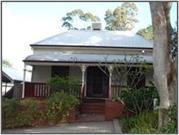
8 Australind St Swanbourne
Claremont
Metropolitan
Constructed from 1896
| Type | Status | Date | Documents | More information |
|---|---|---|---|---|
| Heritage List | Adopted | 07 Jul 2015 |
| Type | Status | Date | Documents |
|---|---|---|---|
| (no listings) |
| Type | Status | Date | Grading/Management | More information | |
|---|---|---|---|---|---|
| Category | Description | ||||
| Municipal Inventory | Adopted | 31 Dec 1995 |
|
Heritage Council | |
| Municipal Inventory | Adopted | 05 Aug 2014 | HA - Category 2 |
HA - Category 2 |
|
HA STATEMENT OF SIGNIFICANCE
Australind Street Heritage Area is significant in demonstrating the early development of modest workers’ cottages in Australind Street, opposite Scotch College. The cottages demonstrate a way of life of modest means. The intact timber cottages make a significant contribution to the historical significance of the context.
Single storey timber cottage with a hipped Zincalume roof and a separate bullnose verandah. The weatherboards are painted. Symmetrical façade with a central door and windows to each side is typical of the Victorian Georgian style.
Servetus, Otway, Rob Roy, Australind and Saladin were all named after Western Australian coastal steamships and they may have all been created around the same time. Swan Location P1070, from which the western side of Australind Street resulted, was subdivided prior to 1898. In 1903, when the Town of Claremont Rate Books commence, there were four houses recorded in Australind Street. This means that over half of the western side of Australind Street was developed during the ‘Birth of a Suburb’ period, a period of rapid growth in Claremont, which saw a population increase from 76 in 1896 to 469 in 1902. A fifth house was constructed in the street during the ‘Consolidation’ period.
Nos. 8 & 10 Australind Street fall into the ‘Birth of a Suburb’ period. Surviving building stock from this period indicate that housing types were mainly bungalows in one of the Federation styles with a smaller number of cottages.
No.4, constructed in 1905, was a latecomer to the street and falls into the Town’s ‘Consolidation’ period of development. The ‘Consolidation’ period was a period of rapid growth within the Town. Population and housing grew steadily with 701 households and businesses in 1905, 872 in 1910 and 1,240 in 1915. The largest area containing houses of this period is the area bounded by Mary, Gugeri, Melville and Loch Streets and Stirling Highway. Surviving heritage homes from this period indicate that housing types were mainly Federation and Federation Queen Anne with three to five rooms.
| Ref ID No | Ref Name | Ref Source | Ref Date |
|---|---|---|---|
| Big Picture of a Small Street. Australind Street, Claremont: The First Hundred Years | Street History |
Development period
1896-1902: ‘Birth of a Suburb’
Individual Building or Group
| Epoch | General | Specific |
|---|---|---|
| Original Use | RESIDENTIAL | Single storey residence |
| Present Use | RESIDENTIAL | Single storey residence |
| Style |
|---|
| Victorian Georgian |
| Type | General | Specific |
|---|---|---|
| Roof | METAL | Zincalume |
| Wall | TIMBER | Weatherboard |
This information is provided voluntarily as a public service. The information provided is made available in good faith and is derived from sources believed to be reliable and accurate. However, the information is provided solely on the basis that readers will be responsible for making their own assessment of the matters discussed herein and are advised to verify all relevant representations, statements and information.