Local Government
Nannup
Region
South West
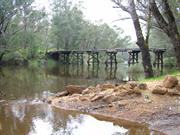
Jalbarragup Rd Jalbarragup on the Blackwood River
No 3978
Nannup
South West
Constructed from 1900
| Type | Status | Date | Documents |
|---|---|---|---|
| Heritage List | Adopted | 26 Mar 2015 | |
| State Register | Registered | 02 Jun 1998 | HCWebsite.Listing+ListingDocument, HCWebsite.Listing+ListingDocument |
| Type | Status | Date | Documents |
|---|---|---|---|
| (no listings) |
| Type | Status | Date | Grading/Management | |
|---|---|---|---|---|
| Category | ||||
| Municipal Inventory | Adopted | 24 Oct 1995 | Category 2 | |
| Classified by the National Trust | Classified | 01 Nov 1993 | ||
| Statewide Lge Timber Str Survey | Completed | 11 Dec 1998 | ||
Shire advises condition deteriorated since 1996.
| Name | Type | Year From | Year To |
|---|---|---|---|
| C S R Palmer | Architect | - | - |
Individual Building or Group
| Epoch | General | Specific |
|---|---|---|
| Present Use | VACANT\UNUSED | Vacant\Unused |
| Original Use | Transport\Communications | Road: Bridge |
| Type | General | Specific |
|---|---|---|
| Other | TIMBER | Other Timber |
| General | Specific |
|---|---|
| DEMOGRAPHIC SETTLEMENT & MOBILITY | Settlements |
| TRANSPORT & COMMUNICATIONS | Road transport |
This information is provided voluntarily as a public service. The information provided is made available in good faith and is derived from sources believed to be reliable and accurate. However, the information is provided solely on the basis that readers will be responsible for making their own assessment of the matters discussed herein and are advised to verify all relevant representations, statements and information.
Constructed from 1900
Refer to National Trust assessment.
Jalbarragup Bridge (ruin) is a now-disused turn of the century wooden river bridge. It is the only remaining turn of the century wooden bridge over the Blackwood River surviving in its original form, and one of few such bridges left in this State.
Shire advises condition deteriorated since 1996.
| Ref Number | Description |
|---|---|
| 041 | Shire of Nannup MHI |
| Owner | Category |
|---|---|
| State of WA (vested in the Shireof Nannup) | Local Gov't |
This information is provided voluntarily as a public service. The information provided is made available in good faith and is derived from sources believed to be reliable and accurate. However, the information is provided solely on the basis that readers will be responsible for making their own assessment of the matters discussed herein and are advised to verify all relevant representations, statements and information.
Architectural/technical accomplishment; Environmental importance; Landscape value The aging timbers of ihe bridge and the texture of the structure created by the horizontal vertical and diagonal elements harmonise with a beautiful river landscape complete with large trees and windmg gravel roads. There is an affinity between the bridge and the near-by timber slab outbuildings and split post and rail fencing of the Jalbarragup homestead. Demonstration of a way of life, custom, process or function It is an important link with bridge building techniques at the turn of the century, particularly in respect to the hewn timbers of the bracing and waling. Historical significance; Development of a cultural phase: The bridge is important in relation to the early development of transport facilities in the district. Educational/research value: The bridge site is important for its potential to promote a wider understanding of the history of the European settlement in the district. Scarcity value; A particularly fine example The bridge is important as the only remaining bridge on the Blackwood River of the turn of the century, which is largely intact, and one of the few such structures in the State,
Both approaches to the bridge are unsealed, graded tracks, very similar to the roads of 1900. The bridge is typical of wooden bridges built around the 1900's. It is founded on driven jarrah piles which are still in fair condition considering the age of the bridge. The bracing is all original hewn Jarrah and is of prime significance in the overall fabric of The bridge. The abutment construction is typical, also consisting of driven jarrah piles supporting sawn jarrah retaining wall and wing sheeting.
Assessment 1993 Construction 1900
This information is provided voluntarily as a public service. The information provided is made available in good faith and is derived from sources believed to be reliable and accurate. However, the information is provided solely on the basis that readers will be responsible for making their own assessment of the matters discussed herein and are advised to verify all relevant representations, statements and information.
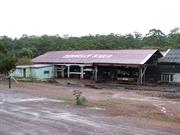
Wheatley
Nr Nannup
Nannup
South West
Constructed from 1949
| Type | Status | Date | Documents |
|---|---|---|---|
| Heritage List | Adopted | 26 Mar 2015 | |
| State Register | Registered | 09 Feb 1996 | HCWebsite.Listing+ListingDocument, HCWebsite.Listing+ListingDocument |
| Type | Status | Date | Documents |
|---|---|---|---|
| (no listings) |
| Type | Status | Date | Grading/Management | |
|---|---|---|---|---|
| Category | ||||
| Register of the National Estate | Indicative Place | |||
| Municipal Inventory | Adopted | 24 Oct 1995 | Category 1 | |
08198 Donnelly River Mill & Townsite Precinct
| Name | Type | Year From | Year To |
|---|---|---|---|
| Wheatley Family | Architect | - | - |
| Library Id | Title | Medium | Year Of Publication |
|---|---|---|---|
| 2464 | Conservation plan : Donnelly River Mill. | Heritage Study {Cons'n Plan} | 1994 |
| 6666 | Donnelly Mill : structural and safety report. | Heritage Study {Other} | 2003 |
| 8033 | Donnelly River Mill. Examination and business case. | Heritage Study {Other} | 2006 |
| 6667 | Donnelly River Mill Steering Committee : agenda papers. | Report | 2003 |
| 6668 | Donnelly River Mill : Manjimup Workshop December 4, 2003 : various papers. | Report | 2003 |
| 9780 | Donnelly River Mill: heritage study and a DRAFT Future use options paper. | Heritage Study {Other} | 2005 |
| 7513 | Donnelly River Mill : structural audit report + plans. | Heritage Study {Other} | 2005 |
| 11567 | Donnelly River Mill: Wheatley | Heritage Study {Cons'n Plan} | 2016 |
| 9801 | Report for Minister for Tourism Donnelly River Mill: future use of reserve 37707. | Electronic | 2005 |
Individual Building or Group
| Epoch | General | Specific |
|---|---|---|
| Original Use | FORESTRY | Timber Mill |
| Present Use | VACANT\UNUSED | Vacant\Unused |
| Style |
|---|
| Other Style |
| Type | General | Specific |
|---|---|---|
| Other | METAL | Steel |
| Other | TIMBER | Tongue & Groove |
| Roof | METAL | Corrugated Iron |
| General | Specific |
|---|---|
| OCCUPATIONS | Timber industry |
| DEMOGRAPHIC SETTLEMENT & MOBILITY | Settlements |
This information is provided voluntarily as a public service. The information provided is made available in good faith and is derived from sources believed to be reliable and accurate. However, the information is provided solely on the basis that readers will be responsible for making their own assessment of the matters discussed herein and are advised to verify all relevant representations, statements and information.
Constructed from 1949
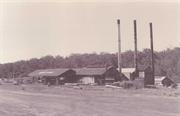
Donnelly River Timber Mill is significant to the history of the timber industry in the south west of Western Australia and to the history of settlement of the region. The residential precinct adjacent to the mill is also significant.
The Donnelly River Mill is constructed largely of local materials. The basic structure of the mill is the mill floor which supports the operating equipment above the floor and also the drive shafts, pulleys and belts under the floor. The initial power to operate all mill equipment came through shafts from a single steam engine. Though below the floor drive equipment was the practice in timber mills and reflected the technology required to operate a mill by steam power, this is different from the usual practice in other workshops, which have drive shafts and pulleys in the roof and belt drivers coming down onto the work benches. The purpose of all drive equipment being below floor level was to achieve an open path for the movement of timber through the mill and also to improve safety. Nearly all the mill equipment is located under the main mill roof. The roof is of robust design and is made of two pitched segments joining at a central box gutter sheeted with standard corrugated roofing material. The support structure is all of timber construction; the support columns are of round bush timber, while the roof timbers, trusses and beams were constructed from sawn timber. The three steel chimney stacks are 20m in height and are stabilised with anchored guy ropes. A smaller chimney provided for exhaust of steam from the steam engines. The boilers generating steam for the engines are under a roofed area and are protected from the weather, while the boiler generating kiln steam is protected under a separate roof. Two of the original steam engines, which respectively provide direct belt power to the mill equipment and coupling to an alternator generating electrical power, remain in position and are protected from weather, though in need of maintenance. A third steam engine, which generated electrical power, has been removed apart from the engine block, while a diesel engine has been removed entirely. A fourth steam engine also used for power generation, remains in position. The original switching equipment and switchboards have been removed. Remaining in position are: the winch used to handle logs from trucks into the mill; the overhead winch for positioning logs on the travelling carriage; the travelling carriage itself; the twin saws which made the first log cuts; bench rollers; other saws; moving feed trolleys and rails; packing case benches; the conveyor systems for waste transport, collection of sawdust from the bench saws and supply of sawdust to the kiln boilers; and, the shaft and pulley drive system under the mill floor. The drying kilns have been demolished, as has the large planer building where dressed timber was produced. The equipment has been removed from the site of the planer building and from the pre-cut areas and the second timber sorting table has also been removed. The rail system used to move timber in the storage yard has been dismantled. The Donnelly River Mill was possibly the first to employ women in a timber mill workforce.
The original Donnelly Mill was established by Wheatley family in 1912 and closed in 1914. The existing mill was built in 1948 and used by Bunnings until 1978. (SWDA information Section B) The mill was served by a network of railway lines. This is a largely intact example of a mill and mill town which is no longer working but which is capable of being conserved for tourism purposes.
The site requires conservation work to protect the mill and equipment from further deterioration.
| Ref ID No | Ref Name | Ref Source | Ref Date |
|---|---|---|---|
| SWDA information Section R | South West Heritage Taskforce | 1990 | |
| MHR Southcombe;"Steam in the Forests". p 106 | Hesperian Press | 1985 |
| Ref Number | Description |
|---|---|
| 017 | Shire of Nannup MHI |
| Reserve | Lot/Location | Plan/Diagram | Vol/Folio |
|---|---|---|---|
| RES37077 | 38 | P194401 | LR3147-987 |
| Owner | Category |
|---|---|
| Department of Planning and Infrastructure | State Gov't |
| WA Tourism Commission | State Gov't |
This information is provided voluntarily as a public service. The information provided is made available in good faith and is derived from sources believed to be reliable and accurate. However, the information is provided solely on the basis that readers will be responsible for making their own assessment of the matters discussed herein and are advised to verify all relevant representations, statements and information.
Cnr Andrew & Sears Rd Wheatley
Nannup
South West
Constructed from 1951, Constructed from 1950
| Type | Status | Date | Documents |
|---|---|---|---|
| Heritage List | Adopted | 26 Mar 2015 | |
| State Register | Registered | 01 Jun 2007 | HCWebsite.Listing+ListingDocument, HCWebsite.Listing+ListingDocument |
| Type | Status | Date | Documents |
|---|---|---|---|
| (no listings) |
| Type | Status | Date | Grading/Management | |
|---|---|---|---|---|
| Category | ||||
| (no listings) | ||||
The Town site buildings are in good condition and have been maintained to consistent standards over time. The Town site also has a high degree of integrity. All the buildings have been appropriately adapted to new uses, and many, including the General Store, Workshop, Club and Workers’ Cottages, retain their original uses. Donnelly River Mill and Town Site Precinct has a high degree of authenticity. The Mill and its equipment is nearly all as originally built and installed, and repairs and restoration work carried out over the years has not adversely affected the authenticity of the place.
| Name | Type | Year From | Year To |
|---|---|---|---|
| Henry Martin | Architect | - | - |
| Library Id | Title | Medium | Year Of Publication |
|---|---|---|---|
| 7513 | Donnelly River Mill : structural audit report + plans. | Heritage Study {Other} | 2005 |
| 6667 | Donnelly River Mill Steering Committee : agenda papers. | Report | 2003 |
| 8033 | Donnelly River Mill. Examination and business case. | Heritage Study {Other} | 2006 |
| 6666 | Donnelly Mill : structural and safety report. | Heritage Study {Other} | 2003 |
| 2464 | Conservation plan : Donnelly River Mill. | Heritage Study {Cons'n Plan} | 1994 |
| 6668 | Donnelly River Mill : Manjimup Workshop December 4, 2003 : various papers. | Report | 2003 |
| 9780 | Donnelly River Mill: heritage study and a DRAFT Future use options paper. | Heritage Study {Other} | 2005 |
| 10085 | Donnelly River Mill Townsite, Wheatley | Heritage Study {Cons'n Plan} | 2012 |
Precinct or Streetscape
| Epoch | General | Specific |
|---|---|---|
| Other Use | RESIDENTIAL | Other |
| Other Use | COMMERCIAL | Hotel, Tavern or Inn |
| Other Use | EDUCATIONAL | Museum |
| Original Use | FORESTRY | Timber Mill |
| Original Use | FORESTRY | Housing or Quarters |
| Style |
|---|
| Vernacular |
| Type | General | Specific |
|---|---|---|
| Roof | METAL | Corrugated Iron |
| Wall | TIMBER | Weatherboard |
| General | Specific |
|---|---|
| DEMOGRAPHIC SETTLEMENT & MOBILITY | Settlements |
| OCCUPATIONS | Technology & technological change |
| OCCUPATIONS | Timber industry |
| OCCUPATIONS | Hospitality industry & tourism |
This information is provided voluntarily as a public service. The information provided is made available in good faith and is derived from sources believed to be reliable and accurate. However, the information is provided solely on the basis that readers will be responsible for making their own assessment of the matters discussed herein and are advised to verify all relevant representations, statements and information.
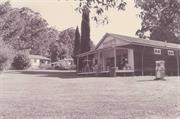
Donnelly River Mill & Townsite is significant to the history of the timber industry in the south west of Western Australia and to the history of settlement of the region.
The townsite buildings are constructed of timber weatherboards with corrugated iron roofs and are in good condition. They have been maintained to consistent standards over time. The townsite also has a high degree of integrity. All of the buildings have been appropriately adapted to new uses, and many, including the General Store, Workshop, Club and Workers’ Cottages, retain their original uses. Donnelly River Mill & Townsite Precinct has a high degree of authenticity. The Mill and its equipment is nearly all as originally built and installed, and repairs and restoration work carried out over the years has not adversely affected the authenticity of the place.
The original Donnelly River Mill was established by the Wheatley family if 1912 and closed in 1914. The existing mill was built in 1948 and used by Bunnings until 1978. The mill was served by a network of railway lines. Donnelly River Mill & Townsite is a largely intact example of a mill and mill town which is no longer working but which is capable of being conserved for tourism purposes.
| Ref Number | Description |
|---|---|
| 018 | Shire of Nannup MHI |
| Reserve | Lot/Location | Plan/Diagram | Vol/Folio |
|---|---|---|---|
| 301 | P50576 | 2671/921 |
This information is provided voluntarily as a public service. The information provided is made available in good faith and is derived from sources believed to be reliable and accurate. However, the information is provided solely on the basis that readers will be responsible for making their own assessment of the matters discussed herein and are advised to verify all relevant representations, statements and information.