Local Government
Moora
Region
Wheatbelt
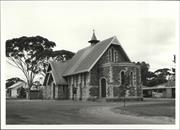
Church & Robert Sts Moora
Moora
Wheatbelt
Constructed from 1911 to 1954
| Type | Status | Date | Documents |
|---|---|---|---|
| Heritage List | Adopted | 25 Jul 2018 | |
| State Register | Registered | 04 Nov 2008 | HCWebsite.Listing+ListingDocument, HCWebsite.Listing+ListingDocument |
| Type | Status | Date | Documents |
|---|---|---|---|
| (no listings) |
| Type | Status | Date | Grading/Management | |
|---|---|---|---|---|
| Category | ||||
| Statewide War Memorial Survey | Completed | 01 May 1996 | ||
| Classified by the National Trust | Classified | 01 Sep 1986 | ||
| Register of the National Estate | Indicative Place | |||
| Register of the National Estate | Nominated | 08 Apr 1988 | ||
| Anglican Church Inventory | YES | 31 Jul 1996 | ||
| Municipal Inventory | Adopted | 19 Nov 1997 | Category 1 | |
Good
| Name | Type | Year From | Year To |
|---|---|---|---|
| Nelson, WA | Architect | - | - |
| Library Id | Title | Medium | Year Of Publication |
|---|---|---|---|
| 8076 | St James Church Moora, Western Australia : conservation plan. | Heritage Study {Cons'n Plan} | 2002 |
Individual Building or Group
| Epoch | General | Specific |
|---|---|---|
| Original Use | MONUMENT\CEMETERY | Monument |
| Present Use | RELIGIOUS | Church, Cathedral or Chapel |
| Original Use | RELIGIOUS | Church, Cathedral or Chapel |
| Style |
|---|
| Federation Gothic |
| Type | General | Specific |
|---|---|---|
| Other | METAL | Corrugated Iron |
| Other | STONE | Local Stone |
| General | Specific |
|---|---|
| PEOPLE | Early settlers |
| OUTSIDE INFLUENCES | World Wars & other wars |
| SOCIAL & CIVIC ACTIVITIES | Religion |
This information is provided voluntarily as a public service. The information provided is made available in good faith and is derived from sources believed to be reliable and accurate. However, the information is provided solely on the basis that readers will be responsible for making their own assessment of the matters discussed herein and are advised to verify all relevant representations, statements and information.
Constructed from 1954, Constructed from 1911
The place demonstrates sgnoficant associations with Moora identities, and the anglican religion. The place is a significant element in the character and townscape of Moora. The place represents a fine example of wrok of the Architect and Builder.
St James Church Gothic Style building is built of stone quarried at DW Griffiths' property, iron roof and timber floor. It was designed by W.A. Nelson a Perth architect, erected by a local builder D.W. Griffiths and consecrated by Archbishop Riley in 1911. The west end was originally of timber construction and was replaced by stone in 1954, when a porch was added.
Reverend FW Gunning was the parish Deacon for Moora Parish in 1909, as was the ordained Priest in 1910 and became the first Rector for Moora. He established the church choir, Sunday School and stayed until 1921.He later spent several years in the Fremantle parish. He stayed with the Padbury's at Koojan whn he travelled to Moora, and conducted services in the Koojan Schoolhouse or th Moora Agricultural Hall. As early as 1908 a collection had been started for the church. It was first intended to build a smal brick brick building near the Roberts Road Bridge, and the government donated the land for the purpose. After the death of Walter Padbury, it was proposed that the echurch be a memorial to him. The Church of England synod agreed, a dn a larger building on a larger site was proposed. The church was named St James after the church at Stonyfield in England where Walter Padbury had been baptised. The government initially refused another site but finally agreed to the style and size of the proposed new church being relvent to the new site. The synod contributed 600 pounds to purchase the two blocks adjacent to the Agricultural Hall. On the 11th March 1911 Loton laid the first stone. The churchwas consecrated on the 15th November 1911 by the Bishop of Perth, Reverend Riley, whose son farmed at Berkshire Valley. In 1950 urgent repairs were needed on the west wall which had been designed and constructed sa a temporary measure to allow another bay. In 1954 a new west was with a porch and a baptistry were constructed. The Hamilton Family donated 800 pounds as a memorial to their son and others lost in World War II. It is the site of the canvas hospital during the 1909/11 diptheria epidemic in Moora.
Integrity: Intact Authenticity: High Degree
Good
| Ref ID No | Ref Name | Ref Source | Ref Date |
|---|---|---|---|
| M Laurie;"Tracks hrough the Midlands, A History of the Moora District." p 91 | 1995 | ||
| Moora Historical Society;" Some Commemmorated Pioneers of the Moora District 1847-1917". | Moora | 1980 |
| Owner | Category |
|---|---|
| Diocesen Trustees of the Church of England | Church Property |
This information is provided voluntarily as a public service. The information provided is made available in good faith and is derived from sources believed to be reliable and accurate. However, the information is provided solely on the basis that readers will be responsible for making their own assessment of the matters discussed herein and are advised to verify all relevant representations, statements and information.
One of the older churches of the Midlands district, St James was architect designed and constructed of stone from the local quarry. It was built in 1911 as a memorial to Walter Padbury who had strong associations with the Moora district and contains a number of links with pioneer settlers of the area.
St James church is built of stone with an iron roof and has timber floors. It was designed by W.A. Nelson, erected by local builder J.W. Clarke and consecrated by Archbishop Riles in 1911. The west end was originally of timber construction and was replaced by stone in 1954, when a porch was added. The condition of the building is generally sound apart from some fretting of the stone work thought to be caused by rising damp.
Assessment 1986 Construction 1911 Architect: W.A. Nelson Builder: J.W. Clarke
This information is provided voluntarily as a public service. The information provided is made available in good faith and is derived from sources believed to be reliable and accurate. However, the information is provided solely on the basis that readers will be responsible for making their own assessment of the matters discussed herein and are advised to verify all relevant representations, statements and information.
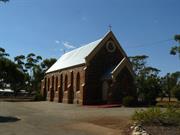
Lot 92 Kintore St Moora
Moora
Wheatbelt
Constructed from 1908
| Type | Status | Date | Documents |
|---|---|---|---|
| Heritage List | Adopted | 25 Jul 2018 | |
| State Register | Registered | 03 Jun 2005 | HCWebsite.Listing+ListingDocument, HCWebsite.Listing+ListingDocument |
| Type | Status | Date | Documents |
|---|---|---|---|
| (no listings) |
| Type | Status | Date | Grading/Management | |
|---|---|---|---|---|
| Category | ||||
| Municipal Inventory | Adopted | 19 Nov 1997 | Category 1 | |
| Register of the National Estate | Indicative Place | |||
| Catholic Church Inventory | Adopted | 01 Jul 1998 | ||
| Classified by the National Trust | Classified | 01 Sep 1986 | ||
| Register of the National Estate | Nominated | 09 Aug 1988 | ||
Maintenance has taken place over a period of many years. However, the long term effects of the flood damage and the lack of regular programmed maintenance and limited financial resources is becoming evident. Overall St John the Baptist Catholic Church, Moora is in fair to good condition.
| Library Id | Title | Medium | Year Of Publication |
|---|---|---|---|
| 5558 | St John the Baptist Catholic Church, Moora : conservation plan. | Heritage Study {Cons'n Plan} | 2002 |
| 7575 | St John the Baptist catholic church, Moora : conservation works final report. | Conservation works report | 2005 |
Individual Building or Group
| Epoch | General | Specific |
|---|---|---|
| Original Use | RELIGIOUS | Church, Cathedral or Chapel |
| Present Use | RELIGIOUS | Church, Cathedral or Chapel |
| Original Use | RELIGIOUS | Housing or Quarters |
| Style |
|---|
| Federation Gothic |
| Type | General | Specific |
|---|---|---|
| Wall | STONE | Donnybrook Sandstone |
| Roof | METAL | Corrugated Iron |
| General | Specific |
|---|---|
| SOCIAL & CIVIC ACTIVITIES | Religion |
This information is provided voluntarily as a public service. The information provided is made available in good faith and is derived from sources believed to be reliable and accurate. However, the information is provided solely on the basis that readers will be responsible for making their own assessment of the matters discussed herein and are advised to verify all relevant representations, statements and information.
Constructed from 1908
The place demonstrates significant associations with New Norcia, the Moora community and the development of the catholic Church in Moora.
A single storey local iron-stone building with corrugated iron roof, designed with vernacular ecclesiastical characteristics showing some influence of the Federation Gothic architectural style. The quoins and buttresses are built with red brick. The gable parapet on the street frontage is detailed with a circular vent and a moulded parapet edge. The skillion additions at the rear is constructed of red face brick.The stone walls of local stone were quarried at the builder's property.
Religion until 1903 Moora was under the Diocese of Perth. At tht time the parish of New Norcia was formed and Father Alcalde arrived on 6 May 1905. Within one week he convened a meeting about a church, but agreement was not reached with regard to the site. Finally from 1907 intensive fund raising got underway, with a Ba;; and Grand Bazaar, Victoria Plains race Day and st Patrick's Sports day at the Moora Showground. The building commenced in November 1908, and cost 735 pounds. It was blessed by Lord Abbott Torres, who also laid the foundation stone, on the 15th August 1909. The alter was am git from Casella of New Norcia. By 1914 Father john Carroll had raised sufficient funds to rent a Presbytery House and became the first resident priest in Moora.
Integrity: intact or redeemable Authenticity: High Degree
| Ref ID No | Ref Name | Ref Source | Ref Date |
|---|---|---|---|
| Moora Historical Society;" Some Commemmorated Pioneers of the Moora District 1847-1917". | Shire of Moora | ||
| National Trust Assessment Form | |||
| M Laurie;"Tracks hrough the Midlands, A History of the Moora District." | Shire of Moora | 1995 |
| Owner | Category |
|---|---|
| Roman Catholic Archbishop of Perth | Church Property |
This information is provided voluntarily as a public service. The information provided is made available in good faith and is derived from sources believed to be reliable and accurate. However, the information is provided solely on the basis that readers will be responsible for making their own assessment of the matters discussed herein and are advised to verify all relevant representations, statements and information.
This church, which has served the district for almost 80 years was dedicated by the Rt Rev Dr Torres, Lord Abbot of New Norcia in 1908. It iso f historical interest for the use of mostly local material in its construction and as a community project. Of special interest is the use of brick in place of stone at the east end of the building. Mr Leo McKinley, whose father was a member of the church sates that this was done to make it easier to dismantle if extensions were needed.
The front and walls of the building are of 'blue coloured' iron stone (quarried from the property of the builder Mr Griffiths, 3 kms from Moora) with brick quoins and buttresses. The east (as stated above) is in brick with a circular vent. There is a moulded parapet on the front of the roof and porch, and the gable has a large glazed rose window with three cusps. Unfortunately, there is an unsympathetic addition in brick at the rear (east end) of the building. The building is in good condition.
Assessment 1986 Construction:1908 - 1909
This information is provided voluntarily as a public service. The information provided is made available in good faith and is derived from sources believed to be reliable and accurate. However, the information is provided solely on the basis that readers will be responsible for making their own assessment of the matters discussed herein and are advised to verify all relevant representations, statements and information.
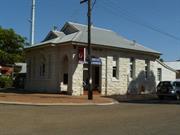
Cnr Padbury & Dandaragan Sts Moora
Moora
Wheatbelt
Constructed from 1896 to 1953
| Type | Status | Date | Documents |
|---|---|---|---|
| Heritage List | Adopted | 25 Jul 2018 | |
| State Register | Registered | 02 Jul 1999 | HCWebsite.Listing+ListingDocument, HCWebsite.Listing+ListingDocument |
| Type | Status | Date | Documents |
|---|---|---|---|
| (no listings) |
| Type | Status | Date | Grading/Management | |
|---|---|---|---|---|
| Category | ||||
| Register of the National Estate | Indicative Place | |||
| Classified by the National Trust | Classified | 01 Sep 1986 | ||
| Statewide Post Office Survey | Completed | 01 Mar 1992 | ||
| Municipal Inventory | Adopted | 19 Nov 1997 | Category 2 | |
11238 Moora Town Precinct
| Name | Type | Year From | Year To |
|---|---|---|---|
| Hillson Beasley | Architect | - | - |
| George Temple-Poole | Architect | - | - |
| Library Id | Title | Medium | Year Of Publication |
|---|---|---|---|
| 5110 | Moora post office & quarters : conservation plan / by Considine and Griffiths Architects. | Heritage Study {Cons'n Plan} | 2001 |
Individual Building or Group
| Epoch | General | Specific |
|---|---|---|
| Original Use | Transport\Communications | Comms: Post or Telegraph Office |
| Original Use | RESIDENTIAL | Single storey residence |
| Present Use | Transport\Communications | Comms: Post or Telegraph Office |
| Style |
|---|
| Federation Free Style |
| Type | General | Specific |
|---|---|---|
| Wall | STONE | Local Stone |
| Roof | METAL | Corrugated Iron |
| General | Specific |
|---|---|
| TRANSPORT & COMMUNICATIONS | Mail services |
| TRANSPORT & COMMUNICATIONS | Telecommunications |
| OCCUPATIONS | Technology & technological change |
This information is provided voluntarily as a public service. The information provided is made available in good faith and is derived from sources believed to be reliable and accurate. However, the information is provided solely on the basis that readers will be responsible for making their own assessment of the matters discussed herein and are advised to verify all relevant representations, statements and information.
Constructed from 1896, Constructed from 1912
The place demonstrates associations witht he telecommunications f the region and associated persons during the development of Moora. It also had associations with prominent architectural example of their work. It is significant element in the street scape and townscape of Moora.
Moora Post Office and Quarters, a single-storey local stone and corrugated iron residence (1896) and adjoining post office (1912) in the Federation Free style. The interior has been modernised. 1896 cost 683 pounds, 1912 cost 1436 pounds. A shed was added in 1911 and major extensions in 1912.
a post Office opened in Moora on 1st october 1894. It was a direct result of the railway coming thorugh Moora. It was opened by Elizabeth Hall. On 2nd September 1896, the official Post Office was built and telegraph operations commenced. In 1905, the phone was connected to Walebing (a morse repeater station). With the advent of the Forrest Government, and the increased activity in communications and development in the Moora area. Extensions were made to the post office. In 1912, the original post office became the residence and a new Post office was constructed on the same site.
Integrity: Intact or Redeemable Authenticity: High Degree
Good
| Ref ID No | Ref Name | Ref Source | Ref Date |
|---|---|---|---|
| M Laurie;"Tracks Through the Midlands, A History of the Moora District." | Shire of Moora | 1995 | |
| National Trust Classification& National Estate | 1993 | ||
| National Trust Assessment Form | 1993 |
| Owner | Category |
|---|---|
| Commonwealth Government of Australia | Commonwealth Gov't |
This information is provided voluntarily as a public service. The information provided is made available in good faith and is derived from sources believed to be reliable and accurate. However, the information is provided solely on the basis that readers will be responsible for making their own assessment of the matters discussed herein and are advised to verify all relevant representations, statements and information.
*demonstration of a way of life, custom, process or junction The arrival of, and despatch of mail shipments dictated the timing of acti vi ties of both townsfolk and countryfolk, and their consequent inter-action with other activities, such as attending the markets, collecting the fresh bread , doing business at the bank, and so on. The Post Office thereby became an important component of the way of life. *historical significance of developnumt of cultural phases ; association with important figures The Colonial Government saw a need to supply gazetted towns with purpose built Post Offices. Many of these first Post Offices were simply extensions of the concept that postal services could be carried out in someone's home and a small office was all that was required. However as time passed and the post and telegraphic services required more equipment these early post offices soon became inadequate for the task they had to perform . Moora's Post Office with Residence displays this kind of inadequacy admirably. *environmental importance; townscape or landscape value; high degree of unity of setting As the development of postal services changed, the relationship between the institution and its constituency altered. The Post Office is seen as providing an important communication service to the community. The importance of communications to the more remote centres gave the Post Offices a very prominent role. This was generally reflected in streetscape terms by the design and location of the building. *social significance In local context , the significance of the Post Offices as a meeting place gauged by the arrival and or departure of the mails initially, as well as a place for the dissemination of news and gossip, for the disbursement of social assistance, for the collection of war bonds and so on, the ediface is of significance to the development of a rural community . As the type of service provided changed in nature, the need to visit the post office in such a community diminished. Enormous social significance accrues to the Post Office.
Both the post office and quarters are constructed of local stone, rock faced on the post office and dressed on the quarters . Both buildings have GCI roofs. The Post Office occupies a comer position with Padbury Street on the eastern side and Dandaragan Street on the southern side. Beasley's Post Office has a symmetrical front facade with a projecting middle section. The projecting middle section has an arched central window with a tri -partite windowpane arrangement ; the central pane is surmounted by a triangular wooden pediment. Flanking this arched window are two narrow square headed windows. These particular design features (a central arched window flanked by two narrow square headed windows and the triangular wooden pediment above the central window pane) are also evident at Katanning, Narrogin Wagin and Donnybrook . The stonework on Moora's Post Office has been painted, while that of the quarters remain s unpainted . Externally the building appears to have retained its original appearance. In the interior of the Post Office the counter and postal area have been modernised. The Post Office is in good condition
Assessment 1986 Construction 1912 Architect: George Temple Poole 1896; H Beasley 1912 Builder J.H. Rennie Moora was a major station on the Midland Railway Line and is the centre of an extensive agricultural district. Postal facilities were available in 1894, possibly at the Railway Station. The present post office at Moora was designed by Beasley and replaces the original Poole building which became the postmaster's residence. Poole's building was completed in 1896 and cost £746. The present post office was let for tender on 20th June 1912 and cost £1436. Seven post offices were constructed during 1912 to Beasley's design, five of these use a very similar design: Donnybrook, Katanning, Moora, Narrogin and Wagin. (Meekatharra and Kellerberrin were the other two post offices constructed .) All five post offices have similar design elements with differences in the treatment of the facade.
This information is provided voluntarily as a public service. The information provided is made available in good faith and is derived from sources believed to be reliable and accurate. However, the information is provided solely on the basis that readers will be responsible for making their own assessment of the matters discussed herein and are advised to verify all relevant representations, statements and information.
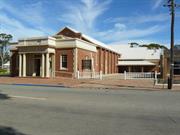
Padbury St Moora
Moora Roads Board office (fmr)
Moora Roll of Honour
Moora
Wheatbelt
Constructed from 1913
| Type | Status | Date | Documents |
|---|---|---|---|
| Heritage List | Adopted | 25 Jul 2018 | |
| State Register | Registered | 27 Nov 1998 | HCWebsite.Listing+ListingDocument, HCWebsite.Listing+ListingDocument |
| Type | Status | Date | Documents |
|---|---|---|---|
| (no listings) |
| Type | Status | Date | Grading/Management | |
|---|---|---|---|---|
| Category | ||||
| Municipal Inventory | Adopted | 19 Nov 1997 | Category 2 | |
| Statewide War Memorial Survey | Completed | 01 May 1996 | ||
11238 Moora Town Precinct
| Name | Type | Year From | Year To |
|---|---|---|---|
| W A Nelson | Architect | - | - |
| Library Id | Title | Medium | Year Of Publication |
|---|---|---|---|
| 1672 | Conservation Plan : Moora Town Hall. | Heritage Study {Cons'n Plan} | 1996 |
Individual Building or Group
| Epoch | General | Specific |
|---|---|---|
| Original Use | GOVERNMENTAL | Town, Shire or District Hall |
| Present Use | GOVERNMENTAL | Town, Shire or District Hall |
| Style |
|---|
| Federation Free Classical |
| Type | General | Specific |
|---|---|---|
| Roof | METAL | Corrugated Iron |
| Wall | BRICK | Common Brick |
| Wall | BRICK | Rendered Brick |
| General | Specific |
|---|---|
| SOCIAL & CIVIC ACTIVITIES | Government & politics |
| DEMOGRAPHIC SETTLEMENT & MOBILITY | Settlements |
This information is provided voluntarily as a public service. The information provided is made available in good faith and is derived from sources believed to be reliable and accurate. However, the information is provided solely on the basis that readers will be responsible for making their own assessment of the matters discussed herein and are advised to verify all relevant representations, statements and information.
Constructed from 1913
The place demonstrates associations with pioneers and civic identities in the formation of Moora. The site represents associations with war, civl emergency and the social events of the town.
The entire place is a brick constructon with a gable corrugated iron roof. The front secton is the entry foyer, former offices and associated spaces, behind which is located the hall. The front is classical in proportion with the central entry portico protruding from the front facade. Double classical columns support the portico's rendered pediment with the name detailed. The building corners are quoined with render in contrast to the majority face brick. The bricks and sandstone were from DW Griffiths property. The army building ws a concrete brick construction with a corrugated asbestos roof.
The Town Hall is the second Town Hall (see ref 72). It was opened by the Minister of Works WD Johnson on 11th June 1913. The opening ceremony was introdueced by a luncheon at the Moora Hotel and followed by a ball in the evening. A fire in April 1922, destroyed records and the insureance had lasped. From 1921, when the England Brothers staged a show to rase money for the hospital, the annual Hospital Ball was a popular and successful social event. "Sheridan's band" of locals entertained. During the 1930's church meetings were held in the Lesser hall. In 1932, a badminton club was formed and played weekly. During World War II, the army has a considerablee presence in the Moor aarea. An amenities hall was constructed south of the Town Hall. The Army Hall was soon use as a kitchen facility as the Town Hall di not have one. In 1962, the Moora and Dandaragan Shires formed the Civil Defence Unit in response tot he Federal Government's alarm at the possibilty of a nuclear war. The Shire allocated the use of the Amenities Hall as the Headquarters. Welfare centres were established. By 1977, the threat had diminished, but the communities were ready for local emergencies and the Moora SES was formed in 1983 and relocated to another site. The Army Hall was demolished in 1984.
Integrity: Intact or Redeemable Authenticity: Medium Degree
Good
| Ref ID No | Ref Name | Ref Source | Ref Date |
|---|---|---|---|
| M Laurie;"Tracks Through the Midlands, A History of the Moora District." | Shire of Moora | 1995 | |
| Moora Historical Society;" Some Commemmorated Pioneers of the Moora District 1847-1917". | Shire of Moora | 1980 |
| Owner | Category |
|---|---|
| Shire of Moora | Local Gov't |
This information is provided voluntarily as a public service. The information provided is made available in good faith and is derived from sources believed to be reliable and accurate. However, the information is provided solely on the basis that readers will be responsible for making their own assessment of the matters discussed herein and are advised to verify all relevant representations, statements and information.
14798 Great Northern Hwy Walebing
Walebing Farm Buildings
Moora
Wheatbelt
Constructed from 1850 to 1880
| Type | Status | Date | Documents |
|---|---|---|---|
| Heritage List | Adopted | 25 Jul 2018 | |
| State Register | Registered | 11 Aug 1995 | HCWebsite.Listing+ListingDocument, HCWebsite.Listing+ListingDocument |
| Type | Status | Date | Documents |
|---|---|---|---|
| (no listings) |
| Type | Status | Date | Grading/Management | |
|---|---|---|---|---|
| Category | ||||
| Municipal Inventory | Adopted | 19 Nov 1997 | Category 1 | |
| Classified by the National Trust | Classified | 09 Sep 1996 | ||
Walebing has value as a precinct, or a collection of buildings the individual use of which illustrates the way of life and operation of a rural station as an entity. Walebing is significant for its rarity. There is unlikely to be found in Western Australia the same combination of various uses of buildings grouped together in a homogenous and well-preserved entity.
An extensive complex of stone farmhouses and outbuilding with corrugated iron roofs (not original). The 1880 homestead is constructed of locally quarried stone and timber from a forrest 72 kms away, bricks fired on site. A verandah surrounds the homestead which faces south over the valley. The roof was originally shingles. A large underground water tank was filled by the roof drainage system. The barn 1859/60- the mill is in the south end.
| Library Id | Title | Medium | Year Of Publication |
|---|---|---|---|
| 5228 | Walebing : conservation works : final report / prepared for Stewart Lefroy by John Taylor Architect. | Conservation works report | 2001 |
| 6554 | Walebing Building C : conservation works (final report). | Conservation works report | 2003 |
| 7836 | Final report: conservation works at Walebing - re-roofing and masonry work to the homestead. | Conservation works report | 2006 |
| 2848 | Walebing building D CIP program 1996/97 | Heritage Study {Other} | 1997 |
| 11323 | Conservation works at Walebing Buildings H & I - Wool Shed/Flour Mill & Store Masonry Wall & Timber floor reconstruction | Conservation works report | 2012 |
| 5921 | Off-shears : the story of shearing sheds in Western Australia. | Book | 2002 |
| 1702 | Walebing homesteads and associated farm buildings - report on the cultural significance | Report | 1992 |
| 3745 | Re-Pointing of Southern Wall to the Meatworks (Building K in August 1992 Report) at Walebing | Heritage Study {Other} | 1998 |
| 288 | Walebing building C men's dining room/kitchen cook's room store | Heritage Study {Other} | 1993 |
| 3562 | Roof reconstruction to the Meatworks (Building K in August 1992 Report) at Walebing-Final Report 1988 Conservation Works | Heritage Study {Other} | 1998 |
| 9510 | Final report: conservation works - masonry restoration at Walebing. | Conservation works report | 2009 |
| 5116 | Conservation plan for Walebing, Shire of Moora, Western Australia / prepared by John Taylor Architect for the Lefroy family, Walebing. | Heritage Study {Cons'n Plan} | 2001 |
| 3994 | Roof Reconstruction to the Cart Shed (Building "L"-"Heavy" Horse Stables in August 1992 Report) at Walebing, Moora-Final Report | Heritage Study {Other} | 1999 |
| 7204 | Conservation works (Walebing), Moora : re-roofing of cottage (building B). Final report. | Conservation works report | 2004 |
Individual Building or Group
| Epoch | General | Specific |
|---|---|---|
| Original Use | FARMING\PASTORAL | Homestead |
| Present Use | FARMING\PASTORAL | Kitchen |
| Original Use | FARMING\PASTORAL | Servants or Shearers Quarters |
| Original Use | INDUSTRIAL\MANUFACTURING | Flour Mill |
| Original Use | FARMING\PASTORAL | Cottage |
| Original Use | FARMING\PASTORAL | Stable |
| Present Use | FARMING\PASTORAL | Homestead |
| Original Use | FARMING\PASTORAL | Shed or Barn |
| Style |
|---|
| Vernacular |
| Type | General | Specific |
|---|---|---|
| Wall | STONE | Granite |
| Roof | METAL | Corrugated Iron |
| General | Specific |
|---|---|
| DEMOGRAPHIC SETTLEMENT & MOBILITY | Settlements |
| OCCUPATIONS | Commercial & service industries |
This information is provided voluntarily as a public service. The information provided is made available in good faith and is derived from sources believed to be reliable and accurate. However, the information is provided solely on the basis that readers will be responsible for making their own assessment of the matters discussed herein and are advised to verify all relevant representations, statements and information.
Constructed from 1880, Constructed from 1850
The place demonstrates significant associations with pioneer identities of the Moora region. It demonstrates associations with convicts and communication. The construction and labour is significant as one of the few examples in the region and certinly the most comprehensive farm complex of the period.
An extensive complex of stone farmhouses and outbuilding with corrugated iron roofs (not original). the 1880 homestead is constructed of locally quarried stone and timber from a forrest 72 kms away, bricks fired on site. A verandah surrounds the homestead which faces south over the valley. The roof was originally shingles. A large underground water tank was filled by the roof drainage system. The barn 1859/60- the mill is in the south end.
In 1842, brothers Gerald de Courcey and Anthony O'Gardy lefroy arrived in the colony and by 1844, were building their assets in Spring Hill. In 1846, G Lefroy arranged a squatting license for 80,000 acres at "Walebing" which was taken up for the purposes of providing grazing country for their stock. The base operation was moved to "Victoria Downs" (Bolgart) while the new property at Walebing was developed. AO Lefroy took up the lease in 1846 and acquired the freehold to Loc 9 (11acres) and Loc 12 (20 acres) in 1853 and 1856 respectively. The first dwelling on the property was a basic shelter built by the brothrs in 1846. Shortage of labour was a problem, but the Lefroy brothers were of the opinion that convict labour would have to be imported. In May 1850, the first convicts arrived in the Swan River colony. Convict labour was responsible for most of the stone buildings at Walebing. The second dwelling was built of local stone in 1851 with convict labour under the direction of Gerald Lefroy. In 1852/53, Gerald handed his interest in the property to Anthony who was at that time the secretary to the Governor of the Swan River Colony. The brother's partnership dissolved in 1855 and G Lefroy took a consignment of horses to India in 1856 for his father-in-law WL Brockman. A Lefroy continued to live in Perth and John Joyce managed the Walebing property until the 1870's when Anthony's only surviving son Henry Bruce Lefroy took over and Joyce became the first settler in Bind Bindi in 1874. Henry Bruce Lefroy took over the property after he completed his education in England. In 1872, he was elected to the Victoria Plains Road Board and was Chairman in 1876. His friend Bishop Salvado, supported his appointment of Justice of the Peace at aged 21. In 1879 he captained and coached the aboriginal cricket team at New Norcia and successfully toured Perth. He was involved in the formation of the Moora Roads Board and the inaugural Chairman from 1909 until 1917, as well as the chairman of the Moora Districts Hospital Board. In 1892, he entered pollitics as the first member for the Moora Electorate in the Legislative council. He was minister for Education in the Forrest Government and between 1901 and 1904 he was Agent General for Western Australia in London. His wife Rose (nee Wittenoom) died in London leaving him three sons. He remarried Madeline Walford in 1904, amd had two sons and a daughter with her. He was Premier of Western Australia between 1917-1919. In 1867 the mail route from Perth to Geraldton was diverted inland from the coastal stock route to cater for the settlers along the inland route, including New Norcia, Walebing, Berkshire Valley and Marah (Watheroo). In 1873, constuction began on a continuous telegraph line from Toodyay to Geraldton, and Walebing and Berkshire Valley both original mail exchanges were turned into telegraph offices. Family members were taught morse code and operated the telephone exchange. In 1875, George Clarke sent a dispatch from the Walebing telegraph office to Perth to inform them of Earnest Giles arrival in Western Australia. GA Walpole was the first telegraph operator. In 1888, Walebing was one of the mail change-over points, and this continued after the railway went through to Moora. The mail would be coached to Walebing twice a week and distributed to further destinations. This practise continued until the official Post Office and Telegraph office was constructed in 1895 and opened in 1896.
Integrity; iIntact or redeemable Authenticity: High Degree
Good
| Ref ID No | Ref Name | Ref Source | Ref Date |
|---|---|---|---|
| Moora Historical Society;" Some Commemmorated Pioneers of the Moora District 1847-1917". | Shire of Moora | 1980 | |
| Alison Lefroy "Unpublished Research Notes" | 1996 | ||
| M Laurie;"Tracks Through the Midlands, A History of the Moora District." | Shire of Moora | 1995 |
| Owner | Category |
|---|---|
| PD, DM & SP Lefroy | Other Private |
This information is provided voluntarily as a public service. The information provided is made available in good faith and is derived from sources believed to be reliable and accurate. However, the information is provided solely on the basis that readers will be responsible for making their own assessment of the matters discussed herein and are advised to verify all relevant representations, statements and information.
The Cultural Heritage value of the "Walebing" buildings has been considered as a group. The buildings themselves are of greatest value as a precinct, or a collection whose individual uses collectively illustrate the way of life and operation of a "station" as an entity. ASSESSMENT OF SIGNIFICANCE Aesthetic Value The homesteads and farm buildings at "Walebing" are simply detailed. The roof forms (basic hips, gables and skillions at varying pitch), and wall structure combine to form buildings which are attractive. However, the community generally has little opportunity to view these buildings as they are not visible from the highway. "Walebing'' is extremely important in its entirety, as a precinct which has a singular character created by its individual components. Collectively, they form a very significant cultural environment. Historic Value The buildings illustrate the "pioneer" development of the locality. Difficult conditions, with a restricted availability of labour and materials lead to slow progress. Farming initially was not greatly more financially rewarding than "subsistence" level, and slow capital accumulation illustrate the very difficult human occupation and evolution of the locality. The fact that the majority of the buildings were constructed with the aid of convict labour is in itself important. The minor acceleration of development of the whole colony of Western Australia came with the availability of convicts in 1850. The buildings have significance for their close association with significant persons. Anthony O'Grady Lefroy (1816-1897) held numerous positions of importance in the government of Western Australia, including Colonial Treasurer. Sir Henry Bruce Lefroy, eldest son of Anthony O'Grady, gave community and State service including his becoming the Premier of Western Australia in 1917. The Lefroy links to the region and their association with New Norcia are important and significant. The buildings have importance as an example of achievement in a particular period. The construction of the buildings in the 1850s appears to have been quite an achievement for the period. The resources (finance, manpower, construction materials) were not readily available or obtainable. The main homestead is perhaps less of an achievement (though still a major undertaking) because the property was more established at that time. Scientific Value The cultural history of Western Australia has an important reference site at "Walebing". Written, drawn and photographic records can to some extent pass on the details to future generations, but the importance of the buildings in their context on the site is not reproducible . Social Value "Walebing'' is important to the local rural community for largely social reasons familiarity with the long standing use and occupation by the Lefroy family and their various family branches in the area. The present Lefroy's are descendants of the original settlers. "Walebing" and other pioneering stations contribute strongly to their various local community's sense of place in that they were the first points of settlement and thus the initial focus of any future development. Rarity The buildings are significant for their rarity, in that, there is unlikely to be found in Western Australia the same combination of various uses of buildings grouped together in a homogenous and well-preserved entity. The buildings represent way of life that is in danger of being lost. The concept of a self-contained rural community such as "Walebin g" with proprietors, staff and livestock accommodated in a singular area, geared to run to serve its own nee9s, is a function no longer truly evident in the State. Buildings no longer required to be used on the property (ie, staff quarters) are the most deteriorated and will eventually disappear without conservation measures being applied. DEGREE OF SIGNIFICANCE Representativeness The cluster of buildings at "Walebing" have all the attributes which identify it as being characteristic of its class as a rural station. Condition The buildings at "Walebing'' are in relatively good physical condition. Given that they are relatively rigid structures, with floorings on a relatively elastic foundation material, it is fortuitous that further deterioration than what exists has not occurred. Generally this is because the buildings have been in continuous use, and thus have been maintained . The buildings 'D's collapse, and the imminent collapse of a portion of building 'C', are due to the fact that they are no longer in use. The buildings are in extremely good condition in relation to each of the values for which "Walebing" has been assessed. Integrity The long term viability or sustain ability of the values identified is quite clearly possible. Authenticity The "Walebing" buildings are generally all in an original state. The decay of building 'D' (former bulk store and living quarters of "Walebing" employees) has occurred in such a way that restoration (by reassembling the wall components) and reconstruction (with new roofing timber and iron following the example of the remaining portion) of the building is possible. This building has authentic features still intact, despite its collapse, including hand-forged hardware to doors and windows.
Physical Evidence The building is described in From Ireland to Western Australia 1842 as follows: "H.B. Lefroy built a house at "Walebing" in 1880 with the intention of living there and managing the property. It is a large building of granite and brick and possesses many attractive features that were lacking in the old building by de Courcy. It was a work involving a great deal of labour. All the necessary timber was hand-sawn and dressed in the Bindoon pits, including the jarrah roof shingles. The latter have since been covered with corrugated iron, and the residence remains sturdy, cool and weatherproof." Generally the 1880 main homestead is the most sophisticated construction on the site. One of the most appealing features of the collection of buildings at Walebing is the homogeneity achieved by the use of the local granite for the construction of the walls. This stone is attractively presented in slightly differing formats throughout the various structures. The difference is attributable to the time spans between the date of construction of each building. Thus the stonemasons were different and possibly the method of procuring granite was different. Some portions of walls appear to have been built with granite that was readily available, that is, manageable block sizes laying on top of the ground. Others have quarried rock which may have been procured with the assistance of fires lit on granite outcrops to split them.
Assessment 1996 Construction 1950-1880 Restoration after 1892 Evidence The "Walebing buildings have retained that name from the original station of that name on the property. (1) The property was initially established in the late 1840s by the transfer of Anthony O'Grady Lefroy's and Gerald de Courcy Lefroy's sheep holdings from a base at "Victoria Downs" near Bolgart.(2) The Lefroys ·appear to have gradually worked their way north from their initial experience - gathering and familiarisation at "Tipperary'' near York in 1842, and Springhill near Northam in 1844. Anthony O'Grady Lefroy leased "Victoria Down" at Bolgart in late 1846, and Gerald de Courcy Lefroy secured the rights to the land at "Walebing" on 8 December 1846. It appears that for the next few years they gradually established the property. By mid-May 1848, it had been arranged by the Lefroys that a Mr Beer should take over the lease hitherto held by them at Bolgart, and that all the sheep would be placed on the Walebing property. They transferred themselves and their remaining sheep to "Walebing", and very shortly work was begun on the first small house there. Gerald de Courcy, when he was not away, and until the house was finished, lived in what he called a "mia". This was, in mid 1848, a hut made from stone and earth, with a rush roof. It remained in existence until 1892, when most of it was destroyed by fire. The "Walebing" property was increased in August 1851 to 80,000 acres and by that time the house de Courcy had started to build the previous November was nearing completion, despite disasters such as "thirty feet of wall fell down, flat as a pancake." The outside walls had stone foundations, but rammed earth formed the supports of the interior ones. The floor was of ants' nest, lime, and sand in equal proportions. The rooms were in size; 20 x 17 feet, 14 x 17, 10 x 17 and 8 x 17 feet. Gerald de Courcy was assisted in the work by a man named Pike, who agreed to erect the stonework at threepence a yard, and be paid 5/- a day for laying the bricks. Mud bricks and pug mortar were used. This house was burnt down, along with the "mia" as already mentioned, in 1892. However the house was rebuilt using the same walls and foundations. This assessment refers to a number of different buildings (as depicted in the site plan): the original homestead completed in 1851/52 (building 'B'); the 'light' horse stables were erected in the 1850s by convict labour (building 'E'); 1852 living quarters for "Walebing" employees were constructed (building 'D'); the men's kitchen/dining room, cook's room and store room is also c. 1850s (building 'C'); the 'old' shearing shed has a 1859 inscription (building 'G'); main homestead was built 1880 (building 'A'); Other buildings include: a new shearing shed (building 'F'); a storeroom under the flour mill (building 'H'); foundation of "horse works" (building 'I'); a meat house (building'K') and a 'heavy' horse stables (building 'J'). The horse-works comprised machinery for gearing to the flour-mill, chaff cutter and other mechanical appliances. It was impelled by a horse which pulled a wooden bar or crank round the perimeter of a fifty foot circle. The majority of the buildings at "Walebing" were built in the 1850s with the aid of convict labour. After Gerald de Courcy Lefroy left in 1856 the property was largely developed by overseers, Anthony O'Grady Lefroy's principal business being in Perth. In the late 1870s, Henry Bruce Lefroy (eldest son of Anthony O'Grady Lefroy) took up residence at "Walebing". and was responsible for the construction of the main homestead in 1880, described in the following section.
This information is provided voluntarily as a public service. The information provided is made available in good faith and is derived from sources believed to be reliable and accurate. However, the information is provided solely on the basis that readers will be responsible for making their own assessment of the matters discussed herein and are advised to verify all relevant representations, statements and information.