Local Government
Nedlands
Region
Metropolitan
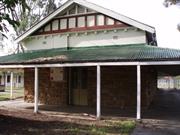
Birdwood Pde Dalkeith
Old Men's Home
Sunset Home
Nedlands
Metropolitan
Constructed from 1904 to 1906
| Type | Status | Date | Documents |
|---|---|---|---|
| Heritage List | Adopted | 18 Dec 2017 | |
| Heritage Agreement | YES | 28 Aug 2014 | HCWebsite.Listing+ListingDocument |
| National Heritage List | Nominated | 15 Mar 2006 | |
| State Register | Registered | 02 Sep 1997 | HCWebsite.Listing+ListingDocument, HCWebsite.Listing+ListingDocument |
| Type | Status | Date | Documents |
|---|---|---|---|
| (no listings) |
| Type | Status | Date | Grading/Management | |
|---|---|---|---|---|
| Category | ||||
| Municipal Inventory | Adopted | 27 Apr 1999 | Category A | |
| Municipal Inventory | Adopted | 23 Oct 2018 | Category A | |
| Classified by the National Trust | Classified | 05 Oct 1993 | ||
| Classified by the National Trust | Classified {Lscpe} | 11 Mar 1993 | ||
| Municipal Inventory | Adopted | 15 Apr 1999 | ||
Generally Good
| Name | Type | Year From | Year To |
|---|---|---|---|
| Hillson Beasley, Chief Architect at the Public Works Department | Architect | - | - |
| Library Id | Title | Medium | Year Of Publication |
|---|---|---|---|
| 6455 | Former Sunset Hospital site : report of the Sunset Steering Committee to the Hon. Minister for Housing and Works. | Report | 2003 |
| 6656 | Sunset Hospital, Birdwood Parade, Dalkeith : conservation management plan. | Heritage Study {Cons'n Plan} | 2003 |
| 3887 | The history of Sunset Hospital. | Book | 1999 |
| 8803 | Geriatric medicine : early policy and practice in Western Australia. | Book | 2005 |
| 1398 | Heritage Assessment and Conservation Policy for Sunset Hospital Birdwood Parade Dalkeith | Heritage Study {Cons'n Plan} | 1995 |
| 11457 | Sunset Heritage Precinct | Archival Record | 2016 |
| 5941 | Sunset Hospital : development referral. | C D Rom | 2001 |
| 10233 | Sunset transformation strategy | Heritage Study {Other} | 2014 |
| 6928 | Sunset Hospital, Birdwood Parade, Dalkeith : Sunset redevelopment heritage study 2000. | Heritage Study {Other} | 2000 |
| 6532 | Western Australian endangered places 2003. | Kit | 2003 |
| 5395 | Metropolitan Region Scheme Amendment No. 1024/33 : Sunset Hospital site, City of Nedlands. Volume 1 : report on submissions. | Legislation | 2000 |
Individual Building or Group
| Epoch | General | Specific |
|---|---|---|
| Original Use | RESIDENTIAL | Institutional Housing |
| Original Use | HEALTH | Hospital |
| Present Use | VACANT\UNUSED | Vacant\Unused |
| Style |
|---|
| Inter-War Old English |
| Federation Arts and Crafts |
| Type | General | Specific |
|---|---|---|
| Roof | METAL | Corrugated Iron |
| Wall | TIMBER | Weatherboard |
| Wall | STONE | Other Stone |
| General | Specific |
|---|---|
| OUTSIDE INFLUENCES | World Wars & other wars |
| SOCIAL & CIVIC ACTIVITIES | Community services & utilities |
| OCCUPATIONS | Commercial & service industries |
This information is provided voluntarily as a public service. The information provided is made available in good faith and is derived from sources believed to be reliable and accurate. However, the information is provided solely on the basis that readers will be responsible for making their own assessment of the matters discussed herein and are advised to verify all relevant representations, statements and information.
Constructed from 1904 to 1906
Sunset Hospital, a complex of Federation Arts and Crafts, Inter-War Arts and Crafts and other style buildings, has aesthetic, historic, social, scientific and rarity cultural heritage significance for the following reasons. It is one of the largest intact early twentieth century public health facilities in the State and, through its site planning and building design, represents the health care policies and practices of the time and throughout its development and operation. Sunset Hospital is a unique example of the type of government sponsored housing for homeless and vagrant men in the State in the early twentieth century. The buildings generally display a high degree of homogeneity and, united by the landscaped open spaces, collectively form an historic precinct. The hospital is a recognised and important landmark which can easily be identified from the river and other areas around Melville Water. Its heritage value is increased with its association with prominent architect Hillson Beasley who, as Chief Architect at the Public Works Department, was ultimately responsible for the original site planning and building design.
The location of Sunset Hospital on riverside land extending along the south east boundary of the suburb of Dalkeith, and includes gently undulating hills and limestone cliffs that fall towards the river adjacent to an area known as Armstrong Spit, adjoining Melville Waters to the south. Tree species remnant of the original vegetation are prevalent on this site, tending to be more common towards the north eastern sector. Some remnant bushland is still apparent on the slopes of the cliff now bounding the hospital on the river side, and features healthy examples of trees and shrubs common to the region such as tuart, marri, jarrah, with grass trees, wattles and acacia species dotted throughout the precinct The site was fenced from the outset with pickets to restrain the inmates. Hot water was derived from a 3,000 metre deep artesian bore, the casing of which cracked in I920s. The Hot Pool (one of three along the river) was formed as a result. This was filled in during the 1950s. Viewed from distant location on the Swan River and its southern shores, the prominent clifftop hospital is dominated by large trees, particularly Norfolk Island pines Araucaria heterophylla and also a group of Moreton Bay figs Ficus macrophylla. Only a portion of the building complex is clearly visible from the river side. The word - SUNSET - constructed of white painted concrete laid on the embankment leading from the river to the hospital is a clear landmark that can be seen from across the river. The change in clientele and work practices has lead to a general evolution of the site which developed from an isolated somewhat self-sufficient institution originally boasting modem buildings and services, into an established yet antiquated hospital, isolated from similar institutes in a primarily suburban precinct. To the design of Hillson Beasley, buildings to house 400 inmates were commenced in 1904, basically of stone construction with corrugated galvanised iron roofing. Limestone for the construction was won from the nearby quarry at Point Resolution. As the river was still considered a viable means of transport, a 90m jetty and shelter (since demolished) was included. The two storey hospital building at the eastern end of the complex was added later The service buildings are of considerable interest as largely intact shells retaining a number of architectural elements typical of the time. Significant around these is the external and internal detail of the dining block, the mortuary (now perhaps unfortunately painted externally) and the laundry facility. After the complex was completed, a timber framed weatherboard and iron building known as the 'bungalow' was removed from its original site at the foot of Mount Eliza. It was transported by horse and dray in sections to the new 22 acre location then known as The Old Men's Home. For many years the building housed the alcoholics and the rowdier inmates of the institution. The floor was added much later. The structure was later used as the Occupational Therapy Department. Accommodation included three residential ward buildings each around a central ablution facility, administration, kitchen, dining, laundry, nurses home, superintendent's residence and mortuary. One of the three ward blocks was used as a hospital. The wards were heated by 'Little Giant' cast iron stoves. A sense of enclosure is demonstrated by the courtyard form of development and strengthened by the covered verandah connections between the buildings via the covered verandahs linking all the important spaces. This is further reinforced by the services and surrounding gardens and activities located on the property such as market gardens and the bowling green. The site is a recognised and important landmark which can easily be identified from the river and other areas around Melville Water. It has many important vistas to and from the Swan River. The vista from the escarpment towards the city illustrates the site's isolation from the city at the turn of the century and the vista across Melville Water and around the bay towards Fremantle illustrates a portion of the present suburban development of the metropolitan region and the encroachment of residential subdivision on this once remote location. The buildings on the site generally display a high degree of homogeneity which collectively forms an historic precinct and significant cultural environment. The most substantial and continuous modifications to the built fabric have been the upgrading of toilet facilities and amenities. Installation and connection to the main city sewerage system in 1942 solved waste removal problems which had plagued the place since its inception. Many of the support services and facilities, such as sheds, workshops and garages, have been adapted, relocated, demolished or removed to other sites, but essentially, the major structures on the site are as originally constructed. Overall, Sunset Hospital has a high degree of authenticity. Footnote: According to the HCWA Report the zincalume Garage, an asbestos cement Workshop. the Switchroom (a small brick building with corrugated fibrolite roofing) and Transformer Compound, the corrugated iron clad Stores, the Nursing Administration Building (clad in Fibrous cement with a colourbond roof). the Gardener's Store (a small brick shed with an iron roof) and the Doctor's and Staff Accommodation (a brick and tile building) are not considered Significant.
Sunset Hospital, previously known as the Old Men's Home, is located on a rise overlooking the Swan River at Freshwater Bay, Dalkeith. The twenty-two acre (8.9 hectare) site was designated by Parliament in 1890 as an 'A' class reserve, for the express purpose of building an institution to house the poor and to be called the "Old Men's Home". The history of the hospital dates back to the I850's when convicts were first transported to this State. Depots were built throughout the colony to house them, one being sited at the base of Mount Eliza and in 1868, when transportation ceased, the depot was fitted up as an Asylum for male paupers. Initially 83 men were house and looked after by a Master and four paid staff but by the end of the century there were 240 inmates housed in accommodation intended for 160. The new institution was urgently needed. In 1904 building started at the Freshwater Bay site and by 1906 the first men were admitted - it was then declared a Poorhouse. The design, following military style of the day, was planned to house 400 inmates and as well as the large dormitory style sleeping quarters, a large kitchen, dining hall, infirmary and a laundry were included. The buildings were constructed from sandstone, which was quarried from the cliff-face at Point Resolution and hauled by horse and jigger to the site. The complex was made up of three main blocks, built facing the river; two to house able bodied men and one to be the hospital. Each block was made up of four L-shaped dormitories surrounding an inner quadrangle, with a small ablutions block in the centre and hand basins round the inner walls. Attached to the ablutions of the centre block were two padded cells. The dining hall was built in the centre of the site, acclaimed for it's well-proportioned design and jarrah hammer-beam ceiling. A residence for the Master, quarters for nursing staff and a mortuary were also built as part of the original plans. The Home filled rapidly after it opened, so to provide more accommodation, one of the timber frame buildings from the Mount Eliza Depot was cut in three parts and transported through the bush by horse and dray and erected on the north west border of the complex - known hence forth as the Bungalow. This timber building is believed to have originally been constructed in the 1890sas one of six Portable Post Offices for the goldfields. On completion, one of the six was probably diverted to the Old Men's Depot at Mount Eliza. This building is probably the most significant building on the Sunset Hospital site as it is the only known survivor of that group of Portable Post Offices and it is the only fabric believed to survive from the former Old Men's Depot [ref D Kelsallpersonal research]. During construction it was decided to build a jetty to facilitate transporting men and materials to the site. It was in constant use up to the 1940swhen it fell into disrepair and was pulled down. The Home initially generated its own power, sufficient only for lighting and to heat water, then at the end of the 1920s was connected to the main grid. Scheme water was connected from the outset but supplemented from a bore sunk below the cliff on the river side of the Home and piped up under its own pressure to a storage tank in the centre of the grounds. A telephone was installed and connected to the Cottesloe exchange which had opened in 1897. John Wade, a harsh and authoritarian man, had been Master of the Poorhouse for 23 years when he retired in 1909. He was succeeded by Albert Rust who improved the lot of the inmates by allowing them more freedom and, through money raised by himself, improved the social amenities of the Home. These included setting up a canteen, library, opening a wireless broadcasting receiving station in 1924 and in 1926 having a projection room built over the servery in the dining hall to show full length feature films. After much lobbying, the two storey hospital block was built in 1927 to house the increasing number of old men needing nursing care. John Bradshaw was appointed superintendent when Albert Rust retired in 1938 and it was suggested that the home's name be changed. In 1941 a competition was launched and the half-guinea won by Mr N C Morgan, an inmate, with his choice of Sunset Home. The name was officially changed in 1943. Following World War 11, facilities and services were in need of upgrading. In the early 1950s nursing procedures and equipment were modernised and in 1958 the first Physiotherapist was employed. In 1959 the Medical Department decided to carry out improvement throughout the Home, particularly the upgrading of the kitchens, building new bathrooms and extending the workshops. Mr Bradshaw retired that year and Bruce Mitchell was appointed Managing Secretary (this position was formerly known as Superintendent) In the early 1960s Dr R B LeFroy was appointed Geriatrician for the state, and immediately started to upgrade the medical care of the residents in Sunset and Mount Henry Homes. The first Occupational Therapist was appointed in 1964 and Social Workers visited from the Medical Department. Women were first admitted to Sunset in 1965 and the Home officially became a hospital under the newly formed Health Department of W A. in 1966. New criteria were set in place at this time for assessing people for admission to permanent care. In the mid 1960s an interdenominational chapel was built in the northwest comer of the grounds to cater to the pastoral needs of all but the Catholics in the Home, who had their own chapel within the grounds. George Kirkby became Managing Secretary when Bruce Mitchell retired in 1967. More refurbishment was carried out during the 1970s with the remodelling of the blocks to create Lodge accommodation and the upgrading and extending of the Occupational Therapy and Physiotherapy Departments. In 1975 Bill Lewtas was appointed Administrator and the following year the Occupational Therapy Day Centre was opened. By the 1980s Sunset residents were receiving the most modem care available - medical, nursing and allied health - which now included Speech Pathology. All disciplines trained their own students and a training programme for Enrolled Nurses was established. In July 1994 the official announcement to close the hospital was made by the then Minister for Health, Mr Foss and the last residents left on 18th October 1995.
High
Generally Good
| Name | Type | Year From | Year To |
|---|---|---|---|
| Hillson Beasley | Architect | - | - |
| Ref Number | Description |
|---|---|
| D33 | LGA Place No |
| Reserve | Lot/Location | Plan/Diagram | Vol/Folio |
|---|---|---|---|
| Cr Res 1667 | Swan Loc 9547 | 3047/572 |
| Owner | Category |
|---|---|
| c/o L Daley | Other Private |
This information is provided voluntarily as a public service. The information provided is made available in good faith and is derived from sources believed to be reliable and accurate. However, the information is provided solely on the basis that readers will be responsible for making their own assessment of the matters discussed herein and are advised to verify all relevant representations, statements and information.
DEMONSTRATION OF A WAY OF LIFE, SOCIAL, HISTORY The "Bungalow" is probably the only known building remaining from the Mount Eliza Depot. Around 1870 the 14th Regiment vacated the Depot and the buildings were fitted out as an asylum for old and incapable paupers (male). It was called the Poorhouse. Assistance with the running of-the establishment was undertaken by the "Tuppenny Orderlies" being the more able bodied inmates. They worked in the kitchen and laundry/ and general nursing and in the hospital. From-the outset of the establishment, the reward for these services was additional rations, and later by payment of 2d (Tuppence) per day. The last of the men still receiving this renumeration died in May 1980. ASSOCIATION WITH PERSONAGES The institution was run from 1869-1887 by Mr and Mrs Dewis. On Mrs Dewis' death John Price Wade became Master/ his wife the cook, and Miss Eliza Speers the Matron. Wade retired in 1909 to be succeeded by Albert Rust in 1910. Rust eased the regimentation and formality of the institution, removed the gates/ eased the rules on a variety of matters including uniforms for the staff. He worked tirelessly for the institution raising funds for the new hospital, library/ books, radios, film projection booth, stage for concerts amongst others. In 1924 a broadcast listening station was officially opened at the home. Live concerts were encouraged. Mr. Rust retired in 1938. In 1943 the name was changed to Sunset. Later a programme of modernisation has been undertaken to make the buildings more comfortable. There have been many benefactors of the home including the Padbury family. ENVIRONMENTAL VALUE The building complex is set on high ground adjoining the river and melds into the landscape from the adjoining residential area and the river due to the maturity of the trees/ the unity of the building materials, the unobtrusive green roofing all in harmony and scale with the surroundings. The recent additions do not intrude on the overall pattern. SCARCITY VALUE The buildings are unique.
Including timber framed weatherboard and iron "Bungalow" building circa 1870, and internal and external portions of limestone buildings still extant in 1991 including morgue, laundry, kitchen, dining (together with cinema projection room, equipment and stage), residential ward buildings, administration, nurses home (plus timber fence and trellis), superintendent’s residence, and later two storey masonry hospital building plus trees-and landscaping fixtures. The "Bungalow" building now used as an occupational therapy unit was removed from its original site at the foot of Mount Eliza around.' 1908. It was cut into three sections and transported by horse and dray to the new 22 acre location by the-n specifically known as "The Old Mens Home". For many years the building housed the alcoholics and the rowdier inmates of the institution. The floor was added much later.; To the design of Hillson Beasley, buildings to house 400 had been commenced in 1904, basically of stone construction and including an infirmary. One of the three ward blocks was utilised as a hospital. The limestone for the construction was won from the nearby quarry at Point Resolution. As the river was considered a more suitable means of transport, a 90m jetty and shelter, since demolished, was added. The two storey hospital building at the eastern end of the site was constructed later. The site was fenced from the outset with pickets/ and leave for the incumbents’ war restricted at the gates for many years. The roof ventilators of the dining block a^ of interest. The wards were heated by "Little Giant" cast iron. stoves. Hot water was obtained from a 3000m deep artesian bore the casing of which cracked in the 1920s forming the hot pool. The last of these was filled in. about 1950.
Assessment 1991 Note: for more information about Albert Rust and the history of the Hospital, refer Sunset Hospital: Its History and Function; Ann T. Whyntie
This information is provided voluntarily as a public service. The information provided is made available in good faith and is derived from sources believed to be reliable and accurate. However, the information is provided solely on the basis that readers will be responsible for making their own assessment of the matters discussed herein and are advised to verify all relevant representations, statements and information.
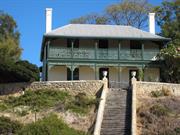
21A Birdwood Pde Dalkeith
Nedlands
Metropolitan
Constructed from 1872 to 1877
| Type | Status | Date | Documents |
|---|---|---|---|
| Heritage List | Adopted | 18 Dec 2017 | |
| State Register | Registered | 10 Oct 1995 | HCWebsite.Listing+ListingDocument, HCWebsite.Listing+ListingDocument |
| Type | Status | Date | Documents |
|---|---|---|---|
| (no listings) |
| Type | Status | Date | Grading/Management | |
|---|---|---|---|---|
| Category | ||||
| Municipal Inventory | Adopted | 23 Oct 2018 | Category A | |
| Municipal Inventory | Adopted | 27 Apr 1999 | Category A | |
| Register of the National Estate | Registered | 21 Oct 1998 | ||
| Classified by the National Trust | Classified | 10 Jul 1982 | ||
| Register of the National Estate | Interim | 24 Jun 1997 | ||
Very Good
| Name | Type | Year From | Year To |
|---|---|---|---|
| Gallop, James | Architect | - | - |
| Library Id | Title | Medium | Year Of Publication |
|---|---|---|---|
| 11878 | Gallop House restoration, the Dome restaurant and the Anderson years | Book | 2018 |
| 3742 | Conservation Plan for Gallop House, Dalkeith, Western Australia. | Heritage Study {Cons'n Plan} | 1998 |
Individual Building or Group
| Epoch | General | Specific |
|---|---|---|
| Present Use | EDUCATIONAL | Museum |
| Original Use | RESIDENTIAL | Two storey residence |
| Style |
|---|
| Victorian Georgian |
| Type | General | Specific |
|---|---|---|
| Wall | STONE | Limestone |
| Roof | METAL | Corrugated Iron |
| General | Specific |
|---|---|
| SOCIAL & CIVIC ACTIVITIES | Education & science |
| DEMOGRAPHIC SETTLEMENT & MOBILITY | Settlements |
| PEOPLE | Early settlers |
This information is provided voluntarily as a public service. The information provided is made available in good faith and is derived from sources believed to be reliable and accurate. However, the information is provided solely on the basis that readers will be responsible for making their own assessment of the matters discussed herein and are advised to verify all relevant representations, statements and information.
Constructed from 1872 to 1877
Gallop House (c. 1872- J 877) has strong aesthetic, historic, social and rarity cultural heritage significance. It was constructed in stone by James Gallop Snr and is significant as the oldest private residence in the City of Nedlands. The place has a strong association with farming that was practiced at a time when the Swan River played an important role in the transportation of produce. Gallop House is a rare example of a colonial residence sited in its original garden setting on a high bank overlooking Melville Water. It has significance for its association with James Gallop and his family, early European settlers who prospered and were instrumental in the development of Dalkeith. Gallop House is a fine example of a Victorian Georgian style residence. It has a landmark quality and is a prominent landscape element impacting on vistas from Melville Water. The proximity of the house to the river, and the vistas thereto, is important in establishing and retaining the landmark quality of the house and its surroundings. Gallop House contributes to the community's sense of place by demonstrating European settlement in the district, particularly through its use as a local history museum. Please Note: A conservation plan for Gallop House is being prepared for the City of Nedlands and the Heritage Council of Western Australia by a consultant team of the National Trust (June 1998).
Gallop House is a two-storey residence built in Victorian Georgian style. It is situated, in isolation, on a high bank with steps leading down the grassed hill to the Swan River. The place is set in a garden environment with landscaped lawns and trees. The rear of the residence is tiered with retaining walls that encase gardens and are connected by paths. The building is surrounded by paving on three sides and bounded by a stone wall. The building can be accessed from the river by a large stone and timber staircase, crucifrom in plan, with a solid stone balustrade and lined either side by gardens. The residence is built of limestone with stucco finish, lined to resemble stone blocks. The building is covered with a double bip roof of corrugated iron with a central box gutter and simple chimneys. A balcony and verandah extend across the front and rear facades. The main roof extends to cover the front balcony, while the rear balcony has a separate roof Both balconies are supported by stop-chamfered timber posts with imported cast-iron infill panels. The underside of the front verandah beam is decorated by a cast iron frieze and cast iron brackets adorn its posts. A timber valance decorates the underside of the rear verandah beam. The front and rear facades are symmetrical with a central doorway and windows either side. The windows have stone lintels and sills except for the lower level windows on the side and rear facades which have timber sills. All windows are double-hung sashes, twelve paned with slim glazing bars. The residence comprises a central passage with three rooms either side. The plan is repeated on the upper level The two front rooms on the lower level feature stone fireplaces with plaster finish and carved timber mantels. Floors to the interior are pit-sawn timber throughout - saw marks can be seen on the boards. The verandah floors and driveway are brick paved - carried out during restoration in the early 1960s. The interior features high ceilings with simple ceiling rose. An oak staircase in a colonial style with slender balusters and a continuous rounded balustrade is located in the passage. An archway supported on square pilasters is located mid-way down the passage on both levels. Although the interior was originally wallpapered, it has been removed and is now painted. In the 1963-64 restoration works included: the installation of new ceilings and timber trims; repairs to cracks in the plasterwork in the interior and the stucco to the exterior; the bathroom and kitchen were modernised; and the garden was moved away from the building walls to ease the problem of rising damp. The building was repainted with colours chosen from paint scrapes to be as close to the original as possible. General maintenance was carried out in the 1980s prior to the place being opened to the public in 1985. In 1995, the garage roof was recovered and the roof beams strengthened. Gallop House today (1998) is in sound condition.
Gallop House is a two-storey residential building, constructed cI872-1877 by James Gallop Snr. and situated in the Perth suburb of Dalkeith. The riverside suburb of Dalkeith derives its name from an estate of 320 acres taken up in 1831 by Adam Armstrong. He named it Dalkeith Farm after the district near Edinburgh from which he had migrated in 1829. Armstrong had first taken up land on the Murray River south of Fremantle, where be established a farm. However, perceived trouble with local Aborigines forced him to relinquish this isolated holding and establish his borne on the Swan River. Here, with his family, he began improving the estate and built Dalkeith Cottage. The exact location of this first house is not known. After suffering financial difficulties, Armstrong decided to return to the Murray River. He sold Dalkeith Farm for 250 pounds on 1 February 1839. At the sale the property included stockyards and five acres of gardens. The new owner was John Lewis, Commissary General and Colonial Treasurer. Two year later, on Lewis' death, Dalkeith Farm was leased firstly to William F Cook and later to James Gallop. James Gallop had arrived in Western Australia in October 1829 with his two brothers. They were indentured labourers selected by the agents of Colonel Edward Latour. Latour never came to Australia and the brothers were left to fend for themselves. Within a short time they found themselves 'good positions'. Through hard work Gallop was able to lease and later purchase land in Dalkeith which enabled him to prosper as a market gardener and wine maker. In 1847, Gallop bought out part of the Dalkeith Farm lease acquiring the cottage and 65 acres of land, including improvements, for 250 pounds. In the mid-to-late 1860s, he acquired the remainder of the 320 acres for 50 pounds. The two parcels of land Gallop bought oomprised most of the present-day suburb of Dalkeith. By this time, Dalkeith Farm had become a well established market garden whieh supplied Perth and Fremantle with much of its fresh produoe. James Gallop married Elizabeth Spencer in 1843 and by the late 1850s the Gallop family had increased by several children. For the sake of their children's better education the family moved from their isolated farm in Dalkeith to reside at FremantIe. However, Gallop continued to work Dalkeith Farm as a fruit orcharder. It is thought that James Gallop Snr built the present two-storey house for his eldest son, James. The 'West Australian' (West Suburbs Supp.) states that "Mr James Gallop, son of the founder of the house, wrote to Mr Williams that the house was built as a wedding present for his mother, about 1875". The construction commenced about 1872 and is thought to have been completed prior to 1877. His son, James Jnr, took up residence after his wedding in December 1877 to Emma Wood of FremantIe. The stone steps leading to the river are believed to have been constructed at this time. Over the years the Gallop family developed a thriving market garden and vineyard operation. However, the growing prosperity of the State around the turn of the century was not reflected in Gallop Gardens, at least in terms of productivity. After James Gallop Snr died in 1897, James Gallop Jnr subdivided the land and sold off land parcels up until around 1911. In 1911, John Scaddan's Labour Government bought the balance of Location 85 and the house for 11,000 pounds. The house had become extremely dilapidated and the surrounds overgrown and neglected. Also, in 1911, the State Gardens Board, which now controlled the foreshore as an "A" Class Reserve, appointed Mr B V Brooks, a former Gallop employee, as tenant-caretaker and he eked out a scant living from the land. In the 1920s and 30s, amid the extensive clearing of bushland in Nedlands and Dalkeith for residential development, the conservation of Gallop House became doubtful as it was in a run-down condition. In October 1959, the WA Historical Society expressed its concern over the condition of the building. However, no work was able to be undertaken immediately and the Nedlands City Council resolved that the place be condemned as unfit for human habitation and a demolition notice was issued on 21 January 1963. Despite this, action was being taken by the Historical Society to organise its possible restoration. After much negotiation. an agreement was reached whereby the City Council agreed to offer the house on a 21 year rentfree lease, in exchange for its occupation, its proper repair and effective maintenance. Gallop House was subsequently leased to Mr and Mrs Anderson and the restoration completed, at their expense, during 1963 and 1964. A memorial erected at the front of Gallop House in 197I by the Royal Western Australian Historical Society, commemorates the contributions made to the early settlement of Dalkeith by Adam Armstrong and James Gallop. The house was further restored after the 2,1year lease ended in the mid-1980s. In 1985, Gallop House was opened to the public as an 'Historical Museum and Old Colonial Home'. The rooms to the left of the passage contain sitting, diniog and bedroom displays. The rooms to the right of the passage are for private use by the tenant. The furniture on display has been collected over the years. A Bible encased in glass, on display in the sitting room, is believed to be the onJy surviving remnant of the Gallops' life in Dalkeith
Original
Very good
| Ref Number | Description |
|---|---|
| D7 | LGA Place No |
| Owner | Category |
|---|---|
| City of Nedlands | Local Gov't |
This information is provided voluntarily as a public service. The information provided is made available in good faith and is derived from sources believed to be reliable and accurate. However, the information is provided solely on the basis that readers will be responsible for making their own assessment of the matters discussed herein and are advised to verify all relevant representations, statements and information.
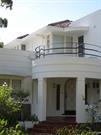
32 Genesta Cr Dalkeith
Residence: 32 Genesta Crescent
Nedlands
Metropolitan
Constructed from 1939
| Type | Status | Date | Documents |
|---|---|---|---|
| Heritage List | Adopted | 19 Dec 2017 | |
| State Register | Registered | 26 Aug 2003 | HCWebsite.Listing+ListingDocument, HCWebsite.Listing+ListingDocument |
| Type | Status | Date | Documents |
|---|---|---|---|
| (no listings) |
| Type | Status | Date | Grading/Management | |
|---|---|---|---|---|
| Category | ||||
| Municipal Inventory | Adopted | 23 Oct 2018 | Category B | |
| Municipal Inventory | Adopted | 27 Apr 1999 | Category B | |
| Classified by the National Trust | Classified | 09 Sep 1996 | ||
Good
| Name | Type | Year From | Year To |
|---|---|---|---|
| Oswald Chisholm, of Cameron, Chisholm & Nicol & later Powell, Cameron & Chisholm | Architect | - | - |
| Library Id | Title | Medium | Year Of Publication |
|---|---|---|---|
| 9711 | Oswald ("Ossie") Victor Chisholm, FRAIA, FRIBA (1903-1989). | Journal article | 2010 |
Individual Building or Group
| Epoch | General | Specific |
|---|---|---|
| Original Use | RESIDENTIAL | Two storey residence |
| Present Use | RESIDENTIAL | Two storey residence |
| Style |
|---|
| Inter-War Functionalist |
| Type | General | Specific |
|---|---|---|
| Wall | BRICK | Rendered Brick |
| Roof | TILE | Aluminium Tile |
| General | Specific |
|---|---|
| OCCUPATIONS | Domestic activities |
This information is provided voluntarily as a public service. The information provided is made available in good faith and is derived from sources believed to be reliable and accurate. However, the information is provided solely on the basis that readers will be responsible for making their own assessment of the matters discussed herein and are advised to verify all relevant representations, statements and information.
Constructed from 1939 to 1940
This house has aesthetic, historic and representative cultural heritage significance. It is highly significant as a fine and intact representative of an Art Modeme style mansion built in Perth in the late 1930s. Constructed just prior to the onset of the Second World War, it is a glamorous reminder of the few years of prosperity experienced in Western Australia before the years of rationing and a shortage of building supplies. A time when Perth was in vogue with the outside world. The house was designed by the respected architect Oswald Chisholm for his family. Except for a 1988 extension which is completely in sympathy with the original design, the house has changed very little since it was built in 1939/40. With the declaration of World War II, the Art Deco style of architecture was virtually brought to a standstill in WA (and elsewhere). The Genesta Crescent house could be seen as the last original and authentic Deco styled house designed in suburban Perth.
The two storey brick rendered house at 32 Genesta Crescent is built opposite a secluded park in a quiet tree lined location. II demonstrates most of the elements which characterise Art Deco architecture as it was realised inWestern Australia in the late 1930s. These include: vertical and horizontal massing of building elements circular and angular elements horizontal banding to unify shapes simplified shapes inspiration of form from ocean liner (Nautical Modeme) curved porches shades constructed as part of the building block verandahs existing only as porches pastel shades wrought iron balustrading glass block decorative panels stepped building elements limestone base horizontal mullioned windows At the front of the building a 'wall to wall plan' is set well back from the footpath in a curved tree-lined street. The lawned garden space is broken only by a circular bed of roses planted when the house was new. Seen from the front bedroom this garden space is enhanced by the park beyond, where a quiet shady space is occupied by ancient blackboys - a reminder that this 'Hollywood Dream Home' is situated in suburban Perth and not the Hollywood Hills or Miami Beach. Like many designs from the period, the Genesta Crescent house demonstrates balance of vertical and horizontal elements. A strong, angular tower contains the stairwell, with an interplay between angles and curves in the balustrading and alcove, while a striking vertical window provides interior lighting. At the same time, the architect took great care to emphasise the horizontal line by the use of horizontal banding on the curved porch and across the front of the house, and by keeping the roofline as low as possible. The low roofline was attained in two ways: 1) The upstairs floor level was kept low by recessing that section into the ground floor level. This resulted in a lower than standard ceiling height in the downstairs entry, dining room, bathroom and passage areas. 2) The upstairs ceiling was designed to extend into the roof cavity, resulting in a Mansard style ceiling. Both these design strategies involved a compromise with the local government authority so that an average ceiling height was considered to be acceptable, rather than a consistent recommended height. Recessed window seats in two of the upstairs bedrooms are physical evidence of the manner in which the upper storey was recessed into the lower one. The extensions have been carried out with great care to retain the building's horizontal aspect, where the waterfall effect, noticeable in the stepping over the enclosed garage, is repeated at the rear of the building. This theme is a integral part of the whole design and enhances the original stepped Iimestone garden layout at the rear of the house which includes a conversation pit and a barbecue area. Limestone has also been used as a means to support both tower and front bedroom. The Nautical Moderne motif is seen to good effect in the external wrought iron balustrading on the upstairs, the curved entrance porch and the rounded comer windows. This motif is repeated in the porthole shaped lighting fixture in the entrance hall, the spectacular chromium-plated curvilinear staircase balustrading and the curved window seating and original circular mirror over the fireplace in the loungeroom. Below, funnel shaped pillars support the banded mantelshelf which in turn is balanced by a vertically incised motif overhead. The remainder of the house pays homage to the luxury and comfort of the great ocean liners and the ambience of 'Screen Deco'. The hint of a Hollywood set is captured in the colourful and exotic three-roomed bathroom suite with stage lighting, imported blue and apricot Czechoslovakian tiles, shiplike bulkheads with racing stripes flanking the bath and elliptical mirrors. Another evocative touch from a bygone era is an original set of maid's bells retained in the kitchen by the new owners when the space was renovated and enlarged for today's living. This historic relic is also a poignant reminder of a gracious mode of living, which, designed to summon the live-in maid, was thwarted by the start of the Second World War, when lifestyles changed rapidly and the maid remained in the employ of the household for only two weeks!
The plans for 32 Genesta Crescent were submitted in 1939 by the owner/architect OV Chisholm (of Cameron, Chisholm and Nichols, Architects). Chisholm moved in with his family early in 1941. The architect at the time was 28-29 years old and he and his family lived there until 1960/61 when Mrs Chisholm died. At this point the house was sold to someone with the name of Telfer. This owner enclosed the rear verandah and replaced some light fittings. After this the house was owned by a series of investors. Prior to the present (1998) owners the house was occupied by the senior manager of Garuda Airways for 10 years. The house was purchased by the present owners in 1988. In the same year an extension was carefully built to reflect the original style of the house. The owner noted in correspondence that some of the interior finishing touches were very innovative for their time and that a harvest moon dressing table was made by Chisholm himself to copy a French design. Chishold thought he was one of the first to design a bathroom area within the house which included the lavatory. He said that his wife was appalled that he should wish to do so, as it was the norm at that time for the lavatory to be at the rear of the house ofTthe back verandah. It is also a point of interest that there is a plaster wall plaque upstairs of 'galloping gazelles', which is one of the major decorative design features established by the 1925 Paris Exposition. In the early 1990s Oswald Chisholm donated to the owners a set of four black and white photographs of the interior spaces taken before Chisholm moved away from the house in 1960/61.
High
Good
| Name | Type | Year From | Year To |
|---|---|---|---|
| Oswald Chisholm | Architect | - | - |
| Ref Number | Description |
|---|---|
| D26 | LGA Place No |
| Reserve | Lot/Location | Plan/Diagram | Vol/Folio |
|---|---|---|---|
| Lot 418 | 1054/965 |
| Owner | Category |
|---|---|
| D & R Lawe-Davies | Other Private |
This information is provided voluntarily as a public service. The information provided is made available in good faith and is derived from sources believed to be reliable and accurate. However, the information is provided solely on the basis that readers will be responsible for making their own assessment of the matters discussed herein and are advised to verify all relevant representations, statements and information.
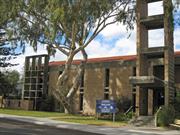
Cnr Viking & Alexander Rds Dalkeith
Nedlands
Metropolitan
Constructed from 1957
| Type | Status | Date | Documents |
|---|---|---|---|
| Heritage List | Adopted | 19 Dec 2017 | |
| State Register | Registered | 09 May 1997 | HCWebsite.Listing+ListingDocument, HCWebsite.Listing+ListingDocument |
| Type | Status | Date | Documents |
|---|---|---|---|
| (no listings) |
| Type | Status | Date | Grading/Management | |
|---|---|---|---|---|
| Category | ||||
| Municipal Inventory | Adopted | 23 Oct 2018 | Category A | |
| Municipal Inventory | Adopted | 27 Apr 1999 | Category A | |
| Anglican Church Inventory | YES | 31 Jul 1996 | ||
| Municipal Inventory | Adopted | 15 Apr 1999 | ||
| Register of the National Estate | Indicative Place | |||
| Survey of 20th Ctry Architecture | Completed | 01 Mar 1988 | ||
Very Good
| Name | Type | Year From | Year To |
|---|---|---|---|
| Anthony Solarski, Polish architect in the firm, Hawkins and Sands | Architect | - | - |
| Library Id | Title | Medium | Year Of Publication |
|---|
Individual Building or Group
| Epoch | General | Specific |
|---|---|---|
| Original Use | RELIGIOUS | Church, Cathedral or Chapel |
| Present Use | RELIGIOUS | Church, Cathedral or Chapel |
| Present Use | RELIGIOUS | Housing or Quarters |
| Original Use | RELIGIOUS | Housing or Quarters |
| Style |
|---|
| Post-War Ecclesiastical |
| Type | General | Specific |
|---|---|---|
| Other | STONE | Granite |
| Wall | BRICK | Common Brick |
| Wall | RENDER | Roughcast |
| Roof | TILE | Cement Tile |
| General | Specific |
|---|---|
| SOCIAL & CIVIC ACTIVITIES | Religion |
| DEMOGRAPHIC SETTLEMENT & MOBILITY | Land allocation & subdivision |
This information is provided voluntarily as a public service. The information provided is made available in good faith and is derived from sources believed to be reliable and accurate. However, the information is provided solely on the basis that readers will be responsible for making their own assessment of the matters discussed herein and are advised to verify all relevant representations, statements and information.
St Lawrence's Anglican Church has strong significant aesthetic. historic and social cultural heritage value. In co-operation with the Vestry. the building committee and the Rector. the architects designed a building of high aesthetic standards. The Church displays the elements necessary both internally and externally to qualify as a fine piece of architectural composition - proportion. form. harmony. rhythm, unity and scale. Designed by Polish architect Anthony Solarski. St Lawrence's demonstrates the Modernist influence of postwar immigrant architects on architecture in Western Australia in the 1950s and 60s. Responding to contemporary issues the architect designed this building to be a neutral backdrop to ensure the congregation focused on the colour and movement of the liturgical presentation. The use of 'negative detailing' at the junction of materials throughout. was innovative in Western Australian architecture in this period. The building is a clear enunciation of the designer's philosophical objectives and demonstrates solutions to problems such as sun control, lines of vision and relationship between the celebrant and the congregation. All of it is executed in an innovative contemporary style that acknowledges traditional church design. The building reflects a high standard of design accomplishment with refinement of detail, such that the solution of complicated problems, appears almost as an over-simplification. The scale and harmonious treatment of the exterior form of the building ensure it melds into the residential nature of the environs and the adjoining open space. St Lawrence's is highly valued by the Dalkeith Parish in reflecting the needs of a new liturgical approach following World War II. The building represents the culmination of the efforts of the founding Vestry of the new Parish.
St Lawrence's Anglican Church is located on the southern side of Viking Road among the Inter-War residential development of Dalkeith. The church site occupies two standard suburban lots, and contains the Church, the Rectory and a Church Hall, called the Blain Room. The Rectory was designed by Hawkins and Sands. The Church, built contemporaneously with the Rectory, was designed by Anthony Solarski and built by Sloan Constructions in 1957. Sympathetic use of building materials ensures visual harmony and unity of the buildings on the site. An important design doctrine adopted by Solarski was what is called negative detailing whereby junctions between materials were treated by forming a grooved recess at the joint rather than the accepted method of covering the junction with a moulding. Solarski also adopted specific and conscious methods for the control of insolation, most evident on the north and west wall of the building. Further, the low roof pitch, the massing of the components and the flat internal ceilings are a fundamental rejection of the Gothic pointed arch as an ecclesiastical idiom in favour of the Mediterranean Romanesque. Accordingly, the building is an innovative post war example of the co-ordinated amalgamation of form and function. The exterior was restricted to three basic. yet harmonious materials - beige face brickwork, rendered and rough cast concrete details and traditional Mediterranean orange terracotta cordova roof tiles. The roof is a saddle back type of low pitch. the rough cast perimeter beam raking to form the gable barges. The masonry surfaces have been treated as sculptural structural panels. The main entrance to the building in the north west corner is surmounted by the Bell Tower with a cantilevered rough cast concrete canopy. The brick and concrete Tower (fitted with loud speakers) is capped with a semi-circular rough cast finished precast concrete slab and flat slabs at intermediate levels. A pattern of textured brickwork in the Tower has been provided by offsetting groups of bricks. The building was an important design development in Perth as an influential forerunner in the evolution of the Late Twentieth-Century Perth Regional 1960 style. It has been maintained to a reasonable standard since constrnction and is in sound condition. Some defects have become apparent including fretting mortar in the lower courses of brickwork and degradation of some areas of concrete. possibly due to insufficient cover of the reinforcement. Members of the congregation of St Lawrence's will. in aLI likelihood. press for the building fabric to be altered from time to time. not only to accommodate new forms of liturgical expression. but also to accommodate memorabilia and largess. Changes in the fabric include the replacement of the original cross, installation of a carpet run in the aisle of the Nave. the predominantly blue leadlight glazing and the gate to the Choir Gallery. These changes are reversible or are not seen as overly intrusive. Otherwise. the designer's original intentions arc intact and the place retains a high degree of integrity.
The Parish of Dalkeith evolved from the Parish of East Claremont in May 1955. The former Rector of East Claremont, Reverend A F J Blain, was appointed and took services in a house on the south west corner of the intersection of Waratah Avenue and Adelma Road, some distance from the present site. The new Vestry, which included Mr Charles Court (later to be Premier of WA), Mr Lloyd Fethers, Mr Oliver Hynes and Mr Reg North, soon decided to demolish the old house and build a new hall on the site. The design and construction of the Rectory in Alexander Road was commenced by 1956, followed by the commissioning of the design and later, the construction of the church. The foundation stone was laid by the Governor, Sir Charles Gairdner, on 28 April 1957 and the building was consecrated on 15 September of the same year. The project was partially funded from loans which eventually became burdensome for the Parish. In 1968 the hall was sold to the Bridge Club and a new hall, called the Blain Room, was built adjoining the church in Alexander Road. Reverend Blain served as Rector until 30 June 1967, handing over to the Reverend John Cook who continued for the next eight years. In October 1975, Bishop Denis Bryant commenced a tenure of ten years to be succeeded by the Reverend Barry May between October 1989 and September 1992, and the Reverend Peter Ferguson from February 1993. In 1962 the St Lawrence Church Tower was used to enhance the television coverage of the Empire Games. Fixed high in the tower was a beam bender, part of Channel 7's equipment for a direct telecast of the Lawn Bowls events at Dalkeith. Channel 7 engineers found they could not beam signals direct from the Dalkeith Bowling Club to the Tuart Hill Studio for transmission - St Lawrence's Tower saved the day.
| Name | Type | Year From | Year To |
|---|---|---|---|
| Anthony Solarski | Architect | - | - |
| Ref Number | Description |
|---|---|
| D32 | LGA Place No |
| Reserve | Lot/Location | Plan/Diagram | Vol/Folio |
|---|---|---|---|
| Lot476 Loc477/478 | Plan 3395 | 649/140 |
| Owner | Category |
|---|---|
| The Perth Diocesan Trustees | Church Property |
This information is provided voluntarily as a public service. The information provided is made available in good faith and is derived from sources believed to be reliable and accurate. However, the information is provided solely on the basis that readers will be responsible for making their own assessment of the matters discussed herein and are advised to verify all relevant representations, statements and information.
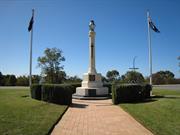
Cnr Waratah Av & Birdwood Pde Dalkeith
Dalkeith War Memorial
Waratah Avenue War Memorial
Nedlands
Metropolitan
Constructed from 1940
| Type | Status | Date | Documents |
|---|---|---|---|
| Heritage List | Adopted | 19 Dec 2017 | |
| State Register | Registered | 08 May 2007 | HCWebsite.Listing+ListingDocument, HCWebsite.Listing+ListingDocument |
| Type | Status | Date | Documents |
|---|---|---|---|
| (no listings) |
| Type | Status | Date | Grading/Management | |
|---|---|---|---|---|
| Category | ||||
| Municipal Inventory | Adopted | 27 Apr 1999 | Category B | |
| Municipal Inventory | Adopted | 23 Oct 2018 | Category B | |
| Statewide War Memorial Survey | Completed | 01 May 1996 | ||
| Art Deco Significant Bldg Survey | Completed | 30 Jun 1994 | ||
| Municipal Inventory | Adopted | 15 Apr 1999 | ||
Good
| Library Id | Title | Medium | Year Of Publication |
|---|---|---|---|
| 7487 | Nedlands War Memorial, Waratah Avenue and Birdwood Parade, Nedlands : conservation plan. | Heritage Study {Cons'n Plan} | 1997 |
| 7453 | A guide to historical military sites in the City of Nedlands. | Brochure | 2005 |
Other Built Type
| Epoch | General | Specific |
|---|---|---|
| Present Use | MONUMENT\CEMETERY | Monument |
| Original Use | MONUMENT\CEMETERY | Monument |
| Style |
|---|
| Inter-War Art Deco |
| Type | General | Specific |
|---|---|---|
| Other | METAL | Other Metal |
| Other | STONE | Donnybrook Sandstone |
| Other | GLASS | Glass |
| General | Specific |
|---|---|
| OUTSIDE INFLUENCES | World Wars & other wars |
This information is provided voluntarily as a public service. The information provided is made available in good faith and is derived from sources believed to be reliable and accurate. However, the information is provided solely on the basis that readers will be responsible for making their own assessment of the matters discussed herein and are advised to verify all relevant representations, statements and information.
Constructed from 1940
The Nedlands War Memorial has aesthetic, historic, social and rarity cultural heritage significance. Erected in 1940, it is a constant reminder to the City of Nedlands people of Australia's contribution to war. For over 50 years it has been the focal point of many Anzac Services held by the Nedlands Sub-Branch of the R S L. Its prominent position on a junction of major streets in Dalkeith reflects the importance the community places on the memorial. It is believed to be the only commemorative light standard war memorial inWestern Australia.
The War Memorial is located at a major junction of streets on Waratah Avenue and Birdwood Parade. It is in a commanding position dominating its small grassed block. as no trees have been grown so it can be clearly viewed from all sides. The Donnybrook stone memorial stands approximately 5 metres tall topped by a light. It is in between two flagpoles flying the WestAustralian and Australian flags.
The Nedlands War Memorial in Birdwood Parade was constructed in 1940 to 'perpetuate in our district the memory of the Fallen'. Negotiations between the Sub Branch of the R S L and the Nedlands Road Board led to the choice of the site and agreements on the outlaywhich appears to be approximately £113. The treasurer of the Ncdlands Sub Branch of the R S L. Alfred Dent submitted a drawing that was approved by the Road Board and work commenced in March 1940. construction was completed by Mr H Wales from the R S L. The Memorial was finished in time for An711cDay 1940when a dedication ceremony took place. A report fromthc The Wcst Australian reveals that approximately 300 to 400 people attended the unveiling ceremony. The bronzed plaque was unveiled by Mr W C Brown (ex-chairman of the Nedlands Road Board). Cast metal plaques are mounted on the memorial. These are dedicated to the memory of those who died in World War II. Korea. Malaya. Borneo and Vietnam. During the 1990s there have been proposals put forward to combine two memorials of the City of Nedlands - the Ncdlands War Memorial and the Peace Memorial Rose Garden. There was a plan to decommission the light standard memorial and erect a new memorial in the Rose Garden, this did not proceed. Each Anzac Day morning a service and wreath laying ceremony is held at the Memorial which is attended by local parliamentarians and civic dignitaries as well as members of the public. This tradition continues today (1998). The Dawson family. who live opposite the War Memorial. have for two generations raised and lowered the flags that flank the memorial. They have performed this dedicated community service seven days a week, morning and night for many years.
Very High
Very Good
| Ref Number | Description |
|---|---|
| D37 | LGA Place No |
| Owner | Category |
|---|---|
| City of Nedlands | Local Gov't |
This information is provided voluntarily as a public service. The information provided is made available in good faith and is derived from sources believed to be reliable and accurate. However, the information is provided solely on the basis that readers will be responsible for making their own assessment of the matters discussed herein and are advised to verify all relevant representations, statements and information.
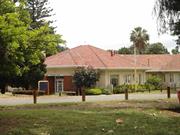
Brockway Rd Mt Claremont
bounded by Brockway Rd, Camelia Ave, Mooro Dve and John XXIII Ave Comprises: Fortescue House (X Blk), fmr ward blocks, orig Rotunda & gardens, Pastoral Centre, Anderson Hall & Kitchen, (Riverton)Gascoyne House together with numerous other bldgs, set in park like landscape. Ashburton, Volunteers & Drysdale Houses are inc in curtilage but are of little cultural heritage sig. Ord, Macdonald, Moor, Shaw, King, De Grey, Kalgan, Forrest, Collie, Mitchell, Fitzroy & Murchison Houses, Frankland Centre, Health Dept Pest Control & Engineering & stores Bldgs are NOT inc in curtilage.
Claremont Hospital for the Insane
Swanbourne Hospital
Nedlands
Metropolitan
Constructed from 1910 to 1991
| Type | Status | Date | Documents |
|---|---|---|---|
| Heritage List | Adopted | 19 Dec 2017 | |
| State Register | Registered | 20 Sep 2002 | HCWebsite.Listing+ListingDocument, HCWebsite.Listing+ListingDocument |
| Type | Status | Date | Documents |
|---|---|---|---|
| (no listings) |
| Type | Status | Date | Grading/Management | |
|---|---|---|---|---|
| Category | ||||
| Municipal Inventory | Adopted | 15 Apr 1999 | ||
| Municipal Inventory | Adopted | 27 Apr 1999 | Category B | |
| Municipal Inventory | Adopted | 23 Oct 2018 | Category B | |
Good
| Name | Type | Year From | Year To |
|---|---|---|---|
| A. E. Clare, Gascoyne House | Architect | - | - |
| Oldham Boas & Ednie-Brown, 1991 Frankland Centre | Architect | - | - |
| Hillson Beasley | Architect | - | - |
| William Hardwick | Architect | - | - |
| Charles Oldham, Harold Boas & Ednie-Brown, 1991 Ashburton Hse | Architect | - | - |
| Public Works Department Architects | Architect | - | - |
| Library Id | Title | Medium | Year Of Publication |
|---|---|---|---|
| 3024 | Historical traces. | Serial | 1997 |
| 12318 | Graylands Hospital Mount Claremont - heritage assesment | Heritage Study {Other} | 2000 |
Individual Building or Group
| Epoch | General | Specific |
|---|---|---|
| Original Use | HEALTH | Asylum |
| Present Use | HEALTH | Asylum |
| Other Use | HEALTH | Hospital |
| Style |
|---|
| Inter-War Functionalist |
| Federation Free Style |
| Type | General | Specific |
|---|---|---|
| Roof | TILE | Terracotta Tile |
| Wall | BRICK | Painted Brick |
| Wall | RENDER | Smooth |
| Other | TIMBER | Tongue & Groove |
| Wall | METAL | Other Metal |
| Wall | BRICK | Face Brick |
| General | Specific |
|---|---|
| OUTSIDE INFLUENCES | World Wars & other wars |
| SOCIAL & CIVIC ACTIVITIES | Community services & utilities |
| SOCIAL & CIVIC ACTIVITIES | Institutions |
This information is provided voluntarily as a public service. The information provided is made available in good faith and is derived from sources believed to be reliable and accurate. However, the information is provided solely on the basis that readers will be responsible for making their own assessment of the matters discussed herein and are advised to verify all relevant representations, statements and information.
Constructed from 1908
Graylands Hospital has significant aesthetic, historic, social and representative cultural heritage value in its original buildings. The Hospital exhibits aesthetic characteristics consistent with Pre World War I public architecture in Western Australia. It is representative of the approach to mental health and its many changes since it was first built in c1908. Graylands Hospital exhibits important social heritage value as it has proYided approximately 90 years of continual service to Mental Health in Western Australia.
There are various buildings on the Graylands site which is a large area facing onto Brockway Road. The main building is Fortescue House. It is a 1:\vo storey brick and tile building with horizontal rendered string courses, painted white. The building has tall brick chimneys with mouldings around the top and stucco rendering for approximately six courses. These are capped with 1:\:vo chimney pots per chimney. The windows are timber vertical sash, nine panes per sash. The entry doors are a pair of timber doors with similar side panels, 24 panes each. The building is divided into wings. The wings are symmetrical with a gable in the centre with timber projecting corbelling and timber detailing, with small louvres at the apex. At either end there are similar gables. The next unit is at an angle. The adjacent one has a corner joining block with the same detailing, but with smaller windows and a lower roof line. Other buildings on the site are from a variety of periods - 1960s with low long flat -roof buildings, and 1970s and 1980s workshops, garages and other medical units in brick and metal deck. A large portion of the site is grassed scattered with trees (Eucalyptus and firs) with red brick paths, two metres wide, connecting the carpark areas to the central building. There are smaller buildings of similar brick and tile design (1940s/1950s) and plant and storage areas serving the main hospital.
Graylands Hospital is part of the hospital fonnerly known as Claremont Hospital. In September 1972, Claremont was split into two hospitals. each named after the then adjoining suburbs: Swanbourne and Graylands. Coincidentally, all of the suburb of Graylands as well as the adjoining portion of suburban Swanbourne becnme Mount Claremont in the ea rly 1990s. Hence Graylands Hospital is now also in Mount Claremont. Swanbourne Hospital accommodated patients with mental deficiency and organic brain syndrome (dementia). Eventually these patients were moved to new. custom-built facilities around the metropolitan area and the old Swanbourne wards were demolished. Six of the former Swanbonrne Hospital buildings remain "up on the hill". The Administrative building can be seen from Brockway Road and John 23rd Drive while the imposing Montgomery Hall can be seen from Montgomery Drive and Rochdale Road. The other four buildings do not have such wide visibility. The "Head Mnlc Nurse's Corridor" building and the "Matron's Corridor" building form a quadrangle with the long-time Stores building. but the quadrangle is almost filled by the main Kitchens building. The Stores building was the very first building completed on the site. Work commenced in late 1901 with a party of about 20 inmates from the Fremantle Asylum who camped on the site tor many months and built the first building under supervision of asylum warders and trades foremen. This building was the first ward before it e\'entually became the Stores building. This building is joined by a covered way (under which the internnl roadwny passed) to the rear of the Administration building. Montgomery Hall was a multi-function building - it was a huge dining hall for many people per sitting. but also a venue for dances. concerts. plays, lilms and other entertainments. with indoor sports and meetings. Il is in fact (since the early 1970s) the largest proscenium arch theatre in Perth. Graylands Hospital wards remain, as the state's major psychiatric hospital. There are a number of buildings on the campus with an interesting history. Buildings known as "X-Block" were commenced in 1908 to relieve "congestion on the male side in the main block" in the Claremont Hospital half a mile away on the hill. The complex consisted of three identical double storey buildings and a fourth building which was only half finished. They had their own main kitchen building and dining hall (Anderson Hall) and were built "as plainly and cheaply as possible". (Anderson Hall had the same multi-function uses as Montgomery Hall). There was also a warden's cottage. The original buildings of Claremont Hospital had been built in the traditionnl Victorian asylum style, with the trademark tower. It is believed that the new wards were designed to be a depnrture from this as the plnn was to have a circle of buildings ('wards) with services in the centre. However. this was only partinlly achieved at the time -and has never been completed. 150 patients were housed in these wnrds. many of them working on the fann. 65 cows provided hospitals in Perth and Fremantlc with milk - and descendants of this herd. now at Whitby Falls Hostel in Mundijong. are still winning prizes nt the Roynl Show. Patient numbers in the X-Block wnrds rose to 260 in the 1950s but as lounge rooms (and Inter dining rooms) had been crcntcd nt the expense of some dormitories. the remaining dormitories were excessively crowded. These preYiously stnnd-nlone buildings were joined with the addition of nblution areas but were still totally separate entities. despite abutting. X-Block wards were refurbished in 1967. Three were named after Perth suburbs (as were all other wards in Claremont Hospital): Palmyra. Osborne and Nedlands.. Patient numbers were reduced to around 90, but sleeping accommodation was still in dormitories. Th'~ half-sized ward became the Occupational Therapy Department. Patients were still segregated by gender, with separate wards for males and females. X-Block buildings were redeveloped in 1987-90. The cottage was demolished and replaced with a large building housing a new Kiosk and OT Department. The wards were e:-.iended and internal spaces reallocated. Dormitories were divided into two-bed rooms and offices were provided for clinical staff of the treating teams. What had been five separate buildings finally became an integrated complex with internal linkways on both the ground and first Doors. Conforming to a hospital-wide change. the building was renamed Fortescue House and the wards within were named Plaistowe. Hutchison and Langley. The former OT Department became the mother and baby unit and was named Cullity. Anderson Hall, used for functions, remains. The old X-Biock kitchen building has been redeveloped and houses the Patient's Library, the Chaplaincy Service and the Chapel. A new kitchen at the rear of Anderson Hall had been provided earlier. In the 1940s a new ward was built which was taken over by the Army as Military Hospital No 5, Davies Road Claremont, until the end of the war. It later housed the Gray lands Day Hospital for a number of years (about 1959-65). This was a separate hospital located in th•e grounds of Claremont. In 1967 it was re-named Riverton House and in 1972, with the separation of Claremont into two hospitals, it housed the administration offices of the new Gray lands Hospital as well as an in-patient ward. In 1965 the Day Hospital was relocated to the nearby Selby complex which was p1urpose built for this function. In 1988 Riverton was re-named Gascoyne House and now it is no longer a ward, being the location of the Postgraduate Centre, the StafT Development Unit, the Centre for Clinical Research in Neuropsychiatry and the Psychiatric Services Library. In 1967 two "temporary buildings" were erected to cater for increasing numbers of patients. They were called Tuart and Swanbourne (later changed to Shenton when Swanbourne Hospital was created). Now known as Moore and Shaw. only one is a ward. the other houses non-clinical departments and the Mental Health Museum of W A In 1975 CreatiYe Expression was opened. An art therapy unit, it had existed since 1968 initially located in the old d<liry. but eventually moved into its own custom-designed building. The architecture was modern and not at all sympathetic to the surrounding historic buildings. In 1981 Wembley A and B were opened as security wards to take the place of the security wards in the Claremont/Swanbourne complex. The complex is now known as Ashburton and the wards within are Smith, Montgomery and Smith Acute. Again the architecture was modern - although different from Creative Expression. Several wards were built on the Graylands campus in the late 1980s to replace those which had been situated on land sold in 1985 for the building of John XXIII College. As well as a cricket ground/football oval complete with grandstand. many buildings were lost including one originally known as "J Block" which was a children's ward - it later became the Mental Health Services School of Nursing. Also lost was Manning WCird - replaced by the current Murchison. now the only long-stay rehabilitation ward at Gray lands. Hospital WCird Clnd the Admissions/ Assessment Ward Cl lso needed to be replaced, and can now be found in Fitzroy House. The Frankland Centre was opened at the end of 1994 amidst much public outmge at the siting of a maximum security unit in the middle of what had over the years become a very affluent near-city suburb. The wards are named Acacia. Banksia and Caesia. Fitzroy House and the Frankland Centre were both designed with architectural features which reflect the historic buildi ngs: nearby. Patient numbers in Graylands Hospital have been reduce:d steadily oyer the years and currently stand at 250. Hospital buildings are named after Western Australian rivers, and wards within them are named after people with an historical connection to Mental Health Services in W A. FORTESCUE Langley Hutchison Plaistowe Cullity ASHBURTON Smith Montgomery Other buildings not already mentioned here are also named after rivers: ORD, MOORE, DE GREY, KALGAN, FORREST, COLLIE and MITCHELL.
Good
Good
| Ref Number | Description |
|---|---|
| MC4 | LGA Place No |
| Owner | Category |
|---|---|
| Graylands Hospital | Other Private |
This information is provided voluntarily as a public service. The information provided is made available in good faith and is derived from sources believed to be reliable and accurate. However, the information is provided solely on the basis that readers will be responsible for making their own assessment of the matters discussed herein and are advised to verify all relevant representations, statements and information.
Heritage L Mt Claremont
Located at the end of Heritage Lane REGISTERED AS PART OF 3228
Swanbourne Hospital (fmr)
Nedlands
Metropolitan
Constructed from 1903 to 1910
| Type | Status | Date | Documents |
|---|---|---|---|
| Heritage List | Adopted | 19 Dec 2017 |
| Type | Status | Date | Documents |
|---|---|---|---|
| (no listings) |
| Type | Status | Date | Grading/Management | |
|---|---|---|---|---|
| Category | ||||
| Classified by the National Trust | Classified | 09 May 1983 | ||
| Register of the National Estate | Nominated | 02 Nov 1983 | ||
| Municipal Inventory | Adopted | 15 Apr 1999 | ||
| Register of the National Estate | Indicative Place | |||
| Municipal Inventory | Adopted | 27 Apr 1999 | Category A | |
| Municipal Inventory | Adopted | 23 Oct 2018 | Category A | |
03228 Swanbourne Hospital Conservation Area
Fair
| Name | Type | Year From | Year To |
|---|---|---|---|
| JH Grainger & Hillson Beasley | Architect | - | - |
| Library Id | Title | Medium | Year Of Publication |
|---|---|---|---|
| 7571 | Swanbourne hospital conservation area, Heritage Lane Mount Claremont WA : conservation plan. | Heritage Study {Cons'n Plan} | 2005 |
| 7522 | Swanbourne hospital conservation area, Heritage Lane Mount Claremont WA : conservation plan (draft). | Heritage Study {Cons'n Plan} | 2005 |
Individual Building or Group
| Epoch | General | Specific |
|---|---|---|
| Present Use | HEALTH | Office or Administration Bldg |
| Original Use | HEALTH | Office or Administration Bldg |
| Type | General | Specific |
|---|---|---|
| Wall | BRICK | Common Brick |
| Wall | STONE | Limestone |
| General | Specific |
|---|---|
| SOCIAL & CIVIC ACTIVITIES | Community services & utilities |
This information is provided voluntarily as a public service. The information provided is made available in good faith and is derived from sources believed to be reliable and accurate. However, the information is provided solely on the basis that readers will be responsible for making their own assessment of the matters discussed herein and are advised to verify all relevant representations, statements and information.
Constructed from 1903 to 1910
The remaining buildings at Swanboume Hospital have significant aesthetic, historic, social, scientific and rarity cultural heritage value. They are of intrinsic aesthetic merit and important to the architectural history of the State and the immediate locality. The Swanboume Hospital complex provides important evidence of tum of the century gold boom public architecture by architects J H Grainger and Hillson Beasley. These two men were prominent Chief Architects of the Public Works Department. The hospital is also directly linked to Dr S Montgomery. an eminent figure described as the father of mental health services in Western Austrnlin. Together with the Fremantle Asylum. Swanbourne forms the essential history of mental health buildings in this state for o,·er 100 years. When designed and constntcted the buildings represented the highest level of 'modern principles of asylum construction' and engendered nn acceptance within the wider community for the treatment of mental health. The hospital represents the change in approach to mental health from a form of incarceration with little hope of cure. to one of expert treatment with cure as the goal.
The Conservation area contains the remaining five buildings of the former Swanbourne Hospital: the Administration Building. Stores Building. Male Attendants and Nurses Quarters Building. Kitchen and the Dining and Recreation Hall Building (Montgomery Hall). The Administration Building is two storey with a brick and limestone external leaf. a Donnybrook stone portico to the central gable roof entrance and with faceted. hipped roof bays to either end. At each end there are flat roofed small wings with stone embattlements. The Stores Building is constntcted of limestone and brick. The roof consists of queen post trusses supporting a comtgated iron roof with a timber tongue and groove ceiling. The building is in original condition with what appears to be original colour schemes still intact. The Male Attendants and Nurses Quarters Buildings are similarly designed brick and stone two storey buildings mnning cast-west and enclosing the kitchen and courtyard formed by the Stores Buildi ng and the Hall. The two major rooms of the kitchen building consist of a kitchen and scullery. These are rectangular, high ceiling rooms with queen post trusses. continuous roof lanterns and clerestory windows. Both rooms are of exceptional architectural qua lity. The Dining and Recreational Hall (Montgomery Hall) is a large brick and limestone structure with a clay tile roof. which was used as a dining and recreation hall as well as a centre where visitors could combine with patients in social activities. The hall has a large free span roof with decorative plaster ceilings. a sprung timber floor and a large sloping stage. The buildings are sited on 2.43 hectares of land. The buildings are structurally sound but have suffered considerable damage to finishes. glazing. doors. skirtings, architraves. sta irs and mechanical and electrical services. Most of the damage is the result of theft and vanda lism since 1987 when the buildings were vacated. Enough remains of the items mentioned to allow duplication.
The few remaining buildings of the Swanbourne Hospital at one time formed the core of a much larger complex. Of the original 160 hectares of buildings and grounds set aside for the Hospital, those that have survived are the Administration, Stores, Covered Arcade, Male Att~ndants and Nurses Quarters, Kitchens and Montgomery Hall. Their close proximity and common original use make them a precinct that demands careful consideration for the future. Montgomery Hall and the Administration Building have been classified by the National Trust. When first built, Claremont Hospital for the Insane represented the latest architectural planning for the treatment of the mentally ill for large open sites. The scale and faci lities provided were a huge advance over the previous asylum at Fremantle, and were indicative of a State undergoing a gold-driven economic boom. The hospital was like a self-contained town with its own power and water, farm, orchard, playing fields, housing and administrative centre. In 190 l DrS Montgomery was appointed Superintendent of the Fremantle Lunatic Asylum. Montgomery, who can be considered the father of modern mental health in W A, was intimately involved in the design of the Hospital complex, and the principal architect Grainger, and his successor Beasley, were important figures in the history of Western Australian architecture. Construction commenced in 1903 and by August that year temporary buildings had been erected to house 20 patients. The asylum complex was completed by 1910 and provided accommodation for 678 patients and associated staff. The hospital continued to provide an important mental health service for many years under the Claremont Hospital banner. In 1972, after expanding over a large area, the hospital was divided and renamed according to their locality. Hence Swanbourne and Gray lands Mental Hospitals developed their own autonomy. In 1984 Swanbourne Hospital patients began to be relocated either to community orientated accommodation or Graylands Hospital. The hospital closed in 1987. The land was subdivided with low density zoning for residential use. The Director of Mental Health's residence, the Administration building and Montgomery Hall, along with a few minor buildings, were retained for their heritage value. Administration problems have arisen with the remaining Swanbourne Hospital buildings. Conservation costs are high and much of the complex stands unoccupied. The Government is currently considering its options for the future use of the property. For further information see Place Record Form: Mount Claremont Locality: Graylands Hospital
Very good
Fair
| Name | Type | Year From | Year To |
|---|---|---|---|
| J H Grainger & Hillson Beasley | Architect | - | - |
| Ref Number | Description |
|---|---|
| MC3 | LGA Place No |
| Owner | Category |
|---|---|
| Government Property Office | State Gov't |
This information is provided voluntarily as a public service. The information provided is made available in good faith and is derived from sources believed to be reliable and accurate. However, the information is provided solely on the basis that readers will be responsible for making their own assessment of the matters discussed herein and are advised to verify all relevant representations, statements and information.
St Johns Wood Bvd Mt Claremont
REGISTERED AS PART OF 3228
Nedlands
Metropolitan
Constructed from 1910
| Type | Status | Date | Documents |
|---|---|---|---|
| (no listings) |
| Type | Status | Date | Documents |
|---|---|---|---|
| (no listings) |
| Type | Status | Date | Grading/Management | |
|---|---|---|---|---|
| Category | ||||
| Register of the National Estate | Indicative Place | |||
| Classified by the National Trust | Classified | 09 May 1983 | ||
| Register of the National Estate | Nominated | 02 Nov 1983 | ||
03228 Swanbourne Hospital Conservation Area
The house is of brick with a tiled roof and verandahs on three sides. It was completed in 1910 and built by the Public Works Department to the design of chief architect, J H Grainger. The stables at the rear had a hay loft and after this building became the garage the loft was adapted to serve as a bedroom for the chauffeur. The buildings are surrounded by spacious, well kept gardens and there is a landscaped approach road.
| Name | Type | Year From | Year To |
|---|---|---|---|
| John Grainger PWD | Architect | - | - |
| Library Id | Title | Medium | Year Of Publication |
|---|---|---|---|
| 7571 | Swanbourne hospital conservation area, Heritage Lane Mount Claremont WA : conservation plan. | Heritage Study {Cons'n Plan} | 2005 |
| 7522 | Swanbourne hospital conservation area, Heritage Lane Mount Claremont WA : conservation plan (draft). | Heritage Study {Cons'n Plan} | 2005 |
Individual Building or Group
| Epoch | General | Specific |
|---|---|---|
| Present Use | RESIDENTIAL | Single storey residence |
| Original Use | RESIDENTIAL | Single storey residence |
| Type | General | Specific |
|---|---|---|
| Wall | BRICK | Common Brick |
| Roof | TILE | Terracotta Tile |
This information is provided voluntarily as a public service. The information provided is made available in good faith and is derived from sources believed to be reliable and accurate. However, the information is provided solely on the basis that readers will be responsible for making their own assessment of the matters discussed herein and are advised to verify all relevant representations, statements and information.
St Johns Wood Bvd Mt Claremont
REGISTERED AS PART OF 3228
Nedlands
Metropolitan
Constructed from 1905
| Type | Status | Date | Documents |
|---|---|---|---|
| (no listings) |
| Type | Status | Date | Documents |
|---|---|---|---|
| (no listings) |
| Type | Status | Date | Grading/Management | |
|---|---|---|---|---|
| Category | ||||
| Register of the National Estate | Registered | 27 Oct 1998 | ||
| Classified by the National Trust | Classified | 09 May 1983 | ||
03228 Swanbourne Hospital Conservation Area
| Library Id | Title | Medium | Year Of Publication |
|---|---|---|---|
| 7571 | Swanbourne hospital conservation area, Heritage Lane Mount Claremont WA : conservation plan. | Heritage Study {Cons'n Plan} | 2005 |
| 7522 | Swanbourne hospital conservation area, Heritage Lane Mount Claremont WA : conservation plan (draft). | Heritage Study {Cons'n Plan} | 2005 |
| 12273 | Montgomery Hall Claremont Hospital - a status report | 1991 |
Individual Building or Group
| Epoch | General | Specific |
|---|---|---|
| Present Use | SOCIAL\RECREATIONAL | Other Community Hall\Centre |
| Original Use | SOCIAL\RECREATIONAL | Other Community Hall\Centre |
| Type | General | Specific |
|---|---|---|
| Wall | STONE | Limestone |
| Wall | BRICK | Common Brick |
This information is provided voluntarily as a public service. The information provided is made available in good faith and is derived from sources believed to be reliable and accurate. However, the information is provided solely on the basis that readers will be responsible for making their own assessment of the matters discussed herein and are advised to verify all relevant representations, statements and information.
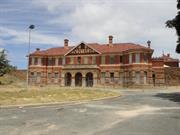
Lot 12040 St Johns Wood Bvd Mt Claremont
Heritage Lane
Nedlands
Metropolitan
Constructed from 1904
| Type | Status | Date | Documents |
|---|---|---|---|
| Heritage Agreement | YES | 16 Mar 2006 | HCWebsite.Listing+ListingDocument |
| Heritage Agreement | YES | 01 Oct 2014 | HCWebsite.Listing+ListingDocument |
| State Register | Registered | 19 Aug 1994 | HCWebsite.Listing+ListingDocument, HCWebsite.Listing+ListingDocument |
| Type | Status | Date | Documents |
|---|---|---|---|
| (no listings) |
| Type | Status | Date | Grading/Management | |
|---|---|---|---|---|
| Category | ||||
| Register of the National Estate | Indicative Place | |||
| Register of the National Estate | Nominated | 02 Nov 1983 | ||
| Classified by the National Trust | Classified | 09 May 1983 | ||
| Municipal Inventory | Adopted | 23 Oct 2018 | Category A | |
| Municipal Inventory | Adopted | 27 Apr 1999 | Category A | |
The Administration Building is two storey with a brick and limestone external leaf, a Donnybrook stone portico to the central gable roof entrance and with faceted, hipped roof bays to either end. At each end there are flat roofed small wings with stone embattlements. The Stores Building is constructed of limestone and brick. The roof consists of queen post trusses supporting a corrugated iron roof with a timber tongue and groove ceiling. The building is in original condition with what appears to be original colour schemes still intact. The Male Attendants and Nurses Quarters Buildings are similarly designed brick and stone two storey buildings running east-west and enclosing the kitchen and courtyard formed by the Stores Building and the Hall. The two major rooms of the kitchen building consist of a kitchen and scullery. These are rectangular, high ceilinged rooms with queen post trusses, continuous roof lanterns and clerestory windows. Both rooms are of exceptional architectural quality. The Dining and Recreation Hall (Montgomery Hall) is a large brick and limestone structure with a clay tile roof, which was used as a dining and recreation hall as well as a centre where visitors could combine with patients in social activities. The hall has a large free span roof with decorative plaster ceilings, a sprung timber floor and a large sloping stage. The buildings are sited on 2.48 hectares of land. Most of the buildings were erected between 1904 and 1912 by the Public Works Department to plans drawn by J H Grainger in consultatioon with Dr S H H Montgomery who had, before leaving England, learnt something of the principles of asylum construction from Mr Hine, architect to the Board of Commissioners and a noted designer of asylums.
| Name | Type | Year From | Year To |
|---|---|---|---|
| Hillson Beasley - after 1905 | Architect | - | - |
| J.H. Grainger, P.W.D. - design of early buildings | Architect | - | - |
| Library Id | Title | Medium | Year Of Publication |
|---|---|---|---|
| 572 | Conservation plan for Swanbourne Hospital, formerly Claremont Hospital for the Insane, Heritage Lane, Mount Claremont WA. | Heritage Study {Cons'n Plan} | 1994 |
| 61 | Claremont Hospital for the Insane: a conservation plan for the remaining buildings. | Heritage Study {Cons'n Plan} | 1992 |
| 6660 | Funding proposal for the restoration of the Swanbourne Hospital buildings : a submission to the Western Ausrtalian Government by the City of Nedlands. | Report | 0 |
| 7522 | Swanbourne hospital conservation area, Heritage Lane Mount Claremont WA : conservation plan (draft). | Heritage Study {Cons'n Plan} | 2005 |
| 7571 | Swanbourne hospital conservation area, Heritage Lane Mount Claremont WA : conservation plan. | Heritage Study {Cons'n Plan} | 2005 |
Individual Building or Group
| Epoch | General | Specific |
|---|---|---|
| Original Use | HEALTH | Asylum |
| Present Use | HEALTH | Hospital |
| Other Use | HEALTH | Office or Administration Bldg |
| Style |
|---|
| Victorian Georgian |
| Type | General | Specific |
|---|---|---|
| Wall | STONE | Limestone |
| Wall | BRICK | Common Brick |
| Wall | STONE | Donnybrook Sandstone |
| General | Specific |
|---|---|
| SOCIAL & CIVIC ACTIVITIES | Community services & utilities |
| OCCUPATIONS | Commercial & service industries |
This information is provided voluntarily as a public service. The information provided is made available in good faith and is derived from sources believed to be reliable and accurate. However, the information is provided solely on the basis that readers will be responsible for making their own assessment of the matters discussed herein and are advised to verify all relevant representations, statements and information.
Constructed from 1903 to 1910
The remaining buildings at Swanboume Hospital have significant aesthetic, historic, social, scientific and rarity cultural heritage value. They are of intrinsic aesthetic merit and important to the architectural history of the State and the immediate locality. The Swanboume Hospital complex provides important evidence of tum of the century gold boom public architecture by architects J H Grainger and Hillson Beasley. These two men were prominent Chief Architects of the Public Works Department. The hospital is also directly linked to Dr S Montgomery. an eminent figure described as the father of mental health services in Western Austrnlin. Together with the Fremantle Asylum. Swanbourne forms the essential history of mental health buildings in this state for o,·er 100 years. When designed and constntcted the buildings represented the highest level of 'modern principles of asylum construction' and engendered nn acceptance within the wider community for the treatment of mental health. The hospital represents the change in approach to mental health from a form of incarceration with little hope of cure. to one of expert treatment with cure as the goal.
The Conservation area contains the remaining five buildings of the former Swanbourne Hospital: the Administration Building. Stores Building. Male Attendants and Nurses Quarters Building. Kitchen and the Dining and Recreation Hall Building (Montgomery Hall). The Administration Building is two storey with a brick and limestone external leaf. a Donnybrook stone portico to the central gable roof entrance and with faceted. hipped roof bays to either end. At each end there are flat roofed small wings with stone embattlements. The Stores Building is constntcted of limestone and brick. The roof consists of queen post trusses supporting a comtgated iron roof with a timber tongue and groove ceiling. The building is in original condition with what appears to be original colour schemes still intact. The Male Attendants and Nurses Quarters Buildings are similarly designed brick and stone two storey buildings mnning cast-west and enclosing the kitchen and courtyard formed by the Stores Buildi ng and the Hall. The two major rooms of the kitchen building consist of a kitchen and scullery. These are rectangular, high ceiling rooms with queen post trusses. continuous roof lanterns and clerestory windows. Both rooms are of exceptional architectural qua lity. The Dining and Recreational Hall (Montgomery Hall) is a large brick and limestone structure with a clay tile roof. which was used as a dining and recreation hall as well as a centre where visitors could combine with patients in social activities. The hall has a large free span roof with decorative plaster ceilings. a sprung timber floor and a large sloping stage. The buildings are sited on 2.43 hectares of land. The buildings are structurally sound but have suffered considerable damage to finishes. glazing. doors. skirtings, architraves. sta irs and mechanical and electrical services. Most of the damage is the result of theft and vanda lism since 1987 when the buildings were vacated. Enough remains of the items mentioned to allow duplication.
The few remaining buildings of the Swanbourne Hospital at one time formed the core of a much larger complex. Of the original 160 hectares of buildings and grounds set aside for the Hospital, those that have survived are the Administration, Stores, Covered Arcade, Male Att~ndants and Nurses Quarters, Kitchens and Montgomery Hall. Their close proximity and common original use make them a precinct that demands careful consideration for the future. Montgomery Hall and the Administration Building have been classified by the National Trust. When first built, Claremont Hospital for the Insane represented the latest architectural planning for the treatment of the mentally ill for large open sites. The scale and faci lities provided were a huge advance over the previous asylum at Fremantle, and were indicative of a State undergoing a gold-driven economic boom. The hospital was like a self-contained town with its own power and water, farm, orchard, playing fields, housing and administrative centre. In 190 l DrS Montgomery was appointed Superintendent of the Fremantle Lunatic Asylum. Montgomery, who can be considered the father of modern mental health in W A, was intimately involved in the design of the Hospital complex, and the principal architect Grainger, and his successor Beasley, were important figures in the history of Western Australian architecture. Construction commenced in 1903 and by August that year temporary buildings had been erected to house 20 patients. The asylum complex was completed by 1910 and provided accommodation for 678 patients and associated staff. The hospital continued to provide an important mental health service for many years under the Claremont Hospital banner. In 1972, after expanding over a large area, the hospital was divided and renamed according to their locality. Hence Swanbourne and Gray lands Mental Hospitals developed their own autonomy. In 1984 Swanbourne Hospital patients began to be relocated either to community orientated accommodation or Graylands Hospital. The hospital closed in 1987. The land was subdivided with low density zoning for residential use. The Director of Mental Health's residence, the Administration building and Montgomery Hall, along with a few minor buildings, were retained for their heritage value. Administration problems have arisen with the remaining Swanbourne Hospital buildings. Conservation costs are high and much of the complex stands unoccupied. The Government is currently considering its options for the future use of the property. For further information see Place Record Form: Mount Claremont Locality: Graylands Hospital
Very Good
Fair
| Name | Type | Year From | Year To |
|---|---|---|---|
| J H Grainger & Hillson Beasley | Architect | - | - |
| Ref Number | Description |
|---|---|
| MC3 | LGA Place No |
| Owner | Category |
|---|---|
| Government Property Office | State Gov't |
This information is provided voluntarily as a public service. The information provided is made available in good faith and is derived from sources believed to be reliable and accurate. However, the information is provided solely on the basis that readers will be responsible for making their own assessment of the matters discussed herein and are advised to verify all relevant representations, statements and information.
The complex is historically and socially important as an institution designed for the care and treatment of the mentally ill about 80 years ago, replacing the Fremantle Asylum which then became an Old Women' s Home (now classified by the Trust as the Fremantle Museum and Art Centre) . It was designed by J.H. Grainger, Chief Architect of the P.W.D., in association with the newly arrived Inspector General for the Insane, Dr. S.H.R. Montgomery. Situated on a hill the in buildings stand out as a landmark in the surrounding area and have a pleasing continuity of style in their construction. The grounds are attractively landscaped , the Norfolk Island pines forming a link with the Cottesloe pines. There are some fine eucalypts in the enclosed gardens of the wards and around the nurses training centre. Although adapted internally to meet the requirements of more recent times the buildings remain as a rare and well maintained example of an institution planned at the beginning of the 20th century . ADMINISTRATION BUILDING SIGNIFICANCE: This building was designed by J H. Grainger, Principal Architect of the P.W.D. and is the centre from which all the other functions of the Hospital radiate and visually it is the centre piece of the crescent lay-out of the complex. It has an impressive facade with the gable over the portico emphasising the central entrance balanced by the two storey bay windows at each end. Within the building is a fine wooden stair case with timber turned balustrade. It has been .in use as the administrative centre since it was first occupied in 1906 and there have been few irreparable changes in the original construction.
The important elements within the Conservation Area are: Administration building and stores, Montgomery Hall {former Dining and Recreation Hall), the crescent shaped series of ten Ward blocks with their enclosed gardens, the Water Tower, Nurses' Quarters and the two old buildings of the Nurses• Training Centre (former Isolation Hospital and Montessori School) with the Norfolk Island pines and old established eucalypts in the grounds . The buildings are of red brick with sandstone foundations, the original slate roofs having been replaced with clay Marseilles tiles. Liberal use was made of rendered string courses and there are decorative turrets and chimneys. There have been no major changes in the exterior of the main buildings, which have been well maintained but the wards have been updated internally over the years and a number of sheds, stores, garages , etc.,(some of a temporary nature) have cluttered the space more recently. These additions are not included in the assessment. Most of the buildin gs were erected between 1904 and 1912 by the Public Works Depart ment to plans drawn by J.H. Grainger in consultation with Dr. S,H.R . Montgomery who had before leaving England learnt something of the principles of asylum construction from Mr. Hine, architect to the Board of Commissioners and a noted designer of asylums. The boundaries of the Conservation Area are shown on the attached plan (A) where the important elements within it are listed. ADMINISTRATION BUILDING: The porch and ground floor of the building are of sandstone with the floor above of brick. The original slate roof has been replaced with clay Marseilles tiles, the typical chimneys of the complex remaining in position. It was completed in 1906.
Assessment 1983 Less than two years after the arrival of Dr. S.H.R. Montgomery to tak e up the new post of Superintending Officer of Asylums (l ater lnspcctor General for the Insane) Reserv e No. 8636 of 394 acres at Claremont was set aside for a new asylum on 27 Feb. 1903. By August 18th of the same year twenty patients were moved into temporary buildings on the site. Prior to this mental patients were accommodated at Whitby Fall s, bought for the purpose in 1896, and the Fremantl e Asylum, now the Fremantle Museum and Art Centre . During his previous post as assistant medical officer in Nottingham Dr Montgomery came in contact with Mr .HineT a noted designer of asylums and architect to the Board of Commissioners and from him he learnt the principles of asylum construction. Shortly after his arrival in W.A. he went with Mr. J.H. Grainger, Principal Architect of the P.W.D.T to the Eastern States to inspect asylums and have discussions with col leagues there. It is clear from the annual report of the P.W.D. for 1904 that by then overal l plans for the whole compl ex, including water supply and drainage, had been drawn up. The completed scheme was to give accommodation for 678 patients and provide for the following buildings: Administration bui ldings, including stores and work shop block, kitchen block, dining and recreation hall, male attendants block, female attendants block, male division with blocks of buil dings for patients in several categories, female divisions with bl ocks for patients in the same categories plus sew ing room and laundry block and miscell aneous buildings and works such as isolation hospital, mortuaryT residence for the Inspector General , roads and approaches, water supply and drainage. The pl anned construction was carried out by 1910 though numerous other buil dings have been added over the years. The foll owing dates with regard to erection of the early buildings have been obtained from the Annual Reports of the Inspector General for the Insane: 1903 Temporary buildings erected to take 20 patients. 1904 - Work shops & stores completed and some portions used for temporary patient accommodation. 1905 - Administration, kitchen, dining and recreation blocks, and blocks for male and female attendants almost completed and machinery and laundry blocks and four or five wards well under way. 1906 - Four more ward blocks started. 1907 - Kitchen completed - temporary kitchen previously in use. 1908 - Two male blocks accommodating 200 patients completed. 1910 - Inspector General's residence completed.
This information is provided voluntarily as a public service. The information provided is made available in good faith and is derived from sources believed to be reliable and accurate. However, the information is provided solely on the basis that readers will be responsible for making their own assessment of the matters discussed herein and are advised to verify all relevant representations, statements and information.
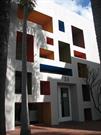
2/31 Broadway Nedlands
Jim Brant Building, Mojo Australia
Watersmart Building
Nedlands
Metropolitan
Constructed from 1964 to 1965
| Type | Status | Date | Documents |
|---|---|---|---|
| Heritage List | Adopted | 19 Dec 2017 | |
| State Register | Registered | 04 May 2012 | HCWebsite.Listing+ListingDocument, HCWebsite.Listing+ListingDocument |
| Type | Status | Date | Documents |
|---|---|---|---|
| (no listings) |
| Type | Status | Date | Grading/Management | |
|---|---|---|---|---|
| Category | ||||
| Municipal Inventory | Adopted | 23 Oct 2018 | Category B | |
| Municipal Inventory | Adopted | 27 Apr 1999 | Category B | |
| Survey of 20th Ctry Architecture | Completed | 01 Mar 1988 | ||
| Register of the National Estate | Indicative Place | |||
| Municipal Inventory | Adopted | 15 Apr 1999 | ||
Excellent
| Name | Type | Year From | Year To |
|---|---|---|---|
| Julius Elischer | Architect | 1964 | 1965 |
| Library Id | Title | Medium | Year Of Publication |
|---|---|---|---|
| 8888 | 33 Broadway, Nedlands. Conservation mangement plan. | Heritage Study {Cons'n Plan} | 2007 |
| 8831 | Heritage assessment for 33 Broadway Nedlands, Western Australia. | Heritage Study {Other} | 2005 |
Individual Building or Group
| Epoch | General | Specific |
|---|---|---|
| Present Use | COMMERCIAL | Office or Administration Bldg |
| Original Use | EDUCATIONAL | Museum |
| Original Use | COMMERCIAL | Shop\Retail Store {single} |
| Style |
|---|
| Late 20th-Century Perth Regional |
| Late 20th-Century Brutalist |
| Type | General | Specific |
|---|---|---|
| Wall | BRICK | Rendered Brick |
| General | Specific |
|---|---|
| SOCIAL & CIVIC ACTIVITIES | Cultural activities |
| OCCUPATIONS | Intellectual activities, arts&craft |
This information is provided voluntarily as a public service. The information provided is made available in good faith and is derived from sources believed to be reliable and accurate. However, the information is provided solely on the basis that readers will be responsible for making their own assessment of the matters discussed herein and are advised to verify all relevant representations, statements and information.
The David Foulkes-Taylor Showroom has aesthetic, historic, social and rarity cultural heritage significance. The design is rare, and except for an intrusive bank building in front of the facade, still maintains its integrity. It is a fine example of a purpose built construction with strong associations with two people, architect, Julius Elischer and artisan/craftsman, David Foulkes-Taylor. According to art circles, David Foulkes-Taylor was very influential in the field of visual arts and interior design. He is said to have 'shown a strong commitment to modernist ideas in the visual and decorative arts, the theatre and in the area of social consciousness'. Foulkes-Taylor died at 36 years of age in 1966 but is still remembered as one of the inspirational leading people in art circles in WA during the 1950s and 60s.
This distinctive building is brick rendered with thick walls and many square, rectangular and irregularly placed windows which provide natural light to the interior. Originally the reveals of each window were painted a different but blending colour. The David Foulkes-Taylor building reflects the input of architect Julius Elischer and the first owner, David Foulkes-Taylor. Elischer described the design of the single volume large building as being influenced by the cubist Le Corbusier (Jean Paul Jeanerette). Inside the old showroom was a mezzanine floor which today has been enclosed with walls to provide office space. The main facade of the building faces north where it is visually obstructed by the construction of the ANZ bank building. According to the architect, though very well constructed and appointed, the showrooms did not cost a lot to build, as he subcontracted all the work directly to tradespeople. Julius Elischer has been described as an architect with a great ability to get a building erected at a low cost with high standards.
The David Foulkes-Taylor Showroom, constructed in the mid 1960s, is important not just for its innovative design by architect Julius Elischer, but also for its association with craftsman-designer, David Foulkes-Taylor. David Foulkes-Taylor was born in Perth in 1929 but was sent east to be educated at Geelong Grammar. After leaving school in 1947 he attended the School of Architecture at Perth Technical School. At the end of a year's study David travelled overseas to study industrial design in England. After travelling for a number of years David returned home and worked in furniture design. More travel and then marriage was experienced before he once more settled in Perth to become very influential in both the visual arts as well as interior furniture design (particularly injarrah). On the event of his death in a car accident in 1966, an obituary in the West Australian revealed that, "he will probably be remembered best for his gift of being a catalyst for new ideas, enthusiasms and ambitions. Many of the ideas that stirred WA 's young artists and sculptors were first expressed at parties held at David Foulkes-Taylor's home in Crawley. Mr Foulkes-Tay/or encouraged young artists by helping them display their own work or accepting it for his own studio {in Broadway) which is said to be unique in Australia." Julius Elischer, the architect who designed the showroom for Foulkes-Taylor has been involved in a number of projects throughout the City of Ned lands including the City of Ned lands Council extensions and Melvista Lodge.
External - Good, Internal - Compromised by changes to the mezzanine space.
Excellent
| Name | Type | Year From | Year To |
|---|---|---|---|
| Julius Elischer | Architect | - | - |
| Ref Number | Description |
|---|---|
| N12 | LGA Place No |
This information is provided voluntarily as a public service. The information provided is made available in good faith and is derived from sources believed to be reliable and accurate. However, the information is provided solely on the basis that readers will be responsible for making their own assessment of the matters discussed herein and are advised to verify all relevant representations, statements and information.
Cnr Bruce St Cnr Gallop Rd Nedlands
Nedlands
Metropolitan
Constructed from 1932 to 1995
| Type | Status | Date | Documents |
|---|---|---|---|
| Heritage List | Adopted | 19 Dec 2017 | |
| State Register | Registered | 17 Sep 2020 | HCWebsite.Listing+ListingDocument, HCWebsite.Listing+ListingDocument |
| Type | Status | Date | Documents |
|---|---|---|---|
| (no listings) |
| Type | Status | Date | Grading/Management | |
|---|---|---|---|---|
| Category | ||||
| Art Deco Significant Bldg Survey | Completed | 30 Jun 1994 | ||
| Classified by the National Trust | Classified | 08 Jun 1998 | ||
| Municipal Inventory | Adopted | 15 Apr 1999 | ||
| Municipal Inventory | Adopted | 27 Apr 1999 | Category B | |
| Municipal Inventory | Adopted | 23 Oct 2018 | Category B | |
18540 Melvista Park
Very Good
| Name | Type | Year From | Year To |
|---|---|---|---|
| N Perkins & H Krantz | Architect | - | - |
| Library Id | Title | Medium | Year Of Publication |
|---|---|---|---|
| 2219 | Nedlands : from campsite to city. | Book | 1984 |
| 9979 | Conservation plan for Nedlands Tennis Club, Nedlands Western Australia | Heritage Study {Cons'n Plan} | 2009 |
Individual Building or Group
| Epoch | General | Specific |
|---|---|---|
| Present Use | SOCIAL\RECREATIONAL | Other Sports Building |
| Original Use | SOCIAL\RECREATIONAL | Other Sports Building |
| Style |
|---|
| Inter-War Functionalist |
| Type | General | Specific |
|---|---|---|
| Wall | CONCRETE | Reinforced Concrete |
| Roof | CONCRETE | Concrete Slab |
| Wall | RENDER | Other Render |
| General | Specific |
|---|---|
| PEOPLE | Famous & infamous people |
| SOCIAL & CIVIC ACTIVITIES | Sport, recreation & entertainment |
This information is provided voluntarily as a public service. The information provided is made available in good faith and is derived from sources believed to be reliable and accurate. However, the information is provided solely on the basis that readers will be responsible for making their own assessment of the matters discussed herein and are advised to verify all relevant representations, statements and information.
This information is provided voluntarily as a public service. The information provided is made available in good faith and is derived from sources believed to be reliable and accurate. However, the information is provided solely on the basis that readers will be responsible for making their own assessment of the matters discussed herein and are advised to verify all relevant representations, statements and information.
The Nedlands Tennis Club has aesthetic. historic and social cultural heritage significance, The Clubhouse contributes 10 the streerscapc of Bruce Street which leads from Birdwood Parade and the Swan River to the south. The open nature of the club and the building as a marker of the presence of the club is significant. II is a fine representative of the Functionalist SI) Ie that '...3.5 one of the new influences in architccrural design in the Inter-War period. It has associations with Harold Krantz. a leading architect, who was also the designer of a number of other projects in Ihe Nedlands district. For oyer 70 years the Ncdlands Tennis Club has provided a base for many sporting and social functions for the local people and has therefore, contributed to a sense of community for the City of Nedlands,
The site is located immediatcly cast of the Nedlands Golf Course. without formal separation. A prominent line of trees forms the eastern rim of the fairways with the open eucalypt-banksia woodland and grassed fairwnys to the west A pmhway extending from Gallop Road passes diagonnlly to a car park to the north west. The approach to the building was Iormcrh via a paved gangway and gardens between tennis courts. on the axis of the building. from Bruce Street to the cast. This gangway is still evident nlthough it is now basically grossed. The forccourt of the building is now grassed and paved. and has a three bay loggia extending across the cast face of the building. Courts extend to within a short distance on the north and south side of Ute main building. A paved courtyard is at the rear of the building. partially enclosed on the west by two steel storage sheds and a bumping waU on the north side of the courryard, The rear and side of the building is seen from Gallop Road and the front from Bruce Street The founding structure of the exterior is executed in Ole Functionalist style dating from the late 1930s. It is likely the building when constructed. replaced a timber and tile roofed structure. The extant building originally had a symmetrical elevation treatment on the east and west with rendered towers on the axis, and the roof slab extended eastwards to form a verandah. The original flat roof was probably intended as a recreation space for club members as it is protected by a raised parapet surmounted by a tubular steel handrail. At the lime of original construction. it is possible that views of the Swan River could have been enjoyed from that level. The parapet conceals the added pitched roof structure from view. Access 10 Ole roof space for the members is no longer available. The lower structure on the west side bears the Ncdlands Tennis Club symbol in raised letters, During the inspection. the material comprising the original masonry could not be determined as all surfaces are rendered nnd painted with a gloss finished paint. The render has joints set out to resemble stretcher bonded blockwork. Many of the openings on the nOM. south and west elevation have projecting hoods An interim addition of a Capulin's room on the len sidc. projects forward 10 give vision over the courts but is under the concrete roof. The original verandah structure has been extended one bay 10 the cast 10 form the previously described loggia which has new piers matching Ole founding structure. The raised verandah has tubular steel handrails. The windows arc a mix of timber fmmed casements and double hung sashes with sash bars giving a horizontal emphasis. The main entrance doors. on Ihe east, lead into the hall which has dropped beams from the Oat slab over. plastered walls with original horizontal orientated ventilators, a limber Iloor and a red tapestry brick dado. Tho Interior is in fair to good condition with a recently installed light, clear finished timber bar filling. A S10re room on the south provides evidence of water damage. Men's change facilities accessed from Ihe verandah on the north have been refurbished.
Nedlands Tennis Club was formed in 1925 with a public meeting at the old Nedlands Picture Theatre (now demolished). The club initiall~' chose a site on the Esplanade and four courts were buill. However. maintenance was difficult owing to the close proximity of the river which made the site very windy. In 1930's when Mclvisa Park Reserve became available for development as a sports reserve, members chose to move the tennis club. The new courts were first used in 1932. The initial club house was a shelter mode from bush boughs. In 1938 n new dub house was opened b~'Governor Sir James Mitchell. The pavilion was built by Mr H Schofield. using the plans of architects. Neil Perkins and Harold Krantz, Both were members of Nedlands Tennis Club. Harold Krantz' approach 10 architecture was functionalist. His work. was characterised by stark, clean lines and a total lack of omamentntion. He also placed high emphasis on efficiency and value for money. (Other projects tJ:. Krantz in the City of Nedlands were a number of blocks of flats.) History was made on the occasion of the opening of the Nedlands Tennis Club as it was broadcast on radio. During World War II patriotic meetings were held at the clubhouse. Other events included bridge meetings and picture nights. By 1962 the number of courts had expanded to 16 and in 1964 there were 148 members. Today (1998) there are 600 members at the Nedlands Tennis Club. 180 of them are juniors and 24 Life Members. Playing Iacillucs include 26 courts - 20 lawn. " svnrhetlc and 2 hard courts. By membership numbers. the Nedlands Tennis Club is one of Ole top Iive in Western Australia. The inaugural president of the club was G R Brown. but tho longest serving president was A R Telfer who held the position for 12 years.
Moderate
Good
| Name | Type | Year From | Year To |
|---|---|---|---|
| N Perkins & H Krantz | Architect | - | - |
| Ref Number | Description |
|---|---|
| N26 |
| Owner | Category |
|---|---|
| City of Nedlands | Local Gov't |
This information is provided voluntarily as a public service. The information provided is made available in good faith and is derived from sources believed to be reliable and accurate. However, the information is provided solely on the basis that readers will be responsible for making their own assessment of the matters discussed herein and are advised to verify all relevant representations, statements and information.
Stirling Hwy Nedlands
Nedlands
Metropolitan
Constructed from 1948, Constructed from 1987
| Type | Status | Date | Documents |
|---|---|---|---|
| Heritage List | Adopted | 19 Dec 2017 | |
| State Register | Registered | 19 Jan 2007 | HCWebsite.Listing+ListingDocument, HCWebsite.Listing+ListingDocument |
| Type | Status | Date | Documents |
|---|---|---|---|
| (no listings) |
| Type | Status | Date | Grading/Management | |
|---|---|---|---|---|
| Category | ||||
| Municipal Inventory | Adopted | 15 Apr 1999 | ||
| Statewide War Memorial Survey | Completed | 01 May 1996 | ||
| Municipal Inventory | Adopted | 27 Apr 1999 | Category B | |
| Municipal Inventory | Adopted | 23 Oct 2018 | Category B | |
Excellent
| Name | Type | Year From | Year To |
|---|---|---|---|
| WG Bennett and Associates | Architect | - | - |
| Library Id | Title | Medium | Year Of Publication |
|---|---|---|---|
| 4437 | Post haste the millennium: opportunities & challenges in Local Studies. Proceedings of the 2nd National ALIA Local studies Section Conference. | Conference proceedings | 1999 |
| 7453 | A guide to historical military sites in the City of Nedlands. | Brochure | 2005 |
Garden
| Epoch | General | Specific |
|---|---|---|
| Original Use | MONUMENT\CEMETERY | Monument |
| Present Use | PARK\RESERVE | Park\Reserve |
| Present Use | MONUMENT\CEMETERY | Monument |
| Original Use | PARK\RESERVE | Park\Reserve |
| Style |
|---|
| Other Style |
| Type | General | Specific |
|---|---|---|
| Other | TIMBER | Log |
| General | Specific |
|---|---|
| OUTSIDE INFLUENCES | World Wars & other wars |
| SOCIAL & CIVIC ACTIVITIES | Community services & utilities |
This information is provided voluntarily as a public service. The information provided is made available in good faith and is derived from sources believed to be reliable and accurate. However, the information is provided solely on the basis that readers will be responsible for making their own assessment of the matters discussed herein and are advised to verify all relevant representations, statements and information.
Constructed from 1948
The Peace Memorial Rose Garden has high aesthetic. hi. toric, social, scientific and rarity cultural heritage significance. The large scale garden is attractive, parucularly in Spring and Autumn when the roses are a mass of bloom and many people visit to enjoy thi natural beauty. The garden has a direct link with people's need to recognise the war. ervicc and sacrifice of men nnd women during war. Classified as a landmark along Stirling Highway. the Rose Garden is recognised by many people outside of the City of Ned lands for a garden of beauty on a large scale. The roses have been used as a source of root stock for many years and provide an education in rose care for people interested in the prunning displays held annually. The garden is a fine and rare example of a dynamic War Memorial when compared to the statues or cenotaphs usua Ily erected.
The Peace Memorial Rose Garden is situated on an elevated block that has a broad frontage on Stirling Highway. The entrance to the rose garden is through a simple wooden pergola. painted mission brown. The pillars are said to come from Witchliffe and were collected by Mr Charles Smith, the Mayor of Nedlands at the time. Originally the pergola had climbing roses but these were damaged when part of the pergola felL. They have not been replaced This rose garden. though the biggest in area in Perth, does not have the most roses. Ihis honour goes to Karrakatta Cemetery. Today (1998) there are approximately 1.000 roses in the garden. Some are original but many have been replaced owing to age and sometimes disease. Occasionally cuttings are made of old plants so that the same roses can go back to their original bed. Maintenance includes a recycling programme of pruning trees which are then chipped for mulch. Large manicured lawn areas in between the rose beds and a gazebo attract many people for picnics. Weddings are also performed here. The MemoriaJ Plaque is located in a central position on a stone obelisk at the end of the brick paved path.
The idea of the Peace Memorial Rose Garden was conceived by the immediate past President of the National Rose Society of WA. Mr Charles Frost. late In 1943 and it was readily agreed to by the Society. Early in 1944 a Trust Fund was created for the establishment of the Memorial Rose Garden and Trustees were appointed. Approximately £ I,000 was raised towards the Memorial Gardens. After some potential site... fell through. the Society became aware that the Nedlands Road Board had acquired the site of approximately four acres on Stirling Highway for the purpose of establishing playgrounds and a park. The land was purchased from the Salvation Army. It was agreed that this ..ite would be admirable. In February 1948, after little negotiation and much cooperation from the Road Board, new plans were drawn up by the Board's architects, WG Bennett and Associates. These were approved of by both the Road Board and the Rose Society. The firsl400 rose bushes were planted in July 1948. The aim of Charles Frost was to have a memorial that wouJd have "national character, a truly State mernonal, that the people of the whole State could subscribe 10 - a national rose shrine which would be outstandingly beautiful and dignified and a symbol of culture and refinement". Tho Peace Memorial Rose Garden had a dedication ceremony on 22 October 1950 at J pm. Speeches were given by J C Smith, Chairman of the Nedlands Road Board, Fred Jackson and Charles Frost. Secretary and President of the National Rose Society of WA and Sir James Mitchell. Sir James. the Governor of WA, unveiled the memorial bronze plaque mounted on a Slone obehsk, The plaque was dedicated to the memory of people who had died Inactive service dunng the war. In 1962 the Nedlands Rotary Club built a wishing well in the north west comer of the gardens to raise money for charity. Two memorial seats (one since stolen). situated at the front of the rose garden, held plaques to commemorate long service to Nedlands by Mr Charles and MI'8 Florence Smith. Charles Smith dedicated 43 years to local government in Nedlands and had two long terms as Mayor. He acknowledged the devoted help of his wife. they were both made Freemen of the City of Ned lands in 1979. Mrs Smith was the first woman in WA to be made a Freeman without havmg served on the Council. The couple were nicknamed Mr and Mrs Nedlands. Today (1998) there are 2.000 rose bushes with over 40 different varieties in the Peace Memorial Gardens. They are tended by a team of City of Nedlands Park and Garden employees supervised by Gordon Crann. Gordon (who displays a passionate interest in his work of the past 14 years) and a mall team take a full week to prune the roses in the City of Ned lands gardens each July. Maintenance of the Rose Garden is high but many people enjoy the quiet atmosphere of the park. Between the beds are a number of mature trees but a planting programme of renewal and change is in constant progress.
High
Excellent
| Name | Type | Year From | Year To |
|---|---|---|---|
| W G Benett and Associated | Architect | - | - |
| Ref Number | Description |
|---|---|
| N27 | LGA Place No |
| Owner | Category |
|---|---|
| City of Nedlands | Local Gov't |
This information is provided voluntarily as a public service. The information provided is made available in good faith and is derived from sources believed to be reliable and accurate. However, the information is provided solely on the basis that readers will be responsible for making their own assessment of the matters discussed herein and are advised to verify all relevant representations, statements and information.
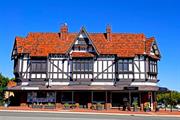
134 Stirling Hwy Nedlands
Nedlands
Metropolitan
Constructed from 1936
| Type | Status | Date | Documents |
|---|---|---|---|
| State Register | Registered | 20 Dec 2022 | HCWebsite.Listing+ListingDocument, HCWebsite.Listing+ListingDocument |
| Type | Status | Date | Documents |
|---|---|---|---|
| (no listings) |
| Type | Status | Date | Grading/Management | |
|---|---|---|---|---|
| Category | ||||
| Municipal Inventory | Removed from MI | 15 Apr 1999 | ||
| Art Deco Significant Bldg Survey | Completed | 30 Jun 1994 | ||
The place is a good example of Inter-War Old English architectural style.
The place is designed by a well-known architect, Edwin Summerhayes
The place is unique as an Old English building erected in the Inter-War period for residential purposes.
The place contributes to the streetscape and townscape of Nedlands.
‘This two-storey red brick and tile commercial structure is built on a prominent Stirling Highway corner. It was designed specifically for this corner aspect as can be seen in the door and gable orientation. The ground floor is red brick in facework with half-timbered jetty construction on the upper floor frontage. The Marseilles pattern, medium blend, terracotta tiles and the steep pitch of the roof are important design elements common to this Old English architectural style of the Inter-War Period.’
‘This building is thought to have been built for a Mr Santich of Kalgoorlie c1936. It was designed by Edwin Summerhayes, an eminent Perth architect. The present owner has owned the building for some time.’
High
Good
| Name | Type | Year From | Year To |
|---|---|---|---|
| Edwin Summerhayes | Architect | - | - |
| Library Id | Title | Medium | Year Of Publication |
|---|
Individual Building or Group
| Epoch | General | Specific |
|---|---|---|
| Present Use | COMMERCIAL | Shop\Retail Store {single} |
| Original Use | COMMERCIAL | Shop\Retail Store {single} |
| Present Use | RESIDENTIAL | Flats\Apartment Block |
| Original Use | RESIDENTIAL | Flats\Apartment Block |
| Style |
|---|
| Inter-War Old English |
| Type | General | Specific |
|---|---|---|
| Roof | TILE | Terracotta Tile |
| Wall | BRICK | Face Brick |
| General | Specific |
|---|---|
| DEMOGRAPHIC SETTLEMENT & MOBILITY | Land allocation & subdivision |
| OCCUPATIONS | Commercial & service industries |
This information is provided voluntarily as a public service. The information provided is made available in good faith and is derived from sources believed to be reliable and accurate. However, the information is provided solely on the basis that readers will be responsible for making their own assessment of the matters discussed herein and are advised to verify all relevant representations, statements and information.
35 Stirling Hwy Nedlands
Nedlands
Metropolitan
Constructed from 1934
| Type | Status | Date | Documents |
|---|---|---|---|
| Heritage List | Adopted | 19 Dec 2017 | |
| State Register | Registered | 31 May 2013 | HCWebsite.Listing+ListingDocument, HCWebsite.Listing+ListingDocument |
| Type | Status | Date | Documents |
|---|---|---|---|
| (no listings) |
| Type | Status | Date | Grading/Management | |
|---|---|---|---|---|
| Category | ||||
| Municipal Inventory | Adopted | 15 Apr 1999 | ||
| Statewide Post Office Survey | Completed | 01 Mar 1992 | ||
| Art Deco Significant Bldg Survey | Completed | 30 Jun 1994 | ||
| Municipal Inventory | Adopted | 23 Oct 2018 | Category B | |
| Municipal Inventory | Adopted | 27 Apr 1999 | Category B | |
Nedlands Post Office (fmr) is a single-storey Inter-War Mediterranean style rendered brick building with Art-Deco detailing and a hipped tiled roof.
Good
| Library Id | Title | Medium | Year Of Publication |
|---|
Individual Building or Group
| Epoch | General | Specific |
|---|---|---|
| Original Use | Transport\Communications | Comms: Post or Telegraph Office |
| Present Use | VACANT\UNUSED | Vacant\Unused |
| Style |
|---|
| Inter-War Mediterranean |
| Type | General | Specific |
|---|---|---|
| Roof | TILE | Terracotta Tile |
| Wall | BRICK | Common Brick |
| General | Specific |
|---|---|
| TRANSPORT & COMMUNICATIONS | Mail services |
This information is provided voluntarily as a public service. The information provided is made available in good faith and is derived from sources believed to be reliable and accurate. However, the information is provided solely on the basis that readers will be responsible for making their own assessment of the matters discussed herein and are advised to verify all relevant representations, statements and information.
Constructed from 1935
The former Nedlands Post Office has aesthetic, historic and social cultural heritage significance. Though a number of interior and exterior modifications have been made, the post office still has strong streetscape value. The post office, along with the Windsor Theatre. the Persian Carpet Gallery. the Sol Cafe. the Maisonettes and the Nedlands Council buildings. represents a period In history when architecture was influenced by modem European design. Together these buildings have an Inter-War theme that strongly contributes to the City of Nedlands character. The post office operated continuously for approximately 63 years, providing a vital service to the Nedlands district.
The Nedlands Post Office is on a comer setting on Stirling Highway. It is constructed from brick with Marseilles pattern terracotta tiles. The single storey building is of a residential scale and is set on an ashlar coursed granite plinth. The portico along the east front has been enclosed and most of the distinguishing architectural accoutrements have been progressively removed until only the street facade remains, Nevertheless, the Nedlands Post Office is included in the Art Deco Society's walks owing to it'; design and contribution to the Stirling Highway streetscape with its Inter-War theme. It was listed as a priority building on pl4 of 'Historical and Architectural Assessment of Post Offices in WA as owned by Australia Post July 1991.'
Tenders for the construction of the Nedlands Post Office were called by the Commonwealth Works Department on 11 May 1934. On 7 September 1935 the new premises were opened. This improved the postal facilities of the Nedlands. Dalkeitb and Hollywood localities, Prior to 1935 the approximately 8,000 residents of the district travelled to Subiaco or Claremont for their postal needs. AI the lime when Perth was slill recovering nom the depression, the funds to build a Post Office of this architectural merit would have been difficult to find. It is thought that a lot of foresight went into the design and planning for the post office. The Nedlands Post Office served the district continuously nom 1935 until 1998 when the post office was moved to a more central location.
Fair
Good
| Ref Number | Description |
|---|---|
| N23 | LGA Place No |
| Owner | Category |
|---|---|
| Australian Postal Commission | State Gov't |
This information is provided voluntarily as a public service. The information provided is made available in good faith and is derived from sources believed to be reliable and accurate. However, the information is provided solely on the basis that readers will be responsible for making their own assessment of the matters discussed herein and are advised to verify all relevant representations, statements and information.
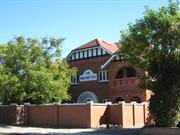
67 Stirling Hwy Nedlands
Nedlands
Metropolitan
Constructed from 1934
| Type | Status | Date | Documents |
|---|---|---|---|
| Heritage List | Adopted | 19 Dec 2017 | |
| State Register | Registered | 08 Jan 1993 | HCWebsite.Listing+ListingDocument |
| Type | Status | Date | Documents |
|---|---|---|---|
| (no listings) |
| Type | Status | Date | Grading/Management | |
|---|---|---|---|---|
| Category | ||||
| Municipal Inventory | Adopted | 27 Apr 1999 | Category A | |
| Municipal Inventory | Adopted | 23 Oct 2018 | Category A | |
| Municipal Inventory | Adopted | 15 Apr 1999 | ||
| Classified by the National Trust | Classified | 01 Nov 1991 | ||
| Register of the National Estate | Interim | 17 Dec 1996 | ||
| Art Deco Significant Bldg Survey | Completed | |||
| Register of the National Estate | Registered | 24 Jun 1997 | ||
| Name | Type | Year From | Year To |
|---|---|---|---|
| Horace Costello | Architect | - | - |
| Library Id | Title | Medium | Year Of Publication |
|---|---|---|---|
| 12213 | The Masionettes - a report on its cultural heritage significance | Other | 1991 |
| 3347 | The cultural heritage significance of the Maisonettes. | Heritage Study {Other} | 1991 |
| 12214 | Measured drawings and documentation : The Maisonettes, Stirling Highway Nedlands | Other | 1991 |
Individual Building or Group
| Epoch | General | Specific |
|---|---|---|
| Original Use | RESIDENTIAL | Flats\Apartment Block |
| Present Use | RESIDENTIAL | Flats\Apartment Block |
| Style |
|---|
| Inter-War Old English |
| Type | General | Specific |
|---|---|---|
| Roof | TILE | Cement Tile |
| Wall | BRICK | Common Brick |
| General | Specific |
|---|---|
| DEMOGRAPHIC SETTLEMENT & MOBILITY | Land allocation & subdivision |
This information is provided voluntarily as a public service. The information provided is made available in good faith and is derived from sources believed to be reliable and accurate. However, the information is provided solely on the basis that readers will be responsible for making their own assessment of the matters discussed herein and are advised to verify all relevant representations, statements and information.
Constructed from 1934
The Maisonettes has significant aesthetic. historic, social and representative cultural heritage value. The flats were designed and buill by Horace Costello, a designer of many notable Inter-War period homes. The Maisonettes were one of the earliest blocks of flats to be built in the Perth metropolitan area. They were constructed in thc Romanesque style with influences from the Arts and Crofts Movement. This movement aimed to invigorate appreciation of traditional arts and crafts which had disappeared largely as a result of the Industrial revolution. The building demonstmtes strong links with this movment, particularly in its gable treatment. joinery; balcony arches and corbel courses. Many traditional Gothio and English vernacular building forms and details are also incorporated. The building has a great consistency of detail both externally and internally. and is free of significant modifications from the original. Beinglocated in Nedlands, the' building is a valuable link in the evolution of the architectural style that defines the suburb. The quality of the example further reinforces its heritage value.
The Maisonettes is a two storey block of four flats constructed of red ¢lay bricks with a concrete tiled roof. 11 was designed by Horace Costello who was influenced by the Arts and Crafts movement The main building is 11 disrlnctive work embodying a relatively high degree of design. It has been described as having a reposeful. sheltering and welcoming character. derived from its. symmetry, its arched and seried forms. its massing, its principal horizontal proportioning mode and its broken roof forms. It was built with a high degree of craftsmanship, including the interior detail of ]eadlight glass. The Maisonettes form an harmonious vista at the end of Webster St where it joins Stirling Highway.
The Maisonettes was designed and constructed cl934 by Horace Costello. Horace Costello was a prominent designer who was quite influential in the Ncdlands dlstirct. He was associated with the design of a number of houses and public buildings in the City of Ncdlands area. These included his own residence Kardo Mordo. ' the house at 150 Victoria Ave. the St Therese Primary School and the Carmelite Monastery and Chapel. The Maisonettes was the proposed site for the expansion of the City of Nedlands Council Offices but public support to retain the buildings saw them saved, According to Vyonne Geneve of the Art Deco Society of Western Australia. The Maisonettes were the first bachelor flats erected in Perth.
Good
Good
| Ref Number | Description |
|---|---|
| N50 | LGA Place No |
This information is provided voluntarily as a public service. The information provided is made available in good faith and is derived from sources believed to be reliable and accurate. However, the information is provided solely on the basis that readers will be responsible for making their own assessment of the matters discussed herein and are advised to verify all relevant representations, statements and information.
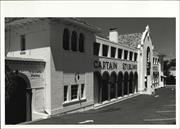
80 Stirling Hwy Nedlands
Nedlands
Metropolitan
Constructed from 1935
| Type | Status | Date | Documents |
|---|---|---|---|
| Heritage Agreement | YES | 18 Aug 2025 | HCWebsite.Listing+ListingDocument |
| Heritage List | Adopted | 19 Dec 2017 | |
| State Register | Registered | 30 Aug 2016 | HCWebsite.Listing+ListingDocument, HCWebsite.Listing+ListingDocument |
| Type | Status | Date | Documents |
|---|---|---|---|
| (no listings) |
| Type | Status | Date | Grading/Management | |
|---|---|---|---|---|
| Category | ||||
| Register of the National Estate | Permanent | 26 Oct 1999 | ||
| Survey of 20th Ctry Architecture | Completed | 01 Mar 1988 | ||
| Art Deco Significant Bldg Survey | Completed | 30 Jun 1994 | ||
| Classified by the National Trust | Adopted | 22 Apr 1998 | ||
| Statewide Hotel Survey | Completed | 01 Nov 1997 | ||
| Municipal Inventory | Adopted | 15 Apr 1999 | ||
| Municipal Inventory | Adopted | 23 Oct 2018 | Category B | |
| Municipal Inventory | Adopted | 27 Apr 1999 | Category B | |
Captain Stirling Hotel is a fine and rare example of an Inter-War Spanish Mission style hotel which demonstrates the principal characteristics of the style, and is considered a landmark along the Nedlands strip of Stirling Highway.
The two-storey Inter-War Spanish Mission style hotel incorporates details such as centralised Dutch gable entrance block, loggia and arcade, rounded archways, and twisted columns.
The hotel was constructed in 1936 for Senator Edward Bertram Johnston, a prominent political figure in WA during the first half of the Twentieth Century. The building was designed by the architects George Herbert Parry and Marshall Clifton.
Good
| Name | Type | Year From | Year To |
|---|---|---|---|
| George Herbert Parry | Architect | - | - |
| Marshall Clifton | Architect | - | - |
| Overman & Zuideveld | Architect | - | - |
| Library Id | Title | Medium | Year Of Publication |
|---|---|---|---|
| 12118 | Captain Stirling Hotel, 80 Stirling Highway Nedlands | Heritage Study {Cons'n Plan} | 2020 |
Individual Building or Group
| Epoch | General | Specific |
|---|---|---|
| Present Use | COMMERCIAL | Hotel, Tavern or Inn |
| Original Use | COMMERCIAL | Hotel, Tavern or Inn |
| Style |
|---|
| Inter-War Spanish Mission |
| Type | General | Specific |
|---|---|---|
| Roof | TILE | Terracotta Tile |
| Wall | BRICK | Rendered Brick |
| General | Specific |
|---|---|
| OCCUPATIONS | Hospitality industry & tourism |
| PEOPLE | Famous & infamous people |
This information is provided voluntarily as a public service. The information provided is made available in good faith and is derived from sources believed to be reliable and accurate. However, the information is provided solely on the basis that readers will be responsible for making their own assessment of the matters discussed herein and are advised to verify all relevant representations, statements and information.
Aesthetic Value The hotel exhibits particular aesthetic characteristics consistent with the 1930s in Western Australia. The building represents arguably the most impressive architectural project undertaken by the sign ificant partnership of Marshall Clifton and Herbert George Parry, two of the leading architects of the time. The masterly adaption of “Mediterranean stylistic elements into a cohesive composition suited to the climate and needs of Western Australia set an example and a standard for the establishment of an indigenous architectural style. The building has stylistic connections with the University of WA buildings nearby on Stirling Highway and is recognised as a major landmark on this main Perth-Fremantle road and adds The building has stylistic connections with the University of WA buildings nearby on Stirling Highway. It adds considerable street value to Stirling Highway and is a major landmark on this main Perth-Fremantle thoroughfare. Historic Value As well as associations with the eminent architects Parry and Clifton, the building has connections with Senator B. Johnson, the original owner, and though its name commemorates Captain James Stirling, the leader of the first settlement in Western Australia. The hotel is significant in the development of architectural history in Western Australia.
The Captain Stirling Hotel is designed in the Mediterranean style by Marshall Clifton and George Parry. (in partnership 1932-37) although authorship of the individual design is difficult to establish. The hotel’s terra cotta tiled roof and stuccoed arcades with pillars and “treacle twist” columns on the second floor verandah relates to Parry’s St. Bridget’s Convent at Lesmurdie (1921). They are also typical of one phase of Marshall Clifton’s work. The general Mediterranean character of the building is reinforced by the later east entrance additions by Erich Leach when in partnership with Clifton. The building offers a strong ‘central’ statement made by the tall vertical round arched window and featuring the decorative balcony under an ornamental gable. This, when coupled with the slightly projecting façade end blocks gives a strong impression of symmetry to what is essentially an asymmetrical façade. The ground floor of this main frontage features a seven bay arcade of circular arches supported on Tuscan columns with a complementary series of four windows set in shallow circular arched recesses on the other side of the ‘central’ feature. The upper floor also features sheltered verandahs on three sides. The exterior walls are all painted brick and and majority of the fenestration is comprised of simple rectangular window openings divided into square mullioned panes. The upper floor of end end of the main façade features circular arches supported on ‘treacle twist’ columns, the left hand end providing three openings to a deep balcony and the right hand end a window immediately behind the two pillars. The building is covered by a complex hipped roof of Marseilles pattern terra cotta tiles with a steeper section behind the gable. The sealed projecting eaves are supported on moulded corbels. Note.. Cordova tiles are used around the parapet on the eastern end of the building on additions carried out by Eric Leach. Note..The attached list of alterations provided by the owner demonstrates the continued upgrading and excellent state of repair of the building, enhancing its commercial viability without seriously compromising the essential characteristics of the external appearance.
Assessment: 1998 Construction 1935 Architect: Marshall Clifton & George Herbert Parry (known as Herbert) The Captain Stirling Hotel was built for Senator Bertie Johnson in 1935. Senator Johnson died in 1941 and later Mrs. Marie Louise Wordsworth, daughter of the Senator, purchased the building in 1985. After that time Mrs. Wordsworth refurbished the building and it re-opened in 1986. The hotel was designed in the partnership of Marshall Clifton and George Parry. (See Notes on Marshall Waller Clifton below) Although it has not been possible to define the extent of contributions made by both partners, the Southern European influence is clearly consistent with the work of Marshall Clifton who travelled to Europe in the early 1930s, designing many buildings in this manner on his return to Perth. Clifton said: “When we travel abroad we are struck by the similarity of our climate and scenic conditions to that of the Mediterranean. The time proven styles of Spain, Southern Italy and Provence would seem much more suitable than any based on English or Northern European examples”. Clifton was greatly influenced by peasant Spanish architecture, an embodiment of a social and physical environment with a sensitive response to climate. His Spanish style, with its rambling design was seen as an ideal for the casual, relaxed, suburban life that was, and still is, characteristic of Perth. The Captain Stirling Hotel embodies many of these principles. Marshall Clifton ( 1903-1975) (Extracts from “Marshall , Architect and Artist” by Barbara Chapman and Duncan Richards, Fremantle Arts Press, 1989) - by Valerie Simms Marshall Gervase Waller Clifton was a direct descendant of the Australind pioneer Marshall Waller Clifton. He was born at Wokalup, where his parents were farmers, on 11th September, 1903. When he was 7 years old his parents moved to Northampton. It has been said that Clifton had a natural vitality, good looks, an easy pleasant personality, warmth and intelligence. During his high school years he lived with the Hughes family in Northam. In 1921 gained an Engineering Matriculation pass for the University of WA and began his 4-year cadetship with the Public Works Department in March, 1922. He soon came to realise that his primary interest lay with architecture. He was employed as a junior draughtsman, and later as an architectural cadet, taking a course with the International Correspondence School in Sydney and attended a course of lectures on the History of Architecture at UWA. He completed his cadetship in 1926 and was elected an Associate of the Royal Institute of Architects of WA. In 1927 he was made Assistant Architect at the Public Works Department until October 1929. For a few months in 1929 he worked with George Herbert Parry before travelling to England in 1930 to extend his knowledge and experience. There he attended the School of Architecture at the Royal Academy while working with one of London’s leading architects, E. Vincent Harris, travelling then to Ireland, Holland and Belgium. Later he travelled Europe on a motorbike, sketching as he went, visiting Russia and (more importantly) Spain before his return. On his return to Perth he joined Herbert Parry in a partnership which offered opportunities with important clients in the hotel industry and with the Anglican Church. It was difficult to obtain work in Perth during the years of the Great Depression, but in the mid 1930s the partnership received the commission to design the Captain Stirling Hotel, the Highway (now Coronado) Hotel at Claremont and the hotel at Big Bell near Cue. Clifton continued to be influenced by the Mediterranean style and designed domestic architecture in this genre in suburban Perth, including a home for his own family at 70 Johnson Street, Mosman Park (1937) and the Day House, Claremont (1939) Marshall Clifton joined the Army during World War Two, serving with the Works and Parks Company of the A.I.F. Engineers from 1941 to 1944, attaining the rank of Captain. After the War and with the easing of building bylaws and the availability of building materials, there was an increased demand for his work. In 1936 Clifton had been appointed Honorary Artist and Architect for the Royal Western Australian Historical Society, a position he held for the rest of his life. In 1952 he became a Fellow of the Royal Australian Institute of Architects and a Fellow of the Royal Society of Arts, London. In 1953 Clifton and his family travelled overseas and in 1956 he became the President of the WA Chapter of the Australian Institute of Architects, often visiting the Eastern States. In 1959 he was made Fellow of the Royal Institute of British Artists and also became Honorary Architect of the National Trust of Australia (WA) from 1965 until his death in 1972. During this time he was responsible for the restoration work on the National Trust properties Strawberry Hill Farm in Albany and Woodbridge, Guildford. He also lent his support in the saving of the old Fremantle Asylum. In 1956 Clifton formed a partnership with Eric Leach, who was a most able and articulate exponent of modernism in WA. The partnership dissolved in 1953 when Clifton was 50 years old and over the next two decades he produced some of his finest architecture. Although he was an Anglophile and an enthusiastic traveller, he never really left the physical realities of the WA environment, with its harsh climate, its sunshine and warmth. It is said that he was obsessed by the sun and the value of light as a source of all beauty. This was reflected in his architecture. As an artist Clifton painted in watercolour from childhood. He was opposed to any over painting of original washes, which resulted in sparkling transparency and pure clear colour which gave his work an enviable individuality. He held many exhibitions and people who owned his paintings value them highly. His architectural practise spanned 50 years- a half a century which was characterised by remarkable discontinuities in architectural thought and practice. The 1920s saw the emergence of “modern architecture” as a challenge to traditional methods. However Clifton focussed on continuity which permeated his life and shaped his artistic and architectural vision. Many attributes from Clifton’s character and architecture sprang from his early family life with its continuity, stability, support and encouragement and he consistently designed with this social environment in mind in his creation of successful and harmonious environments. He was a domestic architect par excellence - homes (large and small and blocks of flats and hotels. He excelled at design and drawing and had a sound grasp of materials and constructional methods. In addition he possessed artistic abilities and great social skills.
This information is provided voluntarily as a public service. The information provided is made available in good faith and is derived from sources believed to be reliable and accurate. However, the information is provided solely on the basis that readers will be responsible for making their own assessment of the matters discussed herein and are advised to verify all relevant representations, statements and information.
Constructed from 1935
The Captain Stirling Hotel has aesthetic, historic and social cultural heritage significance, The Captain Stirling Hotel is one of several buildings constructed in the Inter-War period along the Stirling Highway, reflecting the development of the City of Nedlands and the growing importance of the motor vehicle. This building is a fine example of the Inter-War Mediterranean style. Its detailing presents a high standard of artistic excellence. The arcaded design has proved particularly suitable for the Perth suburban environment. Sufficient exterior fabric remains for the building to reveal its design while the intact fabric of the upper floor accommodation is a fine example of its type. The Captain Stirling Hotel bas operated as a. Significant meeting place for members of the local ccmmuniry since its construction. The hotel Is significant for its association with architects Marshall Clifton and George Herbert Parry. Clifton rose to prominence in Western Australia through his development of a. Mediterranean architectural style in tile Inter- War period. The building is also important for its associations with the Johnson family, as one of their extensive property holdings in Western Australia and as part of their hotel chain.
The Captain Stirling Hotel is a two-storey structure wlrh n single-storey drive-in boltle department in the north-cast corner or the site. The Captain Stirling WIIS originally constructed with an arcade on the ground Iloor. intersected by a gabled projection. and with IJ verandah along the upper Ooor of the southern elevation. The arcade has recently been enclosed. Architectural clcrncnts of note include soffit brackets. serpentine gables and lettering. and twisted precast pressed cement columns. The building is also distinguished by the location. distribution and proportion of the openings. the steel framed casement windows and tJle limber doors and door furniture. The drive-in bottle shop was notable for its butterfly roof at the time of its opening in J 958, It was designed in the office of Marshall Clifton by Mr Bin Evans.
The Captain Stirling Hotcl was designed by the partnership of George Herbert Parry and Marshall Clifton, both prominent architects in the Nedlands/Dalkeith district, The hotel was built for Senator Bertie Johnson by H E Allwood for £9.981. It was construct cd in 1935, Over the years it has had various lessees and owners. including the Johnson family who owned a chain of hotels. and Marie Louise Wordsworth (daughter of Senator Johnson), In 1958 the owners of the Captain Stirling Hotel opened Westena Australia's first driveIn boulcshop. This innovative shopping technique was advertised on a full page advertisement in The West Australian, The advertisement announced: "A new era of motorised shopping commences Friday September 19. for the first time ever in WA you can "Drive-In" for your liquor requirements. There is no parking worries and no delay. Ladies particularly, will appreciate this new idea". During the 1980s the Captain Stirling Hotel was taken over by a new owner, Marie Louise Wordsworth, She believed sentiment may have partly prompted her purchase as the hotel was originally built for her father. However. she also believed she would make a return on her investment. Originally she was advised by ber hotel broker to demolish the hotel and start again but she was quoted as saying this would have resulted in 'a tasteless, ghastly monstrosity'. Instead much time and effort was put into restoring the external part of the hotel and redesigning and renovating the internal part under design guidelines of Architect, Overman & Zuidceveld. In 1997 the hotel was assessed for entry into the National Estate by the Australian Heritage Commission. The National Trust has also recommended the hotel for classification, April 1998.
Moderate
Good
| Ref Number | Description |
|---|---|
| N3 | LGA Place No |
| Owner | Category |
|---|---|
| M Wordsworth | Other Private |
This information is provided voluntarily as a public service. The information provided is made available in good faith and is derived from sources believed to be reliable and accurate. However, the information is provided solely on the basis that readers will be responsible for making their own assessment of the matters discussed herein and are advised to verify all relevant representations, statements and information.
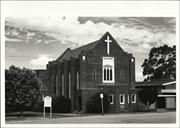
52 Tyrell St Nedlands
Cnr Elizabeth St
St Mary's (fmr)
Nedlands
Metropolitan
Constructed from 1937
| Type | Status | Date | Documents |
|---|---|---|---|
| Heritage List | Adopted | 19 Dec 2017 | |
| State Register | Registered | 16 May 2014 | HCWebsite.Listing+ListingDocument, HCWebsite.Listing+ListingDocument |
| Type | Status | Date | Documents |
|---|---|---|---|
| (no listings) |
| Type | Status | Date | Grading/Management | |
|---|---|---|---|---|
| Category | ||||
| Art Deco Significant Bldg Survey | Completed | |||
| Municipal Inventory | Completed | 15 Apr 1999 | ||
| Anglican Church Inventory | YES | 31 Jul 1996 | ||
| Classified by the National Trust | Classified | 12 Aug 2002 | ||
| Municipal Inventory | Adopted | 23 Oct 2018 | Category B | |
| Municipal Inventory | Adopted | 27 Apr 1999 | Category B | |
23645 St Margaret's Anglican Church Group, Nedlands
St Margaret's Anglican Church is a fine and rare Inter-War Art Deco style church with Inter-War Gothic elements.
The two-storey church is constructed of dark red brick topped with a tile roof. It is exceuted in the Inter-War Art Deco style with elements of the Inter-War Gothic style.
The Anglican Parish of Nedlands was established in the 1920s, holding services in private homes until 1923 when a small weatherboard church was constructed. In 1936 this building was demolished and replaced by St Margaret's Anglican Church. The new church was deisgned by William Bennett.
Good
| Name | Type | Year From | Year To |
|---|---|---|---|
| W G Bennett | Architect | - | - |
| Library Id | Title | Medium | Year Of Publication |
|---|---|---|---|
| 9476 | St Margaret's church, Nedlands: conservation plan, final report for Anglican Parish of Nedlands on behalf of Perth Diocesan Trustees. | Heritage Study {Cons'n Plan} | 2007 |
Individual Building or Group
| Epoch | General | Specific |
|---|---|---|
| Present Use | RELIGIOUS | Church, Cathedral or Chapel |
| Original Use | RELIGIOUS | Church, Cathedral or Chapel |
| Style |
|---|
| Inter-War Gothic |
| Inter-War Art Deco |
| Type | General | Specific |
|---|---|---|
| Wall | BRICK | Face Brick |
| Roof | TILE | Terracotta Tile |
| General | Specific |
|---|---|
| SOCIAL & CIVIC ACTIVITIES | Religion |
This information is provided voluntarily as a public service. The information provided is made available in good faith and is derived from sources believed to be reliable and accurate. However, the information is provided solely on the basis that readers will be responsible for making their own assessment of the matters discussed herein and are advised to verify all relevant representations, statements and information.
The building is of aesthetic significance because of its inherent quality of design and construction. The face brickwork and simulated stone window surrounds, elegant proportions and fine interior detailing of the church are valued by the community, as evidenced by its inclusion in the Municipal Inventory. The building is historically important as an example of the state of architectural achievement of the period and because it represents the establishment of the Anglican Church in Nedlands, WA. The church represents the spiritual basis as well as the social and community associations for those in whose lives it has played an important role. The building and the precinct of which it can be considered a part, forms an important landmark in the area. • AESTHETIC VALUE: The church is a particularly fine example of the Inter-War Free Goth ic style. Its colour-blended brickwork, stucco rendered simulated stonework, imposing proportions and fine detailing constitute a fine architectural achievement which is clearly valued by the community, as is evidenced by its placement on the Municipal Inventory of the City of Nedlands. (Criteria 1.1 & 1.2) The position of the church and hall at a prominent intersection in the heart of the city, adjacent to the Roman Catholic Church, creating a precinct, gives it considerable landmark significance, and its mature trees and gardens add to the picturesque quality of the surround ing landscape. The Church Hall though differing in style is closely integrated and also demonstrates distinctive aesthetic characteristics that contribute to the setting. (Criteria 1.3 & 1.4) • HISTORIC VALUE: The place is important because of the association with the establishment of the Anglican Church and the pattern of religious development in the City of Nedlands. (Criteria 2.1 & 2.2) The church building is historically significant as an example of the standard of excellence achieved in design and construction in the I 930s in Western Australia. This church was the first of its width to be designed in WA without supporting pillars to take the th rust of the roof, relying on substantial buttresses instead, giving it its distinctive appearance. 2 (Criterion 2.4) • SOCIAL VALU E: The place is significant by virtue of its role as a spiritual and social centre and as a major meeting place of the community of people associated with the Church of England in the district of Nedlands. (Criterion 4.1) • RARITY: The building is a rare example of the Inter-War Free Gothic style of architecture appl ied to church buildings in Western Australia in the 1930s and is an uncommon example of early modernism in such buildings. (Criterion 5.1) • REPRESENTATIVENESS: The building demonstrates the principle characteristics of the more advanced thinking in church architectural design at the time in W.A. (Criterion 6.1) The place is significant in representing the advent and continuing presence of the Church of England in Nedlands. (Criterion 6.2) • CONDITION, INTEGRITY & AUTHENTICITY The current condition and authenticity of the place in relation to the values for which it has been assessed is extremely good as the building fabric is virtually in its original state and has been very well maintained. Because of the continuing use of the church and hall as a centre of worship, the long-term viability and sustainability of the values identified is also good .
The style of this prominent and distinguished church building is a fine free 'modern' treatment of Gothic Revival that clearly places it in the Inter-War period. It is an interesting and unusual example of the work of the prolific architect, W. G. Bennett. The building is set on a corner site with lawns and mature vegetation. Externally, the bluish blend, face brick finish contrasts with the cream cement work of the perpendicular windows and other detailing. Heavy brick buttresses supporting the side walls have Art Deco type steppings and reach from the ground to the top of the parapets, dividing the nave externally into five bays. Each bay contains a tall double window in Gothic style with coloured leadlight glazing and with ventilation slots below and a panel of herringbone brickwork above forming the parapet. The gable roof over the nave is of colour-blend, marseilles pattern, terra cotta tiles between brick gable ends which are also stepped at the extremities, with a hipped roof over the chancel at the Eastern end. A large Art Deco style cross features prominently on each gable-end and the West Front also features a triple window in Gothic style under a Tudor flat arch flanked by vertical vents and a cream cement escutcheon at the top of each side pillar. Internally the walls are left in a natural brick of light golden colour blend intended to combine with the coloured window lights and the cream tints of the ceiling to give a feeling of diffused warmth and light. The pews and other church furniture are purpose made of local Jarrah timber and the pulpit is constructed of selected tapestry bricks. Artificial lighting is provided by vertical light fittings to the walls between the windows at an optimum height for comfortable reading, while the main central light to the nave is provided by a large feature light trough in the form of a cross. The two separate arches at the threshold of the chancel and sanctuary respectively, form a distinctive feature of the interior, which has a total interior length of 102ft. with an interior nave width of 28ft. There is a baptistery at the west end with an entry porch on each side approached by brick steps. A roomy organ loft is provided on the north side, with its own separate entrance, and on the south side is the clergy's vestry. Vestries for the choir are provide in a spacious semi-basement area under the sanctuary that also has its own separate entrance. The church has a seating capacity of 210 in the nave and 30 in the chancel and at the time of construction was estimated to cost £4,200. Together with its adjacent hall (see below) and rectory, and with its prominent corner position diagonally opposite the Roman Catholic Church, hall and school, St. Margaret's forms part of a church precinct that constitutes a significant landmark in the area and adds considerable character to the local streetscape.
Assessment 2002 Construction 1937 Architect/Designer W.G. Bennett Builder: A.W. Hill The first stone was laid on this site by The Most Reverend C. 0. L. Riley Archbishop of Perth on 3rd February 1923 and a small brick church originally constructed there. This structure (named St. Mary's) was however found not able to be incorporated i nto a larger building and was pulled down to permit the construction of the existing building. The foundation stone for this was laid on Sunday 30th of May 1937 by the Archbishop's son, The Venerable Archdeacon C. L. Riley. "Before the stone was laid, a receptacle containing the 1936 "Diocesan Year Book," a copy of the order of service for the day, some coins of the realm and a brief history of the church all wrapped in part of "The West Australian" dated May 29, 1937, was placed in a cavity under the stone." 1 The altar rails from the original church, which were carved by the first rector, the Rev. H. G. Barnacle, were incorporated into the new church under the rectorship of the Rev. E. G. Jaquet M.A. The adjacent church hall, which was constructed at the same time as the church, was originally of timber and weatherboard with a raised stage at the eastern end and a kitchen area behind the stage, an enclosed verandah along the southern side and an entry porch at the western end with a brick frontage added in l 937. This street frontage was designed to complement the style of the church itself. The hall was used as the local kindergarten and Sunday School as well as for a wide variety of youth activities and social functions. The current hall replaced the original hall in the 1960s. The History of the Anglican Church in the Nedlands district is also linked to the development of both Subiaco and Claremont. In the early years services were held in various places, including private homes and Mission Halls. In 1922 it was decided to sell the local Mission Hall to raise funds for a church. Five blocks of Land were purchased at the corner of Tyrell and Elizabeth Streets by the Reverend H.G. Barnacle. On th is property a small church called St. Mary's was built in 1923. (The Foundation Stone was laid by Archbishop C. Riley). With an expanding population St. Mary's Church was extended by a verandah and the services of a hall built next door. In 1930 Ned lands was made into a separate parish. Requiring a bigger church, a building fund was set up in 1930 by reverend Canon Burton and the job of fund raising was continued by Reverend Jaquet on his arrival in 1935. Building started in 1937 and in 1938 the new church was consecrated and dedicated to St. Margaret. (The name change was decided owing to other churches in the diocese being dedicated to St. Mary). The foundation stone of the old St. Mary's survives along with the new foundation stone laid by Archbishop C.L.Riley, the son of the Archbishop who laid the first stone. The total cost of the church was $4,626.18.6d. The architect W.G. Bennett, who d id much to establish a distinctively modern regional architectural style in WA also designed a number of public and private buildings in the Nedlands district, including the Ned lands City Council Offices and the Infant Health Clinic and the Rose Garden. A stained glass window can be seen in St. Margaret's church commemorating Reverend Jaquet's long period of services to the Nedlands parish. (This was donated by his family in 1975). The old parish hall continued in use for youth groups, Sunday school and social occasions with the addition of a brick frontage to complement the 1937 church building. The hall was replaced with a new building in the 1960s. Music in St. Margaret's has a long and upstanding tradition, excellent choirs of state level performed on various occasions. In 1959 the organ was seriously in need of replacement and a new organ was installed by Messrs. Walter and Sons of London who were at the time installing the organ at Winthrop Hall, University of Western Australia.
This information is provided voluntarily as a public service. The information provided is made available in good faith and is derived from sources believed to be reliable and accurate. However, the information is provided solely on the basis that readers will be responsible for making their own assessment of the matters discussed herein and are advised to verify all relevant representations, statements and information.
Constructed from 1937
SI Margaret's Cburch has aesthetic. historic and social cultural heritage value. The Church was the first of its particular width to be built without supporting pillars to take the thrust of the roof. Hence. the outside buttressed wall<; give it particular distinction. It is a fine example of Gothic Revival architecture. lIS dominating facade give the Church srreetscape value. St Margaret's adds to the history of the development of the Nedlands community as it was built in a period of rapid population increase in the TI1OO1'- War period. It is also notable as another example of WG Bennett's architectural design. Bennett WaJ< involved In a number of projects in UID Nedlands district, Some of these include the Peace Memorial Rose Garden, the Nedlands Council Offices and the Child Health Clinic.
The wbole Church is set in a comer site with grass and simple concrete paving up 10 the entrance. The east end has brick walling with steel fencing. This appears to have been added at a later date. fhere is no east end window, but a blank wall behind the altar. There is a very simple central pitched clay tiled roof over the altar and aisles. It is a rectangular building. The west end faces the road, whilst the heavy brick detailing is typical of the 1930s. The windows are stone and in Gothic style. They are in rectangular form at the "ides and head. Glazing within the windows is in traditional Gothic perpendicular style for the west end window, with infill detailing over it. The entry into the Church from the corner is symmetrical at the west end, with low entrance porticos on either SIde of a slightly higher entrance that projects out lrom the main body of the Church. The main body of the Church has vertical windows of Gothic Renaissance style. bUJ with rectangular stone surrounds. These nrc built into brickwork side walls between vertical brick buttresses, The brick plinth 11' simple. The brickwork detailing is good wlth tile inserts below the parapet line. vertically at the heads of the buttresses and below ehe vertical windows to form air vents. Ihe east end projects out 10 form the altar recess.
The history of the Anglican Church in the Nedlands district i. linked to the development of both Subiaco and Claremont. Over time sorviccs were held in various places. including private homes and Mission Halls. JIl 1922 it. was decided to sell the Mission Hall to raise funds for a church. Five blocks or Land were purchased at the corner of Tyrell and EIlzabeth Streets by the Reverend H G Barnacle, On this property a small church caJled St Mary's was built 111 1923. (The Foundation Stolle was laid by Archbishop C Riley.) With an expanding population the St Mary's Church was extended by a verandah and the rervices of a hall buill next door. In 1930 Nedlands was made into a separate parish. Requiring a bigger church, a building fund was set up in 1930 by Reverend Canon BUl1.011 and the job of fund raising was continued by Reverend Jaquet on his arrival in 1935. Building started in 1937 and In 1938 the new church was consecrated and dedicated to SI Margaret. (The name change was decided owing to other churches in the diocese dedicated to St Mary.) The foundation stone of the old St Mary's survives along with the new foundation stone laid by Archdeacon CL Riley, the son of the Archbishop who laid the first stone. The total cost of the church was £4.626118/6. The architect was Mr WG Bennett, who designed a number of public buildings in the Nedlands district. including the Nedlands Council Offices and the Infant Health Clinic. The building contractor was AN Hill. A stained glass window can be seen in St Margaret's commemorating Reverend Jaquet's services to the Nedlands parish, (This was donated by his family 111 1975.) The old parish hall continued In use for youth groups and Sunday school. Music In St Margaret's has a long and upstanding tradition, excellent choirs of state level performed on various occasions. ln 1959 the organ was seriously in need of replacement. The new organ was in..stalledby Messrs Walter and Sons of London who were at the time installing the organ at Winthrop l1all. University of Westem Australia. Today (1998) the Angl ican parish of St Margaret's is 51iII very active, Many acti vilies are recorded in their newsletter, St Margaret's News. Sunday school, youth group. Ladies GUIJd and SI Margaret's Women's groups are some of the many facets of St Margaret's in J 998.
Good
Good
| Ref Number | Description |
|---|---|
| N47 | LGA Place No |
This information is provided voluntarily as a public service. The information provided is made available in good faith and is derived from sources believed to be reliable and accurate. However, the information is provided solely on the basis that readers will be responsible for making their own assessment of the matters discussed herein and are advised to verify all relevant representations, statements and information.
69 Webster St Nedlands
Nedlands
Metropolitan
Constructed from 1931 to 1940
| Type | Status | Date | Documents |
|---|---|---|---|
| State Register | Registered | 07 Jun 2024 | HCWebsite.Listing+ListingDocument, HCWebsite.Listing+ListingDocument |
| Type | Status | Date | Documents |
|---|---|---|---|
| (no listings) |
| Type | Status | Date | Grading/Management | |
|---|---|---|---|---|
| Category | ||||
| Art Deco Significant Bldg Survey | Completed | |||
| Municipal Inventory | Adopted | 23 Oct 2018 | Category B | |
| Municipal Inventory | Adopted | 27 Apr 1999 | Category B | |
The Loreto Convent School Building is a substantial two-storey symmetrical brick and tile Inter-War Gothic building with masonry quoining detail; steeply pitched roofs with stepped gables; deep verandahs on the front elevation with masonry arched openings on the east elevation; and a restored two-storey verandah on the north elevation. The main Convent building was constructed in two stages in 1930 and 1940. The first stage comprises the northern (right) wing and north facing verandah with the second stage comprising the southern (left) wing, central connection and additional southern extension constructed in 1940. The building is constructed of cavity brickwork with decorative concrete oriel windows. To the rear of the building the original back verandah has been extended and incorporated into the connection with the adjoining Loreto Performing Arts Centre (2011).
The Loreto Order first arrived in WA in 1897. Established in Adelaide Terrace, Perth (1897) and then in Osborne, Claremont (1901), the Nedlands School was not established until 1931. The Convent was built on bush land purchased for nearly 3 000 pounds in 1928. For two years the land was left uncleared. (Almost simultaneously the Catholic people of Nedlands and Dalkeith received their own parish, separating from Subiaco). A Foundation Stone for the Convent and school was blessed and laid by Archbishop Clune in 1930. Designed by architects Henderson & Gamble, the building programme was to be completed in two stages. The first stage was completed for the beginning of the school year in 1931. It was opened with a blessing from the Archbishop in March 1931. The convent community included six nuns led by Mother Superior Mercedes, and during the first term nine pupils were enrolled. Mass was celebrated in a small chapel on the second floor of the two-storey building. With surplus funds spent on building the convent, furniture became a luxury that the order could not afford. Packing cases doubled as shelving until furniture could be purchased. Funds for this was aided by bridge parties run by the Loreto Ladies Society. Financial difficulties were not limited to the Loreto Convent. Western Australia in 1931 was still in the middle of the Great Depression. The Nedlands Catholic community were stretched to provide funds for the building of the Holy Rosary Church. However, finances improved for the Loreto Convent with an increase in students to 28 in 1932. History of the Loreto Convent and School, which was primarily a girl's school (but took boys up until their First Holy Communion) has coincided with the development of St Teresa’s Parish School. St Theresa’s was established by Father Moss who believed Loreto was a private school and did not fill the requirements of a Parish School which would be directly under his control. Interestingly, Father Moss expected the Loreto Nuns to staff the school and did not seem at all bothered by the situation of having two Catholic schools situated so close together. Both schools struggled to exist as the number of school age children in the Parish of Nedlands did not increase sufficiently to maintain viability, particularly at Loreto. The lower tuition fee at St Theresa’s and the fact that the children were learning the same curriculum as at Loreto and were taught by the Loreto Nuns was a strong lever in drawing pupils to the parish primary school, rather than to Loreto. Student numbers to Loreto enjoyed a boost by the Adelaide Terrace girls who joined Nedlands after the closure of the Perth School in 1938. In 1939 the second stage of the Loreto Convent was constructed at a cost of 8 375 pounds. The extension included the chapel, new kitchen and dining room. The building was carried out by W Ralph and Sons (also involved at St Paul’s, the Nedlands Road Board offices and the Windsor Theatre) and made ready for the new school year in 1940. Archbishop Prendiville officially blessed and opened the additions, 2 February 1940. Loreto Nedlands (K-12) pupil numbers increased from 1938 until they peaked at 212 in 1953. From then they stayed steady except for a shortfall in the late 1960s. Owing to difficulties in numbers for Year 11 and 12 during the 1960s students were transferred after Year 10 to Loreto Osborne to complete their Leaving. The 1960s also saw changes in the Convent, the Rule of Enclosure that the Loreto Order had lived under for many years was released. Visits to their families, eating in public and attendance at marriages and funerals were permitted, changing the lifestyle of the Nuns dramatically. In 1970 declining numbers (owing to an ageing population in Nedlands and Dalkeith) at both St Theresa’s Parish School and Loreto Nedlands sent alarm bells to the Order and Church. Rationalisation led to the closure of Loreto’s senior school and St Theresa’s, leaving Loreto Nedlands the only Catholic Primary School in the district. Over the next few years Loreto Nedlands also had to provide a convincing rationale for continuing as a primary school. The decision to allow for co-education through until Year 7 increased the population markedly. In a 1974 review it was reported that expectations for the school had increased and the threat of closure had passed.
Integrity- High Authenticity- Moderate
Good
| Name | Type | Year From | Year To |
|---|---|---|---|
| Edgar Jerome Henderson & Gamble | Architect | - | - |
| Henderson, Edgar Le Blond | Architect | - | - |
Individual Building or Group
| Epoch | General | Specific |
|---|---|---|
| Original Use | EDUCATIONAL | Primary School |
| Present Use | UNKNOWN | UNKNOWN |
| Style |
|---|
| Inter-War Gothic |
| Type | General | Specific |
|---|---|---|
| Roof | TILE | Terracotta Tile |
| Wall | BRICK | Common Brick |
| General | Specific |
|---|---|
| SOCIAL & CIVIC ACTIVITIES | Religion |
| OUTSIDE INFLUENCES | Depression & boom |
| SOCIAL & CIVIC ACTIVITIES | Education & science |
This information is provided voluntarily as a public service. The information provided is made available in good faith and is derived from sources believed to be reliable and accurate. However, the information is provided solely on the basis that readers will be responsible for making their own assessment of the matters discussed herein and are advised to verify all relevant representations, statements and information.
Constructed from 1931
The Loreto Nedlands Comvent and School has significant aesthetic, historic, social and rarity cultural heritage value. The building has a high integrity as it has been maintained in excellent order with few changes to its exterior since the first stage was built in 1931. The school, convent and chapel are fine examples of Inter-War architectural design. For over 65 years the Loreto Order has provided a Catholic religious education to the children of the district. This institution is unique in the City of Nedlands area and along with the Carnielite Convent provide a sanctuary for those women who have chosen to serve God in this way.
The Foundation Stone for Loreto Primary School is dated 21 November 1930. The site slopes down west with other school buildings being single storey and two storey generally facing north. Later single storey buildings have been added with the assembly area being the latest addition (1990s). The main building has a steep pitched tile roof and has an ecclesiastical style. The verandah posts have simple detailing on the northern verandah, The pairs of timber columns and the timber infill arch have a cross cut in the infill between them. The two storey building with Gothic detailing has a series of six arches to the colonnade at the front, facing onto Webster Street. It has vertical sash windows at ground level, with Gothic heads and projecting bay windows at the first floor level. These windows have cross lattice lead lighting. The other buildings on site have less detail and are less imposing than the main original two storey block.
The Loreto Order first arrived in WA in 1897. Established in Adelaide Terrace, Perth (1897) and then in Osborne, Claremont (1901), the Nedlands School was not established until 1931. The Convent was built on bush land purchased for nearly £3,000 in 1928. For two years the land was left uncleared. (Almost simnllaneously the Catholic people of Nedlands and Dalkeith received their own parish, separating from Subiaco.) A Foundation Stone for the Convent and school was blessed and laid by Archbishop Clune in 1930. Designed by architects, Henderson and Gamble, the building programme was to be completed in two stages. The first stage was completed for the beginning of the school year in 1931. It was opened with a blessing from the Archbislmp in March 1931. The convent community included six nuns led by Mother Superior Mercedes, and during the first term nine pupils were enrolled. Mass was celebrated in a small chapel on the second floor of the two storey building. With all surplus funds spent on building the convent, furniture became a luxury that the order could not afford. Packing cases doubled as shelving until furniture could be purchased. Funds for this was aided by bridge parties nm by the Loreto Ladies Society. Financial difficulties were not limited to the Loreto Convent. Western Australia in 1931 was still in the middle of the Great Depression. The Nedlands Catholic community were stretched to provide the funds for the building of the Holy Rosary Church. However, finances improved for the Loreto Convent with an increase of students to 28 in 1932. History of the Loreto Convent and School, which was primarily a girls school (but took boys up until their First Holy Communion) has coincided with the development of St Theresa's Parish School. St Theresa's was established by Father Moss who believed Loreto was a private school and did not fill the requirements of a Parish School which would be directly under his control. Interestingly, Father Moss expected the Loreto Nuns to staff the school and did not seem at all bothered by the situation of having two Catholic schools situated so close together. Both schools struggled to exist as the number of school age children in the Parish of Nedlands did not increase sufficiently to maintain viability, particular!)' at Loreto. The lower tuition fee at St Theresa's and the fact that the children were learning the same curriculum as at Loreto and were taught by the Loreto Nuns was a strong lever in drawing pupils lo the parish primary school, rather than to Loreto. Why pay more for a product when the same quality is offered at a cheaper price! Student numbers to Loreto eajoyed a boost by the Adelaide Terrace girls who joined Nedlands after the closure of the Perth School in 1938. In 1939 the second stage of the Loreto Convent was constructed at a cost of £8,375. This extension included the chapel, new kitchen and dining room. The building was carried out by W Ralph and Sons (also involved at St Paul's, the Nedlands Road Board offices aud the Windsor Theatre) and made ready for the new school year in 1940. Archbishop Prendiville officially blessed and opened the additions, 2 February 1940. Loreto Nedlands (K-12) pupil numbers increased from 1938 until they peaked at 212 in 1953. From then they stayed fairly steady except for a shortfall in the late 1960s. Owing to difficulties in numbers for Year 11 and 12 during the 1960s students were transforrcd after Year 10 to Loreto Osborne to complete their Leaving. The 1960s also saw changes in the Convent. The Rule of Enclosure that the Loreto order had lived under for many years was released. Visits to their families. eating in public and attendance at marriages and funerals were permitted, changing the lifestyle of the nuns dramatically. In 1970 declining numbers (owing to an ageing population in Nedlands and Dalkeith) at both St Theresa's parish school and Loreto Nedlands sent alarm hells to the Order and Church. Rationalisation led to the closure of Loreto's senior school and St Theresa's, leaving Loreto Nedlands the only Catholic primary school in the district. Over the next few years Loreto Nedlands also had to provide a convincing rationale for continuing on as a primary school. The decision to allow for co-education through until Year 7 increased the population markedly. In a 1974 review it was reported that expectations for the school had increased and the threat of closure had passed. Today (1998) the Convent and school (population 281) are run independently of one another. The last nun taught in the school in 1996. However, the Loreto Order still own the school and therefore have a position to represent the Order on the school board.
Good
Good
| Name | Type | Year From | Year To |
|---|---|---|---|
| Anderson & Gamble | Architect | - | - |
| Ref Number | Description |
|---|---|
| N16 | LGA Place No |
This information is provided voluntarily as a public service. The information provided is made available in good faith and is derived from sources believed to be reliable and accurate. However, the information is provided solely on the basis that readers will be responsible for making their own assessment of the matters discussed herein and are advised to verify all relevant representations, statements and information.
6 Selby St Shenton Park
Admin & Wards Block & Paraplegic Block,
Royal Perth Rehablitation,Shenton Park Annexe
Nedlands
Metropolitan
Constructed from 1938 to 1963
| Type | Status | Date | Documents |
|---|---|---|---|
| Heritage List | Adopted | 19 Dec 2017 | |
| Heritage Agreement | YES | 05 Nov 2020 | HCWebsite.Listing+ListingDocument |
| Heritage Agreement | YES | 12 Feb 2019 | |
| State Register | Registered | 12 May 2015 | HCWebsite.Listing+ListingDocument, HCWebsite.Listing+ListingDocument |
| Type | Status | Date | Documents |
|---|---|---|---|
| (no listings) |
| Type | Status | Date | Grading/Management | |
|---|---|---|---|---|
| Category | ||||
| Municipal Inventory | Adopted | 23 Oct 2018 | Category C | |
| Municipal Inventory | Adopted | 27 Apr 1999 | Category C | |
| Classified by the National Trust | Classified | 08 May 2000 | ||
| Municipal Inventory | Adopted | 15 Apr 1999 | ||
Good
| Name | Type | Year From | Year To |
|---|---|---|---|
| Hawkins & Sands | Architect | - | - |
| Peter Parkinson & Ron Bodycoat | Architect | - | - |
| Colin Rule | Architect | - | - |
| PWD A W Clare | Architect | - | - |
| Library Id | Title | Medium | Year Of Publication |
|---|---|---|---|
| 3665 | Royal Perth Rehabilitation Hospital formerly known as the Victoria Hospital, the Infectious Diseases Hospital and Shenton Park Annexe : conservation plan. | Heritage Study {Cons'n Plan} | 1998 |
| 11761 | Victoria House - Shenton Park Rehabilitation Hospital : Lot 38 Montario Quarter, Shenton Park | Archival Record | 2019 |
| 12403 | Archaeological Management Plan Shenton Park Rehabilitation Hospital Lemnos Street, Shenton Park FINAL | Heritage Study {Other} | 2016 |
Individual Building or Group
| Epoch | General | Specific |
|---|---|---|
| Present Use | HEALTH | Hospital |
| Original Use | HEALTH | Hospital |
| Type | General | Specific |
|---|---|---|
| Other | TIMBER | Other Timber |
| Other | STONE | Limestone |
| Wall | BRICK | Common Brick |
| General | Specific |
|---|---|
| SOCIAL & CIVIC ACTIVITIES | Education & science |
| SOCIAL & CIVIC ACTIVITIES | Community services & utilities |
| PEOPLE | Innovators |
| OCCUPATIONS | Technology & technological change |
This information is provided voluntarily as a public service. The information provided is made available in good faith and is derived from sources believed to be reliable and accurate. However, the information is provided solely on the basis that readers will be responsible for making their own assessment of the matters discussed herein and are advised to verify all relevant representations, statements and information.
Constructed from 1937
The Royal Perth Rehabilitation Hospital has ae thetic. historic, social and scientific cultural heritage significance. The site is historically linked with the provision of health services since 1893 when the Victoria Hospital first provided isolation care for smallpox patients. I'hough the hospital site appears to be a conglomeration of various architectural styles. this aspect is important as it reflects the growth of facilities and services since it first began as the Infectious Diseases Hospital in 1937. Some individual aspects of the built environment of the hospital therefore have heritage value. Social and scientific significance is embodied in the hospital through its association with innovative rehabilitation therapy for chronically ill or injured people since the early 1960s.
The Royal Perth Rehabilitation Hospital site is pleasantly wooded around the perimeter. bounded on the east by Selby Street and the south by Selby Street. Buildings in the complex can be separated into several discrete groups. Part ofrho site is covered by buildings wlth little heritage significance in architectural terms. Wards and Reception Building - A Block This building is of rcd pressed brick construction, It is two storey with rendered walls above a first floor dado. Interesting brick detailing is evident with soldier courses, terracorta as relief inserts and architectural eloquence and proportions. The bnildings arc in the style of Inter-War Georgian Revival. Thorburn House - B Block The former Nurses' Quarters building is located in the south eastern corner of the site and occupies an area which reaches almost half the length of the Lemnos Street boundary. It consists of a three storey, crossplanned bnilding with long narrow wings to the north, cast and west and an entrance to the south. At (he western end are also two single storey blocks. Tn the north-eastern comer is a swimming pool and a tennis court. Thc building is of salmon coloured brick with a flat roof. The entrance has a rough terrazzo finished feature wall and there me decorative mosaic tile panels above and below the steel framed windows. Tbere is also a feature walt of rough-cut granite and external courtyard walls of decorative breeze blocks. A simple flat-roof steel walkway is located around the entrance. The single level blocks are also salmon brick with flat roofs. Paraplegic Block - Sir George Redbrook Spinal Unit - G Block Block G is located on the northern western edge of the main group of buildings on the site, between the main ward block E and the group of limber framed building making up Block T. This building is single storey with a steel frame and chocolate brown clay brick infill panels. Door and windows frames are steel in full height openings. Externally. the steel framed beams are exposed to form a covered walkway. The roof i$ low-pitched with steel fascia panels that have a simple pattern. From a contemporary perspective, the building is not remarkable. However, at the time its planning principles were innovative. The peripherally Located wards allowed for maximum natural light and view while concentrating the service core centrally both simplified operations and made them more efficient. The building's planning type and architectural style formed the basis of further building development on the site through the 19605 and early 1970s_ However, this remains the most architecturally and aesthetically significant. Ryder Cheshire Buildings - T Block These two single storey buildings built in the mid 1950s are of a domestic style and face the northern side of the main entrance drive, the first (eastern) building houses the Ryder Cheshire Foundation and the second (western) contains offices. The Ryder Cheshire building has a limestone base with face red brick walls and a tiled roof. Windows on the western side are timber but on the eastern side are aluminium or timber framed with louvres. The rear verandah has been Infilled with asbesros cladding and the front verandah has been enclosed with timber framed fly screens. The building has timber stumps and the front verandah floor is concrete. Now called Barbara Seabrook House, the facility was extended in 1998.
The Infectious Diseases Hospital was established in 1893 owing 10 a strain on public utilities caused by the gold boom when WA's population soared. Due to an outbreak of smallpox, the government needed to find a place where patients could be treated in isolation. Government Reserve land which had been put aside for a future hospital in what was then west Subiaco became the obvious choice. Tents, and then a corrugated iron building accommodated the smallpox pationts in the Victoria Hospital until the epidemic diminished. For a short period the hospital was closed until an outbreak of typhoid fever. The Victoria Hospital was used temporarily to treat patients with the fever until each outbreak died down. Other infectious diseases treated in the Victoria Hospital were measles, venereal diseases, diphtheria, scarlet fever and tuberculosis. When the WoorolooTB Sanatorium was opened in 1913-14, all patients from Perth and the Coolgardie Sanatorium were transferred. Some of tho Coolgardie buildings were transported and reerected at the Infectious Diseases Hospital Following World War I the hospital had to deal with an influx of people with •Spanish' influenza, a very debilitating disease causing many deaths in 1919. During the 19205and 305. despite the continual decline of the hospital's facilities. patients. including children, continued to be treated. However. by the early 1930s public outcry about the condition of the hospital led to a conference discussing the concerns. The new hospital was built (after many revisions of the plans) in 1937. Tho Government architect, A E Clare was responsible for the final design of a 90 bed facility. The new Infectious Diseases Hospital opened in September 1938after an expenditure of £52,175. During the 1940s there was a welcome decline in infectious diseases except for poliomyelitis which between 1948 and 1956 kept the hospital busy. The polio outbreak has been recognised as a catalyst for the changes that occurred at the Infectious DiseasesHospital in the 1950s. With many polio victims requiring long term treatment. and rehabilitation owing to severe paralysis, the Infectious Diseases Hospital controlling body began to look at other chronic medical conditions. These included cardiac disease, arthritic conditions and hemiplegia Expansion of tile hospital facilities included Iho School of Physiotherapy and the rehabilitation of paraplegics under the dircction of Dr G M Bcdbrook. The paraplegic unit which was established in ] 954 was the first of its kind in Ausrrnlla. In 1956 the hospital was nnmed the Royal Pcrth Hospital Annexe. Plans for increasing bed space. the hospital grounds and workshop and laundry facilities were announced at the same time. Further expansion (1958) included a rehabilitation unit for patients disabled by strokes (hcmiplegla). the construction of Thorbum House (1962). a new nurses home and a new paraplegic unit (1963) designed by architects. Pcter Parkinson and Ron Bodycoat. Another name change carne in 1966 when the hospital was renamed Royal Perth (Rehabilitation) Hospital. Following this additional ward blocks (1966). an interdenominational chapel (1968) and a new building for the Schools of Physiotherapy and Occupational Therapy (1972) were erected. In 1985 a redevelopment plan for the Hospital was integrated leading Loexpansion. upgrades and development of facilities with the focus on Rehabilitation. In the early 1990s the Ryder Cheshire Foundation set np in T Block now called Barbara Seabrook House. The foundation is M non profit organisation that is British based but operates throughout the world providing relief and support for friends and family of patients or outpatients. This building, which is open to people outside the metropolitan area. is set up in the style of a hostel. It provides accommodation for 19 people since its extension was opened in April 1998.
Good
| Ref Number | Description |
|---|---|
| SP2 | LGA Place No |
| Owner | Category |
|---|---|
| General Manager | Other Private |
This information is provided voluntarily as a public service. The information provided is made available in good faith and is derived from sources believed to be reliable and accurate. However, the information is provided solely on the basis that readers will be responsible for making their own assessment of the matters discussed herein and are advised to verify all relevant representations, statements and information.
a. The place is significant for its role in the initial care of poliomyelitis patients and its ongoing role in the care and rehabilitation of paraplegic and quadriplegic patients. The paraplegic unit, established under the direction of George Bedbrook, is recognised nationally and international!) as a world class facility. b. The place represents the establishment of a hospital to accommodate those affected by infectious diseases; such as small pox, during the 1890s. c. Royal Perth Rehabilitation Hospital has aesthetic value as a well designed hospital complex set in landscaped gardens, open spaces and remnant bushland. It is a disparate hospital complex set in landscape gardens. d. The place has social significance to staff and patients associated with the place since the establishment of the facility in the 1890s. Aesthetic Value Royal Perth Rehabilitation Hospital has aesthetic value as a well designed hospital complex set in landscaped gardens, open spaces and remnant bushland. The Central Administration Building (Block A) constructed in 1938 has some aesthetic significance as the main administration block with an imposing entrance approached along a box tree lined avenue. The wards set at an angle on either side of the entrance increases the attractiveness of both the building and adjacent space. The Paraplegic Block (Block G) constructed in 1963 with its associated lawns and courtyard area is of aesthetic significance. The large pine tree located to the north-east of Block A dates from the first phase of the hospital's development (1890s to 1930s). Historic Value The place represents the establishment of a hospital to accommodate those affected by infectious diseases; such as small pox, during the 1890s largely as a result of the gold rushes and associated mass immigration. The building (Block A) constructed in 1938 was financed by local authorities concerned about the need to house the patients and staff at the Infectious Diseases Hospital in better conditions. The place is hugely significant for its role in the initial care of poliomyelitis patients and its ongoing role in the care of paraplegic and quadriplegic patients. This development brought about the hospitals new purpose in the care and rehabilitation of these patients. Of primary importance is the paraplegic unit which, since its establishment, has been recognised nationally and internationally as a world class facility. The place is associated with George Bedbrook the Director of the Spinal Cord Injury Unit from 1954 to 1972 and Senior Surgeon to 1986. Bedbrook won international acclaim as a result of his contribution to the field as well as to sport for the disabled; the first Commonwealth Paraplegic Games were held in Perth in 1962. Social Value The place is associated with the staff and patients associated with the place since the establishment of the facility in the 1890s. Since the late 1940s, the place has had great importance to paraplegic and quadriplegic patients who have been cared for and been through rehabilitation programs at the hospital, and to those who have been associated with the establishment and development of these specialised services in Western Australia. Scientific Value The majority of buildings at Royal Perth Rehabilitation Hospital have been designed specifically for the accommodation and rehabilitation of paraplegic patients and is a facility that has been recognised nationally and internationally as a world leader in the rehabilitation field.
Royal Perth Rehabilitation Hospital is located on the comer of Selby and Lemnos Streets, Shenton Park. The site slopes moderately from the south-west down to a relatively flat area on the north east. Hospital buildings, infrastructure, recreation, garden areas, and open spaces occupy the eastern three quarters of the site. A strip along the western boundary consists of undeveloped land (natural vegetation), a large carpark and drainage sump at its centre. Overall, the hospital is situated in a landscaped setting with lawns, mature trees and remnant bushland around the perimeter of the site. The hospital site contains numerous buildings of varying age, construction type, material and style. The most recent buildings are of concrete construction with dark brown coloured brick. Other buildings are of red brick construction with terracotta tiles and there are several examples of the original weatherboard and corrugated iron pre-1938 buildings.
Assessment 2000 Construction 1890s onward in three main phases: 1890 - 1938: Block A, Central Administration building. Infectious diseases Hospital established 1894. 1938 - late 1960s Architect/Designer: : Public Works Department; PWD Architect A. W. Clare (Central Administration Bldg 1938; F. J. Power Builder); Colin Rule Architect (Fmr Nurses Quarters 1962; Chapel 1968); Hawkins and Sands - Peter Parkinson & Ron Bodycoat (Paraplegic Unit 1963) The first isolation ward for infectious diseases in Western Australia was constructed in the grounds of the Colonial Hospital in 1885 in response to concerns that an outbreak of smallpox occurring in the eastern colonies would spread to the west. The spread of the epidemic did occur in 1893 as a result of the gold rush and large numbers of people who had come from the eastern colonies. Initially the small pox victims were isolated and accommodated in tents at Mt. Eliza before the makeshift isolation ward moved to Reserve 2290 in West Subiaco. The tents were eventually replaced by a corrugated iron building and the place became known as the Victoria Hospital. When the smallpox epidemic had passed the hospital was closed only to be reopened the following year after an outbreak of typhoid fever. In the 1890s, the hospital closed and reopened in response to the outbreak and passing of infectious disease. The need for a permanent facility became all too obvious. This need was highlighted in 190I when Perth Public Hospital was quarantined for two weeks because of an outbreak of bubonic plaque. Facilities were also overextended as a result of the soldiers returning from the Boer War with djseases such as the measles and venereal disease. In 1907 the Victoria Hospital in Subiaco was placed under the Board of Management of the Perth Public Hospital and became known as the Infectious Diseases Hospital. When the Coolgardie sanatorium closed in 1915 some of the corrugated iron buildings were relocated to the Infectious Diseases Hospital, however accommodation at the site was still crude. During World War One, children who had been struck down by diphtheria and scarlet fever had to be accommodated two to a bed. Facilities at the Infectious Diseases Hospital were further taxed by the 'Spanish' influenza epidemic in I 919. The increase in venereal disease post World War One resulted in this unit being moved to the Infectious Diseases Hospital. The Infectious Diseases Hospital continued to operate during the 1920s and 1930s despite threats of closure due to lack of resources and primitive conditions for both staff and patients. Public awareness of the conditions at the hospital was raised in the 1930s and there was a public outcry. In 1933, a conference was held to discuss concerns about the Hospital. The meeting resolved that a new building was needed, however disputes over whom would pay delayed construction of the building for several years. In 1937, plans drawn by the government architect A. E. Clare for a 90-bed hospital were accepted. F. Power was awarded the contract the final cost of construction of the building was £52,175. It was opened in September 1938. The hospital continued to use the original timber framed wards when the new building was full to capacity. In the early I 940s, patient numbers continued to increase and the hospital was forced to use the original timber framed wards for patients. Despite an immunisation program, there was an outbreak of diphtheria epidemic in 1942, followed by cerebra-spinal meningitis in 1941 and scarlet fever in 1943. The threat of air raids during World War Two resulted in the extension of a one of the original wards to accommodate 120 beds in 1942. The oval is thought to be the site World War 1 I POW Camp. Check with Defence Heritage. In the late 1940s, there was a decrease in the cases of infectious diseases and establishment of an infectious diseases unit at Princess Margaret Hospital further reduced demand on the Infectious Diseases Hospital. Further to this, the I 950s brought about a change in emphasis to caring for the chronically ill. In the early I 950s, it was recommended that the infectious Diseases Hospital be allocated to the care for the chronically ill. This recommendation was to be confirmed by poliomyelitis epidemics between 1948 and 1956. The hospital was required to provide long periods of treatment and rehabilitation for large numbers of paralysed patients. In I 953 the School of Physiotherapy opened and, in 1959, some RAAF buildings were transferred from Wembley to provide a ward and classroom. In 1954, two of the original wards were adapted for rehabilitation of paraplegics thus providing the facilities for the pioneering work which gained approval for the establishment of a specialised paraplegic unit in December 1954. The establishment of a program for paraplegics at the hospital, in conjunction with the Orthopaedic Department of Royal Perth Hospital, occurred under the Direction of George Bedbrook. Th is unit was the first of its kind to be established in Australia and soon gained a reputation as a leader in its field both nationally and internationally. Awarded an OBE for his work, Bedbrook was the Director of the Spinal Cord Injury Unit from 1954 to I972 and remained its Senior Surgeon to 1986. The unit was renamed the Sir George Bedbrook Spinal Unit in honour for his work. In 1956, the Infectious Disease Hospital became known as the Royal Perth Hospital Annexe and the Annexe House Committee administered the hospital. A master plan detailed the replacement of the original wards with a facility with a minimum capacity of 250 beds as well as nurses home for 200. Services increased to include a boiler house, workshop, laundry facilities, and an animal house. It was also at this time that the property was extended to 17 acres. A second specialist unit was established in 1958 for the rehabilitation of hemiplegics. Facilities were also provided for the accommodation of rheumatoid arthritis sufferers and post neuro-surgical patients. Jn August 1962, a nurses' home, designed by Colin Rule Architect, was constructed. (This was later became known as Thorburn House, and was eventually adapted for an Independent Living Centre that opened in 1978) In I 963, a new paraplegic unit, designed by Hawkins & Sands, with accommodation for 40 beds and 32 fully air-conditioned rooms was constructed. From 1963 to 1972 ten wards, a therapy unit and operating theatres were also added to the complex. Jn 1966, the place was renamed the Royal Perth (Rehabilitation) Hospital and a purpose built physiotherapy unit was also built in this year. In 1968, an inter-denominational chapel was opened. The Quadriplegic Centre was opened in 1969. In 1972, a building was constructed to house the Schools of Physiotherapy and Occupational Therapy, Curtin University.In 1974, the Board of Management transferred 7 acres of land to the Paraplegic and Quadriplegic Association, which built a workshop complex and activity centre. An updated hydrotherapy pool was opened in 1982, followed by the opening of the Outpatients and Day Hospital in 1983. In 1985, the Board of Management accepted a redevelopment plan that included expansion and upgrading of many of the wards and facilities. 'In the late 1980s, the hospital had 238 beds designed to provide a state service for the rehabilitation of disabled people as well as an up-to-date infectious diseases unit. The hospital was regarded as one of the leading rehabilitation hospitals in the world and the most up-to-date in Australia.' 1960s to present day
This information is provided voluntarily as a public service. The information provided is made available in good faith and is derived from sources believed to be reliable and accurate. However, the information is provided solely on the basis that readers will be responsible for making their own assessment of the matters discussed herein and are advised to verify all relevant representations, statements and information.
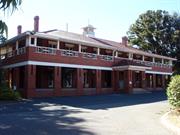
Stubbs Tce Shenton Park
INCLUDES: Aleppo pine Tree, Admin Block, Services Block, Crete House, Borneo House, Alamein House, Patient Shelter & Pavilion + site features, landscape areas and elements DOES NOT INCLUDE: Flanders House & Gallipoli House
Shenton College
Nedlands
Metropolitan
Constructed from 1926
| Type | Status | Date | Documents |
|---|---|---|---|
| Heritage List | Adopted | 19 Dec 2017 | |
| State Register | Registered | 27 Aug 1999 | HCWebsite.Listing+ListingDocument, HCWebsite.Listing+ListingDocument |
| Type | Status | Date | Documents |
|---|---|---|---|
| (no listings) |
| Type | Status | Date | Grading/Management | |
|---|---|---|---|---|
| Category | ||||
| Municipal Inventory | Adopted | 27 Apr 1999 | Category A | |
| Municipal Inventory | Adopted | 23 Oct 2018 | Category A | |
| Municipal Inventory | Adopted | 15 Apr 1999 | ||
| Statewide War Memorial Survey | Completed | 01 May 1996 | ||
Excellent
| Name | Type | Year From | Year To |
|---|---|---|---|
| W B Hardwick, Chief Architect of the Public Works Department | Architect | - | - |
| Library Id | Title | Medium | Year Of Publication |
|---|---|---|---|
| 4127 | Lemnos Hospital/Selby Centre (Proposed Shenton College) Shenton Park: conservation plan. | Heritage Study {Cons'n Plan} | 1999 |
| 5947 | Shenton College/Lemnos Hospital : referral plans. | C D Rom | 2002 |
| 3157 | Lemnos Hospital Shenton Park Heritage Assessment | Heritage Study {Other} | 1997 |
Individual Building or Group
| Epoch | General | Specific |
|---|---|---|
| Present Use | HEALTH | Hospital |
| Original Use | HEALTH | Hospital |
| Original Use | HEALTH | Asylum |
| Style |
|---|
| Inter-War Mediterranean |
| Type | General | Specific |
|---|---|---|
| Roof | TILE | Ceramic Tile |
| Wall | BRICK | Common Brick |
| General | Specific |
|---|---|
| SOCIAL & CIVIC ACTIVITIES | Community services & utilities |
| OUTSIDE INFLUENCES | World Wars & other wars |
This information is provided voluntarily as a public service. The information provided is made available in good faith and is derived from sources believed to be reliable and accurate. However, the information is provided solely on the basis that readers will be responsible for making their own assessment of the matters discussed herein and are advised to verify all relevant representations, statements and information.
Constructed from 1926
Selby-Lemnos Hospital has significant aesthetic, historic, social, rarity and representative cultural heritage value. It is a fine representative of a Large number of Menial Health buildings in the City of Ncdlands. The selling and architectural integrity of the buildings have strong heritage merit that reflect an interesting mix of interwar design influenced by Federation filigree style. The hospital was uniquely designed to provide a homely domestic selling to enhance the possibility of recuperation from mental illness, this was a diversion from the norm in the post World War I period. Historically the hospital has had strong associations with providing a vital service in Mental Health for soldiers recuperating from two world wars.
The site is well located with a pleasant curved driveway flanked by mature trees. The buildings are basically red brick, and appear set in bushland context with outlook to the west. The unity of the added buildings with the original structures has been obtained by restrain! in the use of materials and proportions. This results in a peaceful. non-aggressive environment. The reception building is two storeys with a broken back clay tiled roof. composite brick and timber balustrade recanting the filigree of the Federation era, and the Union flag in the design of the balustrade. The ward buildings appear less opulent than the reception building. each laking its relative part in the hierarchy of development on the site. Attractive well maintained gardens complete the setting of this historic place.
Lemnos Hospital was opened on 12 July 1926 to provide treatment and care for ex-servicemen suffering from mental illness. The hospital was named after the island in the Aegean Sea used as a hospital during World War L Though there is no evidence, il is thought that Dr James Bentley, the Inspector General of the Insane in 1926 chose the name Lemnos for the new hospital. Bentley had served in the Australian Infantry Force during World War I and spent time on Lemnos in the Aegean Sea recovering from malaria. It was designed with the intention of providing a home rather than an institution for returned service men, and in this respect reflected the contemporary attitude towards hospital design in the I920s. The layout and plans for the new hospital were the result of consultation between the Inspector General for the Insane Dr J T Anderson and the principal architect of the Public Works Department. Mr W 0 Hardwick. The final design was domestic in scale and detail with an emphasis of symmetry in the facade and the intention to give it Australian character. The scale and detailing of the buildings and gardens contrasted with the grander but more forbidding institutional buildings and open landscape characteristic of Claremont Hospital (now Swanbourne and Graylands Hospitals). Lemnos was officially opened by Governor Sir William Campion on the 12 July 1926 in the presence of Colonel Semmens (Commonwealth Repatriation Commission), S W Munsie, MLA (the Minister for Health) and Premier Collins. Following World War II the number of patients at the hospital increased. resulting in the construction of a new closed ward in 1955. An additional ward block was constructed in the 19605. The hospital currently houses geriatric patients suffering from mental illness. Among them are a very few of the original returned servicemen. In more recent years n number of other mental health facilities have been established on the land around Lemnos Hospital. In 1965 the Shenton Park Day Centre opened. This was renamed the Selby Community Clinic in 1967. In 1983 Administration Offices for Mental Health Services were constructed and in 1987 Selby Community Clinic was extended and the Head Injured Unit and the Child Psychiatric Unit were relocated to the site. In November 1995 a commemoration plaque wac; unveiled by Mr A Bansemen to recognise the naming of the Sclby-Lernnos Hospital.
Excellent
Excellent
| Name | Type | Year From | Year To |
|---|---|---|---|
| W B Hardwick | Architect | - | - |
| Ref Number | Description |
|---|---|
| SP1 | LGA Place No |
| Owner | Category |
|---|---|
| c/o P Monahan | Other Private |
This information is provided voluntarily as a public service. The information provided is made available in good faith and is derived from sources believed to be reliable and accurate. However, the information is provided solely on the basis that readers will be responsible for making their own assessment of the matters discussed herein and are advised to verify all relevant representations, statements and information.
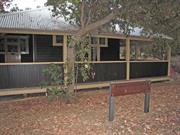
11 Kirkwood St Swanbourne
Relocated to Allen Park, adjacent to P23687 Tom Collins' House.
(formerly) 74 Clement St
Nedlands
Metropolitan
Constructed from 1907, Constructed from 1909
| Type | Status | Date | Documents |
|---|---|---|---|
| Heritage List | Adopted | 19 Dec 2017 | |
| State Register | Registered | 13 Jul 2007 | HCWebsite.Listing+ListingDocument, HCWebsite.Listing+ListingDocument |
| Type | Status | Date | Documents |
|---|---|---|---|
| (no listings) |
| Type | Status | Date | Grading/Management | |
|---|---|---|---|---|
| Category | ||||
| Municipal Inventory | Adopted | 15 Apr 1999 | ||
| Municipal Inventory | Adopted | 27 Apr 1999 | Category C | |
04487 Allen Park, Melon Hill & Wood/Sayer Sts Walkway
Poor
| Library Id | Title | Medium | Year Of Publication |
|---|---|---|---|
| 8427 | The Furphy family in Western Australia : upwardly mobile in Perth. | Journal article | 2005 |
| 8075 | Initial conservation works to Mattie Furphy House, Swanbourne. | Report | 2006 |
| 9967 | Mattie Furphy's House (1907-1909) 74 Clement Street, Swanbourne. Interim draft report. | Heritage Study {Cons'n Plan} | 2005 |
Individual Building or Group
| Epoch | General | Specific |
|---|---|---|
| Original Use | RESIDENTIAL | Single storey residence |
| Present Use | RESIDENTIAL | Single storey residence |
| Style |
|---|
| Federation Bungalow |
| Type | General | Specific |
|---|---|---|
| Wall | TIMBER | Weatherboard |
| Other | TIMBER | Other Timber |
| Roof | METAL | Steel |
| General | Specific |
|---|---|
| OCCUPATIONS | Intellectual activities, arts&craft |
| PEOPLE | Famous & infamous people |
| OCCUPATIONS | Domestic activities |
This information is provided voluntarily as a public service. The information provided is made available in good faith and is derived from sources believed to be reliable and accurate. However, the information is provided solely on the basis that readers will be responsible for making their own assessment of the matters discussed herein and are advised to verify all relevant representations, statements and information.
Constructed from 1912
The Furphy residence in Clement Street, Swanbourne has aesthetic, historic, representative and rarity cultural heritage significance. Though in poor condition, the house has high integrity as it remains uncornpromiscd with few changes to its original design. The deep verandahs, post and rail fence. and lock of adornment mark the house as a 'working man's' cottage. It is a good representative of increasingly rare 'turn of the century' timber couages. However. the most significant feature of the house is its close association with LItefinal years of Joseph Fnrphy's (author Tom Collins) lifo. The house ..vas built for Joseph's son Sam as (I home for Slim and his wife Mattie. Joseph and Sam, both being artistic handymen, did much of the work on the house. Joseph Furphy became a renowned Australian author after 'his death. His works, particularly Such is Life became popular during the 19)05 and 1940s. even though he had published as early as 1903. Joseph Furphy died in this residence in 1912 and is buried in Karrakaua Cemetery.
This single storey, modest cottage has a hipped galvaniscd corrugated iron roof with north and south gables. The timber framed cottage with jarralt weatherboards and brick chimney presents <111 understated picture to the street, The tcadlights (Ire significant. It h;JS an interesting outbuilding lind much of the original fabric, such as the fence with link mesh. is still In place, though in poor condition.
Sam Furphy was the son of Joseph Furphy (Author Tom Collins). This house has direct links to Joseph through his involvement in the development of the land and house, In 1905 Joseph and his wife. Leonie. moved to Western Australia 10 be close to their children. Felix and Sam. They bought three adjacent lots in Clement Street. Swanboume. and proceeded to Clear the land and build shocks for themselves. In 1906 Sam bought Joseph's And Felix's land and eventually he and his wife Mattie built the house that still stands in a hugely unaltered stnte on the corner of Pine Close and Clement Street. Joseph, who worked as a handymnn while writing short stories and poetry. helped Sam and Mattie to build the house. In his letters Joseph Furphy makes references to the house and grounds and some of the work he undertook there to help his son and daughter-in-law. Joseph died in this house of a cerebral haemorrhage on 13 September 1912 after walking a borrowed horse from his house in Servetus Street. Sam and Mattie Furphy moved from the house in Clement Street to Joseph Fnrphy's house in 1939
High
Poor
| Ref Number | Description |
|---|---|
| SW2 | LGA Place No |
| Owner | Category |
|---|---|
| S Reagan & J Carrigg | Other Private |
This information is provided voluntarily as a public service. The information provided is made available in good faith and is derived from sources believed to be reliable and accurate. However, the information is provided solely on the basis that readers will be responsible for making their own assessment of the matters discussed herein and are advised to verify all relevant representations, statements and information.
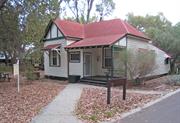
88 Woods Street Swanbourne
Portion of Reserve 7804 - Wood Street
Nedlands
Metropolitan
Constructed from 1907
| Type | Status | Date | Documents |
|---|---|---|---|
| Heritage List | Adopted | 19 Dec 2017 | |
| State Register | Registered | 05 Nov 1999 | HCWebsite.Listing+ListingDocument, HCWebsite.Listing+ListingDocument |
| Type | Status | Date | Documents |
|---|---|---|---|
| (no listings) |
| Type | Status | Date | Grading/Management | |
|---|---|---|---|---|
| Category | ||||
| Classified by the National Trust | Classified | |||
| Register of the National Estate | Indicative Place | |||
| Municipal Inventory | Completed | 15 Apr 1999 | ||
| Municipal Inventory | Adopted | 27 Apr 1999 | Category B | |
04487 Allen Park, Melon Hill & Wood/Sayer Sts Walkway
| Library Id | Title | Medium | Year Of Publication |
|---|---|---|---|
| 88 | At the toss of a coin : Joseph Furphy the western link. | Book | 1987 |
| 734 | Heritage assessment and conservation plan for Tom Collins House. | Heritage Study {Cons'n Plan} | 1995 |
| 4437 | Post haste the millennium: opportunities & challenges in Local Studies. Proceedings of the 2nd National ALIA Local studies Section Conference. | Conference proceedings | 1999 |
| 87 | Tom Collins and his house | Book | 1973 |
| 12123 | Tom Collins House - Architectural evalution for the Western Australian Heritage Committee | Heritage Study {Other} | 1988 |
| 8427 | The Furphy family in Western Australia : upwardly mobile in Perth. | Journal article | 2005 |
| 1195 | Tom Collins' house. | Heritage Study {Cons'n Plan} | 0 |
Individual Building or Group
| Epoch | General | Specific |
|---|---|---|
| Original Use | RESIDENTIAL | Single storey residence |
| Present Use | SOCIAL\RECREATIONAL | Other |
| Style |
|---|
| Federation Bungalow |
| Type | General | Specific |
|---|---|---|
| Wall | TIMBER | Weatherboard |
| Roof | METAL | Zincalume |
| Other | BRICK | Common Brick |
| General | Specific |
|---|---|
| PEOPLE | Famous & infamous people |
This information is provided voluntarily as a public service. The information provided is made available in good faith and is derived from sources believed to be reliable and accurate. However, the information is provided solely on the basis that readers will be responsible for making their own assessment of the matters discussed herein and are advised to verify all relevant representations, statements and information.
Tom Collins House is highly significant for its association with the writer Joseph Furphy who wrote Such is Life (1903) under the pen name Tom Collins. The book is regarded as one of the classics of Australian literature. The house was built by Furphy with the help of a neighbour. Various doors and the fireplace surrounds contain decorative panels made by Furphy's daughter in-law, Mattie Furphy. These panels have significant cultural and rarity value. The house with its museum collection is significant. It is regarded as one of the most important literary museums in the country. Some loss of value has occurred with the relocation of the house to another site. However the relocation has been in accordance with the guidelines of the Burra Charter and the house will continue to function as the headquarters of the Fellowship of Australian Writers (WA) and as a museum. The new site of Tom Collins House is of some significance in that it lies in the vicinity of the area where Joseph Furphy and his family first settled before moving to Servetus Street. The existing Clement Street house built by Sam and Mattie Furphy on the site of these former houses has the original fireplace surrounds which contained Mattie's panels, and other decorative wood work is still in situ. In his letters Joseph Furphy makes reference to the house and grounds and some of the work he undertook there to help his son and daughter-in-law. He died at the Clement Street house after walking a borrowed horse from Servetus Street. Impact of relocation on heritage significance of Tom Collins House While it is unfortunate that Tom Collins House had to be moved from its site in Servetus Street, this was the only alternative to its demolition Article 9 of the Burra Charter allows for relocation when there is no other alternative course of action, dependent on the following condition: "If any structure is moved, it should be moved to an appropriate setting and given an appropriate use. Such action should not be to the detriment of any place of cultural significance." The new site is considered an appropriate setting, and the former functions of the house will be maintained. It could be argued that because the bushland setting of Allen Park is closer to the original nature of the Servetus Street site when Joseph Furphy built and lived in the house, the relocation gives a truer sense of the ambience of the place as it used to be. Furphy described the Clement Street area where he first lived as a "wild bush spot" and the Servetus Street site would have been very similar. Both places had to be cleared of bush before he could build his homes. The following is an evaluation of the impact of relocation on the heritage values established in the original assessment. Aesthetic Value The former picturesque quality of the house in its setting will be re-established through the use of sensitive landscaping. The slope of the land down to the house has been maintained, although not to the extent where this had previously caused problems with rising damp. The aesthetic value of the interior in relation to the artworks and fittings, in particular the beaten copper panels by Mattie Furphy will be maintained. Historic Value The association of the house with Joseph Furphy will be maintained as well as the ongoing history of the house as the headquarters of the WA Branch of the Fellowship of Australian Writers. As stated above there are also strong historical associations with the area. The Furphy family acquired three adjacent lots in nearby Clement Street and these were cleared by Joseph who built 'shacks' for himself and his sons. In 1906 Fel ix and Joseph's wife Leonie sold their allotments to the other son Sam, and daughter-in-law Mattie eventually built on the comer of Clement Street and Pine Close still stands in a largely unaltered state. The beaten copper panels and doors which were installed in Tom Collins House by Sam and Mattie when they moved in were originally made for the Clement Street house. Joseph would have been familiar with the Allen Park area bushland as a number of his letters testify to his long walks over the district and along the beaches. Scientific Value Little of scientific value has been associated with the house. Social Value Social and cultural values will remain with the house through its association with one of Australia's great literary figures and the reputations of many of the past and present members of the Fellowship. The house is also regarded as one of Australia's most important literary museums. The housing of the collection and functioning of the place will be much improved through conservation work on the building and the opportunities presented with the new location. This value will be enhanced with the implementation of the overall plan for Allen Park. Quotations from Furphy's letters describing the area will be used on instructional nodes throughout the Park. Rarity The house is one of a dwindling number of the simple type of weatherboard cottage built in the metropolitan area at the turn of the century. Representativeness Tom Collins House remains a typical example of the working man's cottage built to a simple plan. It is representative of the timber and iron houses constructed before building by-laws prohibited the erection of timber dwellings in the metropolitan area. Condition, Integrity and Authenticity Before removal, the house was in a very poor condition. This is now being rectified through restoration and repairs. Original fabric that was in sound condition was retained and reused. Adjusted Statement of Significance "Tom Collins House and its contents is highly significant for its association with the writer Joseph Furphy whose book Such is Life is regarded as one of the classics of Australian literature. This significance is strengthened by the fact that the original front section of the house was built by Joseph Furphy, and some fittings and furnishings are reputed to be by his hand. He lived in the house for the last five years of his life. The house also has significance as an example of a modest hand crafted weatherboard cottage constructed in the metropolitan area prior to the First World War. As such it has potential rarity value. Of high aesthetic value and significance is the decorative copper work by Mattie Furphy found on various doors and the fireplace overmantle. This work has considerable rarity value. Tom Collins House is also significant as the headquarters of the Fellowship of Australian Writers (WA) and as a literary museum. Many leading literary figures have been and are associated with the house. Those aspects of significance relating to the site, setting and garden have been diminished through relocation. However a number of these aspects are being addressed. For example a re-established garden will contain cuttings from the original fig tree and mulberry tree planted by Joseph Furphy, and the Fellowship's garden furniture such as the Furphy Water Tank, sun-dial and various memorials will be re-established. The new site of Tom Collins House is of some significance in that it lies in the vicinity of the area where Joseph Furphy and his family first settled before moving to Servetus Street. The existing Clement Street house built by Sam and Mattie Furphy on the site of these former houses has the original fireplace surrounds which contained Mattie" panels, and other decorative wood work is still in situ. In his letters Joseph Furphy makes reference to the house and grounds and some of the work he undertook there to help his son and daughter-in-law. He died at the Clement Street house after walking a borrowed horse from Servetus Street.
Tom Collins House is a timber and iron 'worker's cottage' originally built to a standard design used at the turn of the century. Viewed from the outside it has an asymmetric plan form with a projecting front room on the left and verandah to the right. The original central passageway was altered some time in the late 1930s with part of the verandah enclosed to create an entrance foyer and the front door moved to the side. Since 1907 a verandah was added to the rear of the house and later converted to additional living rooms to what had been a four room cottage. Other internal changes were made when the house becan1e the headquarters of the Fellowship of Australian Writers (WA). The weatherboards are painted white and the iron roof is painted red. The house has been resited in a lightly wooded area in Allen Park.
Assessment 1997 Construction:1907 Builder: Joseph Furphy & Thomas Reinfeld The NTWA historical information comes from several sources. Jean Lang's book At the Toss of a Coin. Joseph Furphy: The Western Link which was published by the Tom Collins Press, Swanbourne in 1987 is the major source for the text with additions and adjustments made based on other documents and sources of information.
This information is provided voluntarily as a public service. The information provided is made available in good faith and is derived from sources believed to be reliable and accurate. However, the information is provided solely on the basis that readers will be responsible for making their own assessment of the matters discussed herein and are advised to verify all relevant representations, statements and information.
Constructed from 1907
Tom Collins House has highly significant aesthetic, historic. social, rarity and representativeness cultural heritage value. It is highly significant for its association with the writer Joseph Furphy who wrote Such is Life (1903) under the pen name Tom Collins. The book is regarded as one of the classics of Australian literature. The house was buill by Furphy with the help of a neighbour. Various doors and the fireplace surrounds contain decorative panels made by Furphy's daughter In law. Mallie Furphy. The house remains a typical example of the working man's COllagebuilt to a simple plan, It is representative of the timber and iron houses constructed before building by-laws prohibited the erection of timber dwellings in the metropolitan area. It is one' of the dwindling number of the simple type of weatherboard cottages built in the metropolitan area at the turn of the century. Tom Collins House is also significant as the headquarters of the Fellowship of Australian Writers (WA) and is a literary museum. Many leading literary figures have been and are associated with the house.
Tom Collins Honse is a timber and Iron 'worker's COllage'originally built to a standard design used at the rum of the century. Viewed from the outside it has an asymmetric plan formwith a projecting front room on the lell and vcrnndah to the right, The original central passageway was altered some time in the late 1930s with part of the verandah enclosed to create an entrance foyer and the front door moved to the side. Since 1907 a verandah.. later converted to additional Livingrooms, was added [0 the rear of the house Which had been a four roomed cottage. Other internal changes were made when the house became the headquarters of the Fellowship of Australian Writers (WA). The weatherboards are painted white and the iron roof is painted red. The house has been resited in a lightly wooded area of Allen Park. While it is unfortunate that Tom Collins House had to be moved from its site in Servetus Street. this was the only alternative to its demolition. Article 9 of the Burra Charter allows for relocation when there is no other alternative course of action. dependent on the following condition: "If any structure is moved. it should be IUO\'ed to nn appropriate setting and given 311appropriate use. Such action should not be to the detriment of any place of cultural significance". The new site is considered an appropriate setting. and the former functions of the house will be maintained. A number of diminished aspects of relocation arc being addressed. For example, a re-established garden will contain cuttlngs from the original fig tree and 111II Iberry tree planted by Joseph Furphy. and the Fellowship's garden furniture such as the Furphy WaterTank. sun-dial and various memorials will be re-established. It could be argued that because the bushland selling of Allen Park is closer to the original nature of uic Servctus Street site when Joseph Fnrphy built and lived in the house, the relocation gives a truer sense of the ambience of the place as it used to be. Fnrphy described the Clement Street area where he first lived as a 'wild bush spot' and the Scrvorus Street site would have been very similar. BOUI places had to be cleared of bush before he could build his homes.
Joseph Furphv was born in September 1843 at Yarra Glen. Victoria. He was the second son of Irish immigrants Samuel and Judith Furplry, Joseph completed his formal education in 1857. He was a 'jack of all trades' and worked at various jobs includlng form labourer.mechanic. gold prospector, and owner-operator of agricultural machinery and farmer During these years he began writing. winning his first prize for poetry in 1867, the year he married Leonie Celina Germain and became the licensee of the Vineyard Hotel. Daylesford. During the l870s he moved to various towns in Victoria. and eventually settled in Hay where he established a long-distance carrier business. However. drought and illness ensured business failure. It was during the 1880s that Joseph Furphy became attracted to socialist principles and began his longtime relationship with Kate Baker. twenty years his junior. Tn the I890s he wrote Such is L1{e.but amendments to the original manuscript were I10tcompleted for some years and the book eventually published in 1903. Joseph Fnrphy and his wife arrived in Western Australia on January 20th. 1905 to join their sons Felix and Samuel and their families. The sons had arrived about two years earlier and had established tbe Furphy foundry in Grey Street. Frernantlc in 1903
Original fabric restored. design uncomprised as only few changes. Relocated.
Good
| Ref Number | Description |
|---|---|
| SW5 | LGA Place No |
| Owner | Category |
|---|---|
| City of Nedlands | Local Gov't |
This information is provided voluntarily as a public service. The information provided is made available in good faith and is derived from sources believed to be reliable and accurate. However, the information is provided solely on the basis that readers will be responsible for making their own assessment of the matters discussed herein and are advised to verify all relevant representations, statements and information.