Local Government
Claremont
Region
Metropolitan
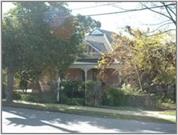
8 Goldsworthy Rd Claremont
Claremont
Metropolitan
Constructed from 1908
| Type | Status | Date | Documents |
|---|---|---|---|
| Heritage List | Adopted | 07 Jul 2015 |
| Type | Status | Date | Documents |
|---|---|---|---|
| (no listings) |
| Type | Status | Date | Grading/Management | |
|---|---|---|---|---|
| Category | ||||
| Municipal Inventory | Adopted | 05 Aug 2014 | HA - Category 2 | |
| Municipal Inventory | Adopted | 31 Dec 1995 | ||
25830 Goldsworthy Road Heritage Area
Goldsworthy Road Heritage Area comprises a substantial group of Federation residences that predominantly demonstrate a similarity of design and detail of the later Bungalow style, with the fine examples at 16, 18 and 20, all developed by the Irvine family; namely Captain Irvine and his daughters Pearl and Jessie respectively, in 1909, following their residences at Nos 2. and 4 in 1905, noting considerable improvements to the detail of the similar designed places. Overall the group forms a cohesive cultural environment of quality residences of the ‘Federation’ period.
Single storey painted brick. The expansive tiled roof is hipped with gablets on the ridge, and a feature gable on the front over a bay window, with a break pitch roof continuing over the verandahs to the front and both sides. The verandah is supported by turned timber posts and lace brackets. The tall square chimneys have clay pots.
The majority of places in the Goldsworthy Road Heritage Area were constructed during the ‘Consolidation’ period. Occupation of Goldsworthy Road is however older being first developed during the ‘Gentry Village’ period which had two foci, one of which was the area between Freshwater Bay and Stirling Highway west of Goldsworthy Road and east of Bayview Terrace. Three households can be identified on Goldsworthy during this period and two of these (Nos.10 & 12) are within the Goldsworthy Road Heritage Area. By 1903 the number of residences had increased to fifteen. By the end of the ‘Consolidation’ period (1915) there were twenty six houses on the street. The ‘Consolidation’ period was a period of rapid growth within the town. Population and housing grew steadily with 701 households or businesses in 1905, 872 in 1910 and 1,240 in 1915. The largest area containing houses of this period is the area bounded by Mary, Gugeri, Melville and Loch Streets and Stirling Highway. Surviving heritage homes from this period indicate that housing types were mainly Federation Bungalow and Federation Queen Anne with three to five rooms. Captain James Irvine and his daughters Jessie and Pearl had considerable interest in the original developments of the residences at Nos. 2, 4, 16, 18, and 20.
Level contributory significance: Some Contribution
Individual Building or Group
| Epoch | General | Specific |
|---|---|---|
| Original Use | RESIDENTIAL | Single storey residence |
| Present Use | RESIDENTIAL | Single storey residence |
| Type | General | Specific |
|---|---|---|
| Wall | BRICK | Common Brick |
| Roof | TILE | Other Tile |
This information is provided voluntarily as a public service. The information provided is made available in good faith and is derived from sources believed to be reliable and accurate. However, the information is provided solely on the basis that readers will be responsible for making their own assessment of the matters discussed herein and are advised to verify all relevant representations, statements and information.