Local Government
Swan
Region
Metropolitan
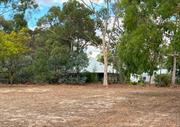
156 Copley Rd Upper Swan
Municipal Inventory No: 540
Swan
Metropolitan
Constructed from 1910, Constructed from 1900
| Type | Status | Date | Documents |
|---|---|---|---|
| (no listings) |
| Type | Status | Date | Documents |
|---|---|---|---|
| (no listings) |
| Type | Status | Date | Grading/Management | |
|---|---|---|---|---|
| Category | ||||
| Municipal Inventory | Adopted | 30 Aug 2017 | Category 4 | |
| Local Heritage Survey | Adopted | 23 Apr 2025 | Category 3 | |
| Municipal Inventory | Adopted | 10 Jul 1996 | Some Significance | |
House, 156 Copley Road has cultural heritage significance for the following reasons: • The place has aesthetic value as a good example of a timber weatherboard cottage built during the Federation period of architecture. • The place has historical significance for its association with the early rural subdivisions of the Swan Valley and Upper Swan area.
House, 156 Copley Road is a single storey timber weatherboard dwelling with a corrugated steel hipped roof displaying characteristics from the Federation period of architecture. The place has a symmetrical form with a high hipped roof and central ridge gablets. The roof features two face brick chimneys with brick corbelling. The main roof pitch extends over all sides to form a wrap around verandah supported by square timber posts. The external walls are clad with jarrah weatherboards. The front facade has a central timber framed door with French doors opening onto the verandah. There appears to be a small lean-to addition to the rear of the place. The dwelling is set well back from the road and accessed via a gravel driveway with avenue of tall eucalypts. The front of the dwelling is densely planted with mature trees and is largely obscured from the street.
In March 1827, Captain James Stirling explored the Swan River including the area which was later named Guildford, and noted the fertile soils in the Upper Swan. Stirling returned to establish the Swan River Colony in June 1829. In September 1829, Stirling and Surveyor General Roe travelled to the head of the Swan River above Guildford with a group of settlers to whom permission had been given to select land. These were the first rural land grants in the Colony, and among them was that of Peter Broun (Brown) who selected 10,000 acres to the north at Swan Location 3 known as “Coulston”. In c.1851 the first convict built timber bridge was constructed at the site of the present day Yagan Bridge, providing access across the Swan River. In 1871, following the establishment of the Swan Road District,1 the Midland Railway line was constructed extending north through the present day town of Upper Swan. A new rail siding in Upper Swan was built in 1894, however, the surrounding area wasn’t subdivided until 1910, when Lord, Hassen & Co advertised the sale of one-acre and half-acre lots as part of the ‘Upper Swan Estate’. The subdivision formed the original layout of Upper Swan which is still evident today. Apart from some properties the area remained rural and did not take up significant residential development until the 1970s. Further research is required but it is likely the house at 156 Copley Road was constructed around in the early 20th century aligning with the original rural subdivisions. Copley Road is named after Samuel W. Copley who in 1900 purchased 40,000 acres of land in Upper Swan which he developed for sheep and cattle farming, and high class vineyards.2 Aerial imagery indicates that a small lean-to was added to the rear of the dwelling in the early c.1990s. Apart from the lean-to the place appears to have undergone very little external changes since 1953.3
Good
Good
Individual Building or Group
| Epoch | General | Specific |
|---|---|---|
| Present Use | FARMING\PASTORAL | Cottage |
| Original Use | FARMING\PASTORAL | Cottage |
| Type | General | Specific |
|---|---|---|
| Wall | TIMBER | Weatherboard |
| Roof | METAL | Corrugated Iron |
| General | Specific |
|---|---|
| DEMOGRAPHIC SETTLEMENT & MOBILITY | Settlements |
This information is provided voluntarily as a public service. The information provided is made available in good faith and is derived from sources believed to be reliable and accurate. However, the information is provided solely on the basis that readers will be responsible for making their own assessment of the matters discussed herein and are advised to verify all relevant representations, statements and information.