Local Government
Upper Gascoyne
Region
Gascoyne
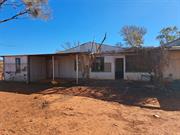
Waldburg Rd East Lyons River
Lot 201 on DP 425600
Upper Gascoyne
Gascoyne
Constructed from 1921, Constructed from 1932, Constructed from 1970 to 1980
| Type | Status | Date | Documents |
|---|---|---|---|
| (no listings) |
| Type | Status | Date | Documents |
|---|---|---|---|
| RHP - Does not warrant assessment | Current | 10 Dec 2024 |
| Type | Status | Date | Grading/Management | |
|---|---|---|---|---|
| Category | ||||
| (no listings) | ||||
• Walburg Homestead, Waldburg Road, East Lyons River is representative of a rudimentary steel and timber-framed homestead or outstation in the Gascoyne region, related to the pastoral industry, in the earlier half of the 20th century.
Waldburg Homestead, Waldburg Road, East Lyons River (Waldburg Homestead) is situated on Waldburg Station, a large pastoral lease in the Shire of Upper Gascoyne, approximately 280km north west of Meekatharra. The place comprises a main homestead, approximately 8-10 scattered outbuildings and sheds, a water-tank and a simple stock-proof fence around the perimeter which is now dilapidated. There also appears to be the remnants of stock-holding pens to one side of the homestead. The main homestead is a steel and timber-framed building, with custom orb corrugated iron cladding. It has a gable roof with no gutters, and verandahs (some closed-in). Internally, it is lined with asbestos and some replacement fibre-board sheeting. The floor is concrete - likely made with local aggregate
Waldburg Homestead is on Walburg Station, a large, unproductive, pastoral lease (P/L 3114/1156) of nearly 250ha in the Gascoyne Region. The lease has always been run as a cattle station. At the turn of the century, gold was discovered at Mt Egerton, on what is now part of the Walburg lease, prompting a short-lived gold-rush that quickly dissipated when a significant mother lode was never found, despite considerable efforts. The earliest records of the Waldburg lease date to approximately 1921 when the lease was held briefly by Healy and Russell. Norwegian blacksmith Peter Haugsted took up the lease in 1932 for 11 hard years, until drought drove him off the land. The district is a little too far south to get the summer rains, which are the feature of the Nor'-West, and a little too far north to get the southern rains…. The lease exchange hands several times until 1964 when John and Maureen Woods took it up. In 1999, it was purchased by State Government with the aim of negotiating with the native title holders to convert it to a national park.
Dilapidated
Individual Building or Group
| Epoch | General | Specific |
|---|---|---|
| Original Use | FARMING\PASTORAL | Homestead |
| Present Use | VACANT\UNUSED | Vacant\Unused |
| Style |
|---|
| Vernacular |
| Type | General | Specific |
|---|---|---|
| Wall | METAL | Steel |
| Wall | TIMBER | Other Timber |
| General | Specific |
|---|---|
| DEMOGRAPHIC SETTLEMENT & MOBILITY | Settlements |
| PEOPLE | Early settlers |
| OCCUPATIONS | Grazing, pastoralism & dairying |
| Economy | Rural Occupations |
This information is provided voluntarily as a public service. The information provided is made available in good faith and is derived from sources believed to be reliable and accurate. However, the information is provided solely on the basis that readers will be responsible for making their own assessment of the matters discussed herein and are advised to verify all relevant representations, statements and information.