Local Government
Beverley
Region
Avon Arc
Forrest Street Beverley
Reserve 4620
Beverley Nurses' Quarters
Beverley
Avon Arc
Constructed from 1962 to 1963
| Type | Status | Date | Documents |
|---|---|---|---|
| (no listings) |
| Type | Status | Date | Documents |
|---|---|---|---|
| RHP - Assessed - Consultation (Statutory) | Current | 06 Jan 2026 | HCWebsite.Listing+ListingDocument |
| Type | Status | Date | Grading/Management | |
|---|---|---|---|---|
| Category | ||||
| (no listings) | ||||
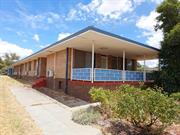
Mid-century brick building with a low-pitched, tiled roof. Building is approx. 40 X 10m, with sloping gradient at eastern end. Building comprises entry via stairs, with sitting rooms (three) at both ends of the building. Eight bedrooms are located on one side of a central corridor, with laundries, bathrooms and store rooms located on the opposite side. A covered carport and veranda bookend the building.
The Ballardong Noongar people refer to the Beverley area as Wergijan. Due to its location along the Avon River, the area is rich in bush food and native animals. The Ballardong people were the original inhabitants of this land and lived virtually undisturbed until Ensign Robert Dale of the 63rd Regiment, led three expeditions in the region in 1830/31, which resulted in the discovery and settlement of pastoral lands in the 1840s and 1850s. The district was surveyed in 1843 and town of Beverley was formally established in 1868. After the Eastern Railway Line reached Beverley in 1886, the population grew rapidly.As a result, development of the town saw an increase in commercial businesses and government facilities and services. Following a local outbreak of influenza, which saw several people die, medical facilities became a priority. In 1898, the Beverley Hospital was constructed, however the building sat idle for the first 8 years. Changes to government and the unwillingness to spend money on the hospital due to its proximity to the York hospital were reasons for this. In 1906, residents were becoming impatient and regularly began lobbying the government to open the hospital. Finally on 2nd July 1910, the hospital officially opened. By 1929, discussions about the lack of suitable accommodation for hospital staff were repeatedly on the agenda of the Beverley Hospital Board’s monthly meeting. Funds were raised for new facilities, but when the Great Depression hit, any activity was postponed and the Medical Department later advised it no longer had the funds. As frustrations grew amongst hospital staff, a leading article was published in the Nurse’s Journal calling attention the lack of suitable facilities. This prompted the Lotteries Commission to assist with funding 50% of the cost new nurses’ quarters. By 1938 a new building was proposed for construction with plans drawn up by the Public Works Department. However, to cut costs, in May 1938 the Hospital Board unanimously decided to instead purchase a residential property in Forrest Street, whose owner had recently died and convert it to the new nurses’ quarters. The new quarters were officially opened on 21st July 1938 by Hon J.J. Kenneally, Chairman of the Lottery Commission. By 1963 the repurposed nurses’ quarters were considered no longer fit for purpose. At the opening of the new Beverley Junior High School a year earlier, Premier David Brand announced the construction of a new quarters next to the hospital, on the corner of John and Forrest Streets. To address the lack of accommodation for teachers, the original nurses’ quarters building was purchased by the Education Department and converted into the headmaster’s residence. The previous headmaster’s residence in Vincent Street was taken over by the Shire Council. As outlined in the Thematic History of Government Housing in WA, in the early twentieth century, nurses’ quarters were generally provided as shared bedrooms for the nurses and a private room for the matron. Although by the second half of the twentieth century, every nurse was intended to have a private room, living and dining facilities remained communal. The design of the new Beverley Nurses’ Quarters by Perth architect, Raymond Jones, who had an original budget of £17,000 for the building’s construction, reflected this intent. Raymond Jones was a notable Perth architect who won several awards for his modernist housing designs. Jones was also noted for his many ecclesiastical projects and commercial buildings. He was responsible for the development of the ‘Tetrakit’ system, a prefabricated kit home resistant to strong winds in north-western Australia in the mid-1970s. Construction of the Beverley Nurses’ Quarters building began in 1962 by contractor, Gordon Reynolds, whose final quote was £21,002. It officially opened on 29 March 1963 and was described as a ‘handsome addition to the town’s buildings…providing for six nurses as well as embracing a matron’s flat’. Nurses occupied the building in the 1970s and 1980s. By the late 1980s other hospital staff also lived there as fewer nurses were in residence. This reflected the change in training and accommodation requirements for nursing trainees following the introduction of a tertiary nursing qualification in 1974 across the State. In recent years the building was used as an allied health centre, with dietitian, occupational therapy, physiotherapy, podiatry and speech pathology services. In 2024, the building is vacant.
| Name | Type | Year From | Year To |
|---|---|---|---|
| Raymond Jones | Architect | - | - |
Individual Building or Group
| Epoch | General | Specific |
|---|---|---|
| Present Use | VACANT\UNUSED | Vacant\Unused |
| Original Use | HEALTH | Housing or Quarters |
| Style |
|---|
| Post-War International |
| Type | General | Specific |
|---|---|---|
| Wall | BRICK | Common Brick |
| General | Specific |
|---|---|
| Social Services | Health |
This information is provided voluntarily as a public service. The information provided is made available in good faith and is derived from sources believed to be reliable and accurate. However, the information is provided solely on the basis that readers will be responsible for making their own assessment of the matters discussed herein and are advised to verify all relevant representations, statements and information.