Local Government
Busselton
Region
South West
Lot 42 Farm House Ct Bovell
Off Bussell Highway 1.6km S/E of Busselton
Busselton
South West
Constructed from 1911
| Type | Status | Date | Documents |
|---|---|---|---|
| Heritage List | Adopted | 16 Oct 2024 | |
| Heritage List | YES | 13 Aug 2014 | |
| Heritage Agreement | YES | 12 Nov 2014 | HCWebsite.Listing+ListingDocument |
| Type | Status | Date | Documents |
|---|---|---|---|
| RHP - To be assessed | Current | 26 Aug 2011 |
| Type | Status | Date | Grading/Management | |
|---|---|---|---|---|
| Category | ||||
| Local Heritage Survey | 16 Oct 2024 | Category 1 | ||
| Municipal Inventory | Adopted | 20 Jun 1996 | Category 1 | |
| Municipal Inventory | Adopted | 13 Aug 2014 | Category 1 | |
| Register of the National Estate | Permanent | 21 Mar 1978 | ||
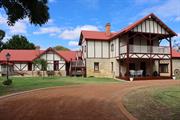
Little Holland House, a single and two storey farm house complex in the Federation Queen Anne style has cultural heritage significance as an unusual and picturesque application of the style in a picturesque composition located on the banks of the river. Little Holland House has historic value for its association with Henry Prinsep, Chief Protector of Aborigines and influential figure in the arts in the Western Australian community. The place has associations with the Bussell family who originally owned the land and through Charlotte Bussell who married Henry Prinsep. The residence has historic value for its connection with prominent architect George Temple Poole, friend of the Bussells who designed the house. Little Holland House is valued by the local and wider community as an intact remnant of the settlement of the area by leaders in the community in their retirement, and the style and scale of the residence demonstrates the type of home of professional men and their families.
Little Holland House is a partial two-storey homestead located in a large well maintained garden of lawns and mature trees on the banks of the Vasse River. The architectural style has been influenced by the Federation Queen Anne and Inter-War Old English styles and features the common characteristics, being a two-storey residence with timber gabling and imitation half-timbering. The place comprises a homestead, a tennis court, paddocks and some associated buildings. The ground floor of the homestead is mainly constructed of jarrah and limestone with walls half a metre thick. The upper level is of timber and weatherboard. The homestead has a gabled iron roof with brick chimneys.
The site of this residence is land that was originally owned by the Bussell family and subsequently acquired by Henry Prinsep (1844-1922). Henry Prinsep was an estate manager, horse-trader, artist and civil servant. He was a man of literary and artistic pursuits, brought up in 'Little Holland House' in Kensington, the home of his aunt and uncle. He travelled to Western Australia in 1866 to view 'Belvedere' the property his father purchased, his travel plans were delayed when he met and married Charlotte Josephine Bussell (1849-1929) in 1868. He took on the management of his father's estate until 1874, when he took on a role as a civil servant in the Department of Lands. He was later appointed as the Chief Protector of Aborigines in 1898, a position that was limited by poor government funding and lack of political support. Prinsep retired in 1908 and relocated to Busselton. The Prinsep's engaged architect George Temple Poole to design a home for themselves and their unmarried daughter Emily. The house was completed in 1911 and named after the Kensington home in which Henry was raised. The couple were influential in their retirement in Busselton, engaging in artistic pursuits, contribution to St Mary's Anglican Church and Henry was Chairman of the Busselton Road Board for some years. The land holding on which the property is located was gradually subdivided, most recently in 2014, the same year in which the City of Busselton and the owners entered into a Heritage Agreement for the future management of the property. Conservation works were subsequently undertaken to improve the amenity of the place whilst retaining the heritage values
The place retains a high degree of integrity. The place retains a high degree of authenticity.
Good
| Ref Number | Description |
|---|---|
| PN093 | Reference No. |
| 100049927 | COB Property ID |
| 534430 | Landgate Pin |
Individual Building or Group
| Epoch | General | Specific |
|---|---|---|
| Original Use | FARMING\PASTORAL | Homestead |
| Present Use | FARMING\PASTORAL | Homestead |
| Style |
|---|
| Federation Queen Anne |
| Type | General | Specific |
|---|---|---|
| Wall | TIMBER | Weatherboard |
| Roof | METAL | Corrugated Iron |
| Wall | BRICK | Other Brick |
| General | Specific |
|---|---|
| OCCUPATIONS | Grazing, pastoralism & dairying |
This information is provided voluntarily as a public service. The information provided is made available in good faith and is derived from sources believed to be reliable and accurate. However, the information is provided solely on the basis that readers will be responsible for making their own assessment of the matters discussed herein and are advised to verify all relevant representations, statements and information.