Local Government
Mundaring
Region
Metropolitan
Kalamunda to Albany
The entire track runs from Kalamunda to Albany
Bibbulmun Track (Kalamunda to Albany)
Mundaring
Metropolitan
Constructed from 1994 to 1998, Constructed from 1974 to 1978, Constructed from 1986 to 1988
| Type | Status | Date | Documents |
|---|---|---|---|
| (no listings) |
| Type | Status | Date | Documents |
|---|---|---|---|
| RHP - To be assessed | Current | 26 Sep 2025 |
| Type | Status | Date | Grading/Management | |
|---|---|---|---|---|
| Category | ||||
| (no listings) | ||||
Bibbulmun Track is the longest walking trail in Western Australia and one of the best-known long trails in Australia. It is highly valued as an outdoor recreation location across the South West region for individuals, families, hiking groups and (domestic and international) tourists and school groups since its creation in the 1970s.
Bibbulmun Track traverses the South West of Western Australia, recognised as a global biodiversity hotspot, providing walkers the opportunity to experience a rare environment unique to the State.
The creation of the Bibbulmun Track reflects a simultaneous movement amongst walking enthusiasts across Australia in the 1970s to create walking trails throughout forest and wildlife settings. Similarly, the later development and realignment of the Track under funding associated with the Australian Bicentennial works reflected parallel works in the eastern states.
The place is associated with Western Australia’s 150th year celebrations in 1979 and the Australian 1988 Bicentennial celebrations.
The creation of the original 1974 route, and the later realignments and extensions of the now 1000km Bibbulmun Track demonstrates a high degree of technical achievement by volunteers and government representatives.
Bibbulmun Track has special meaning to the members and volunteers of the Bibbulmun Track Foundation and the responsible State agencies , and the walkers who have completed sections of the Track, including those who have conquered the ‘end to end’ walk.
The involvement of prison inmates in the prefabrication of shelters and toilet facilities and the construction of the 1997 track extension and realignment of Bibbulmun Track established a significant relationship between the Department of Corrective Services and the Parks and Wildlife Service that continues today, and does not appear to be replicated elsewhere.
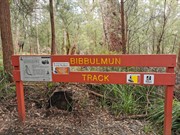
The Bibbulmun Track (the Track) is a long-distance walking trail extending 1000km from Kalamunda to Albany in the South West region of Western Australia. The route of the Track has been realigned and extended significantly since its original construction. Bibbulmun Track passes through Mundaring, Dwellingup, Collie, Balingup, Donnelly River Village, Pemberton, Northcliffe, Walpole, Peaceful Bay and Denmark, taking in the Darling Range and Southern Forests through Eucalypt bushland, granite outcrops, wetlands and southern coastal sections between Walpole and Albany. The Track has been designed to allow day walks for a range of skill levels, as well as longer sections requiring camping along the Track at designated campsites. Each of the 49 campsites on the Track includes a shelter, tent sites, picnic tables, bush toilets and rainwater tank. Most shelters are prefabricated three-sided constructions designed to accommodate 8 to 15 people and are constructed of either timber or rammed earth. A repurposed fire watchman’s house located adjacent to the defunct fire watch tower at the Mt Wells campsite is the only hut shelter located on the Track. The portion of Bibbulmun Track associated with the Brookton campsite comprises 2.5 kilometres of wheelchair accessible trail, and the shelter and toilet in this location have been modified to allow access and use by people with mobility impairment. Boardwalks, lookouts and footbridges all form part of the trail which is marked by the distinctive yellow triangular Waugal trail markers, a stylised representation of the Waugal (Rainbow Serpent) spaced approximately 500m apart. The route often has temporary diversions and realignments for various reasons, and hikers are advised to follow trail markers on the Track. With some changes made to the route in response to changing land uses and environmental changes, it is likely the route of the Bibbulmun Track will continue to vary over time.
Geoff Schafer is recognised as the instigator of the Bibbulmun Track. In 1972 Schafer approached the Minister for Forests, Hywel David Evans, with his idea for a walk in Western Australia to encourage people to explore the South West. Schafer was encouraged to consult with the Forests Department. Alongside Forests staff Peter Hewett, Wayne Schmidt and Ross Gobby, Schafer developed the route of the Bibbulman Track extending from Kalamunda to Northcliffe. The first iteration was marked out in March 1974 across what appears to have been mostly State government land. The suggestion for the name is attributed to forester Len Talbot. In October 1979, the Bibbulmun Track was officially opened as part of WA’s 150th year celebrations and was celebrated by 900km Bibbulmun Walk ’79. In the late 1980s, the former Department of Conservation and Land Management (CALM, now Parks and Wildlife Service) realigned the Bibbulmun Track between Kalamunda and Dwellingup to avoid conflict with bauxite mining and extended the track to Walpole. It was at this point that the Track was incorporated into the Heritage Trail Network and the Waugal symbol, a stylised representation of a snake on a distinctive yellow triangle, was adopted as the trail marker and symbol. In 1993 CALM initiated the ‘Building a Better Bibbulmun Track Project’, headed by Jim Sharp (CALM) and coordinated by walker Jesse Brampton, and assisted by a Steering Committee. Over 80% of the track was re-routed, and a south-coast extension to Albany increased the overall length to 840km. The ‘new’ purpose built Bibbulmun Track was aligned through national parks and reserves to take in the most scenic routes and ‘provide people with a chance to immerse themselves in the natural environment’. Many of the shelters and toilet buildings were prefabricated in prison workshops as part of a joint venture between CALM and the former Ministry of Justice (now Department of Corrective Services). Waalegh campsite and nearby trails were built by staff and minimum-risk prisoners. The success at Waalegh led to crews from Karnet Prison Farm and Pardelup Prison Farm working on campsites along the southern portion, and the establishment of prison work camps at Walpole and Badgingarra. The first section of the new track from Kalamunda to Brookton Highway was opened by the Hon. Peter Foss, Minister for the Environment, on 15 August 1995. The new northern section, comprising 453km track and 26 campsites, was formally opened by WA Premier Richard Court on 14 August 1997. The completed southern section, including the extension to Albany was opened by Hon Cheryl Edwards, Minister for the Environment, on 13 September 1998. In 1997, the Friends of Bibbulmun Track was established to support CALM in the management, marketing and maintenance of Bibbulmun Track. The Parks and Wildlife Service and the Bibbulmun Track Foundation continue to manage Bibbulmun Track which is divided in 147 maintenance sections varying in length from 5 to 10kms. Bibbulman Track is named for the Bibbulmun Noongar people, also known as Piblemen or Bibelmen, who speak for the country stretching from Denmark, north-east towards Nannup and inland to include the Manjimup area.
| Name | Type | Year From | Year To |
|---|---|---|---|
| 1990s Steering Committee (Jim Sharp, Wayne Schmidt and Marg Buckland, Les Cousins, Fred Robinson, Jay Cook, Peter Kemp, Mike Wood, Jesse Brampton) | Architect | 1993 | 1997 |
| Geoff Schafer | Architect | 1974 | - |
Landscape
| Type | General | Specific |
|---|---|---|
| Wall | EARTH | Pise {Rammed Earth} |
| General | Specific |
|---|---|
| SOCIAL & CIVIC ACTIVITIES | Sport, recreation & entertainment |
| DEMOGRAPHIC SETTLEMENT & MOBILITY | Environmental change |
| Environment | Environment |
This information is provided voluntarily as a public service. The information provided is made available in good faith and is derived from sources believed to be reliable and accurate. However, the information is provided solely on the basis that readers will be responsible for making their own assessment of the matters discussed herein and are advised to verify all relevant representations, statements and information.