Local Government
Bunbury
Region
South West
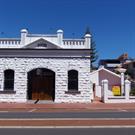
5 Victoria Bunbury
Lot 10
Bunbury
South West
Constructed from 1903
| Type | Status | Date | Documents |
|---|---|---|---|
| Heritage List | Adopted | 31 Jan 2023 |
| Type | Status | Date | Documents |
|---|---|---|---|
| (no listings) |
| Type | Status | Date | Grading/Management | |
|---|---|---|---|---|
| Category | ||||
| Local Heritage Survey | Adopted | 31 Jan 2023 | Exceptional Significance | |
Dalgety & Co. Building (fmr) has cultural heritage significance for the following reasons: • The place helps to illustrate the consolidation of the port and the town as an important regional centre at the turn of the century, through its development as the local headquarters for the Australia wide stock, station and shipping agency, Dalgety & Co Ltd. In this context it helps to illustrate the development of the northern end of Victoria Street as a focus for activities associated with the port. • The place also has long-term associations with the Meyer family, including Dietrich Heinrich (‘Henry’) Meyer (c.1860-1935), who had operated butcher shops in Bunbury from at least the 1890s and two of whose children, Karl and Alma, made a significant contribution to local musical recitals and musical education. • The Federation period architectural style, including the materials, building form, parapet, symmetry and architectural details all combine to positively contribute to the Victoria Street streetscape. • The place is part of an identifiable precinct of commercial and administrative buildings dating from the turn of the century, when architecture began to reflect the increasing prosperity of the town.
Dalgety & Co. Building (fmr) is a single storey stone building with a concealed corrugated steel hip roof displaying characteristics of the Federation Free Style style of architecture. The building has a symmetrical form with a zero building line set back to the street. The front facade has a stepped parapet divided into three distinct bays. The parapet has rendered pilasters with vermiculated detailing and coping stone details. The central bay has a triangular pediment with rendered decoration and the inscribed date '1903' featured. The lower section of the parapet has seven recessed arched details. A decorative rendered chimney is located behind the parapet. A rendered string course separates the parapet from the stone facade below. The lower section of the front facade has an exposed sandstone finish that has been painted white. The side walls have a smooth rendered finish and have been painted white. The stone foundation is offset at the base of the wall alignment. The building has signage that reads ‘Common Ground – Late Live Local’. The recessed timber front double door is a contemporary design with a concrete ramp from the footpath to the floor level. The entry is flanked by timber double hung windows with rendered sills and steel security grilles to the exterior. The door and window openings have stone voussoirs and keystones. To the north of the main building is a separate structure that is set well back from the street boundary and has a zero setback to the laneway to the north. This structure is rendered masonry with a corrugated steel gable roof. There is a roller door to the laneway elevation. The front courtyard yard is paved and enclosed by a rendered masonry pier fence with steel infill panels. The building appears to be in good condition and whilst there are some modifications, such as the front door and painted stonework, the building retains a high degree of authenticity.
At the beginning of the 1890s, Bunbury had a population of only 572. By the end of that decade, the population had risen to 2,970 – reflecting the rate of increase experienced by the colony as a whole following the discovery of significant gold deposits. This was matched by improvements in infrastructure, including the opening of the Perth to Bunbury railway line in 1893 and significant development of the port. From this time on the town developed not only as an important regional centre, but also as a seaside tourist resort. Despite the adverse impact of war and depression, Bunbury continued to experience residential and business development during the Inter-War era, and the population reached around 6,000 in 1939. The ongoing development and consolidation of the town over time continues to be reflected in its local heritage places. In late 1901, after several years of operating through local agents, a branch of Dalgety & Co Ltd, an Australia wide stock, station and shipping agency, opened in Victoria Street. By the middle of the following year, plans were advancing for the construction of purpose built premises for this firm: Sir Edward Wittenoom was in Bunbury this afternoon, principally with the view of inspecting a site in Victoria street, in front of the Bunbury Brewery premises, where it is the intention of Dalgety and Co. to erect a large brick building, to be utilised as a warehouse. In consequence, however, of the reports he has received as to the bad weather in Bunbury during the winter months, he has decided to postpone building operations till spring. A contract was finally signed for the construction of “a large warehouse and office for Messrs. Dalgety and Co.” in around March 1903, when it was announced: Mr W. Boundy is the successful tenderer for the erection of a warehouse for Dalgety and Co, Ltd., the price being £558. The building will be constructed of Donnybrook stone, and when finished should present a very attractive appearance. Mr Chas. Balding is the architect. The readily available evidence indicates that this was the building constructed on Lot 2 of plan 1541 (5 Victoria Street). Note: The architect, Charles Balding, was working in Bunbury by September 1896, when he called for tenders for additions to the Wellington Hotel. He was subsequently mentioned in newspaper reports with reference to the design and supervision of various shops and houses. He was still advertising his services with premises in Victoria Street in 1905, but appears to have moved away at around that time. In 1912, Lots 1 & 3 of diagram 1541 (flanking the Dalgety building which was on lot 2) were offered for sale by the liquidators for the Bunbury Brewery Co. By May 1922, advertisements indicate that the Bunbury office of Dalgety & Co had moved from Victoria Street to Wellington Street, and by 1926 the property was owned by Dietrich Heinrich (‘Henry’) Meyer (a local butcher). At that time it was being used as a music store by the Meyer Brothers (Karl Fritz Meyer and William Vondel Meyer), offering a range of musical instruments and accessories. It also appears to have been adapted as a residence and in 1931 was listed in the Electoral Rolls (known then as 126 Victoria Street) as the residential address of Dietrich Heinrich Meyer (butcher) and his four children, Alma Amelia Meyer (music teacher), Henry Edward Meyer (butcher), Karl Fritz Heinrich Meyer (music teacher) and William Vondel Meyer (butcher). By 1932, it was known as ‘The Studio of Music’, with Alma teaching pianoforte and Karl teaching violin, guitar, cello, and banjolin. In 1936, Bunbury underwent a major reallocation of street numbers which resulted in the property changing from 126 Victoria Street to its present address of 5 Victoria Street. In 1939, Lots 1, 2 and 3 of diagram 1514 were offered for sale with “a sound Brick and Stone Building suitable for a residence and business combined, or a large storeroom and warehouse”. However, it does not appear to have been sold as Alma was still listed as a music teacher of this address in the Electoral Rolls of 1943 and was listed as the owner of the property in 1951. In c.1948, the building was occupied as a depot for the Egg Marketing Board and it continued to be used for this purpose until at least 1951 (during which time Alma moved elsewhere). However, by 1958, she was once again listed as a music teacher of 5 Victoria Street, and remained here until c.1963. From c.2016-2019, the building was occupied by Sala Wine Lounge and Kitchen. In 2019, the building was occupied by Common Ground restaurant and bar. In October that year the place announced that it would be closing until further notice and remains permanently closed as of March 2022.
Medium
Good
Management Category 1
Individual Building or Group
| Epoch | General | Specific |
|---|---|---|
| Present Use | VACANT\UNUSED | Vacant\Unused |
| Original Use | COMMERCIAL | Office or Administration Bldg |
| Style |
|---|
| Federation Romanesque |
| Federation Warehouse |
| Type | General | Specific |
|---|---|---|
| Wall | STONE | Donnybrook Sandstone |
| Roof | METAL | Corrugated Iron |
| General | Specific |
|---|---|
| TRANSPORT & COMMUNICATIONS | River & sea transport |
| DEMOGRAPHIC SETTLEMENT & MOBILITY | Settlements |
This information is provided voluntarily as a public service. The information provided is made available in good faith and is derived from sources believed to be reliable and accurate. However, the information is provided solely on the basis that readers will be responsible for making their own assessment of the matters discussed herein and are advised to verify all relevant representations, statements and information.