Local Government
Claremont
Region
Metropolitan
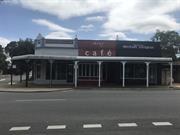
91-95 Shenton Rd Swanbourne
Comprises three semi-detached shops at Nos. 91, 93, 95 Shenton Road.
Claremont
Metropolitan
Constructed from 1913 to 1915
| Type | Status | Date | Documents |
|---|---|---|---|
| Heritage List | Adopted | 27 Jun 2023 |
| Type | Status | Date | Documents |
|---|---|---|---|
| (no listings) |
| Type | Status | Date | Grading/Management | |
|---|---|---|---|---|
| Category | ||||
| Local Heritage Survey | Adopted | 27 Jun 2023 | HP - Category 2 | |
The form of the shops remains reasonably intact and represents a sense of place for generations of residents. No. 95 has a significant association with the founder of the Aherns Department Store, who originally owned this shop. The interior of the building is not of cultural heritage significance. Included in the Heritage List for reasons of contributing to the townscape, meeting the requirements of Clause 78.3(c) of Local Planning Scheme 3.
No. 91: Single-storey painted and rendered tuckpointed brickwork. Timber framed bullnose verandah over pavement. Masonry parapet decorated with stucco ornamentation. Shopfront is a modern metal replacement. No. 93: Single-storey painted and rendered tuckpointed brickwork. Timber framed bullnose verandah over pavement. Masonry parapet decorated with stucco ornamentation. Original timber framed shopfront. No. 95: Single-storey painted and rendered tuckpointed brickwork. Timber framed bullnose verandah over pavement. Masonry parapet decorated with stucco ornamentation. Shopfront retains some original details.
Prior to European settlement the locality of Swanbourne and the wider district of Claremont was known as Mooro and was associated with aboriginal people of the Whudjuck Nyungar group. The Swan River Colony was established in 1829 and the area where the Town of Claremont is located did not start to develop until the 1850s. This is when a subdivision occurred to provide accommodation and land for the Pensioner Guards who had accompanied convicts to the colony. From 1875 onwards large tracts of land were acquired by speculators and in the 1880s and 1890s these lots were further subdivided for housing lots. Initially the people who took up these lots were the moderately wealthy and the merchants of the day. The area was served by the Perth to Fremantle Road from the 1860s and the completion of the Perth to Fremantle railway in 1881 enabled the area to be more densely settled. The municipality of Claremont was declared in 1898 and at this time the majority of the population was clustered around Stirling Highway and Bay View Terrace. During the early 1900s many of Claremont’s major buildings and institutions were established. The Swanbourne area became more settled in the early 1900s with the advent of the railway and the establishment of the Claremont North State School in 1905 in Devon Road. The name Swanbourne commemorates the English home of Thomas Francis Fremantle, 1st Baron of Cottesloe. He was the brother of Captain Charles Howe Fremantle RN, after whom Fremantle is named. When the Town of Claremont Rate Books commence in 1903 there were a total of 45 houses already built in Shenton Road. The majority of the 19 houses on the northern side of the street were concentrated between Devon Road and Stirling Road and were mainly brick with a few also in weatherboard and stone. By 1915, the end of the ‘Consolidation’ period, there were a further nine houses built in the street and four of these nine were built on the northern side between Derby Road and Servetus Street. Population and housing grew steadily with 701 households or businesses in 1905, 872 in 1910 and 1,240 in 1915. The largest area containing houses of this period is the area bounded by Mary, Gugeri, Melville and Loch Streets and Stirling Highway. Surviving heritage homes from this period indicate that housing types were mainly Federation Bungalow and Federation Queen Anne with three to five rooms. In 1904 the Post Office Directory lists seven people living between Stirling Road and Devon Road. Two shops are first recorded on the corner of Devon Road in 1905, occupied by fruiter Charles Knapp and grocers Tilley & Mugridge. These are the two shops at No.95 and 93, which had residential sections at the rear. By 1908, the fruit shop was being run by C. F. Williams and Tom Dawson had the grocery store. The shop at No.93 continued to be occupied as a greengrocer, and in 1920 Duncan Stewart, greengrocer and confectioner was in the place. In 1925 Mrs L. M. Dhue was running a tea room but by 1930 it was William Bealing's mixed business. By 1938, Mrs Ada Harris was running the mixed business there and she remained throughout the war years to at least 1949. In 1966, No.93 had a suspended awning added at the front, and new interior fitouts in 1982 and 2003. In 2004, the place was Choux Café. No.95, on the corner of Devon Street, was the typical corner grocery store for most of its life, but it was vacant during the latter years of the First World War. John Holbrook was the grocer in 1920 and by 1925 Mrs S. Holbrook was manning the store. In the 1930s W. Bennett and Mrs V. S. Lovell followed, and Mrs P. Woolley had the premises in the 1940s. John Holbrook's grocery store later appeared in the Swanbourne Shops in Claremont Cres. No.95 had opportunities for development with its two street frontages. In 1966, the shop front on Devon Street was removed and a suspended awning put in place. The following year, a boundary wall and carport were added. In 1983, the use changed from delicatessen to office and the residential portion would have become part of the office function. By 1992, the place was occupied by two tenants, a hairdresser and a fabric shop, at which time the rear was extended, bullnose verandahs were added around the street corner and at the rear, and new timber frame windows replaced the aluminium frames that had been installed at some earlier time. In 1998, Swanbourne Dental Centre moved into the front space and the interior fit out was upgraded. No.91 - Lot 2 Strata Plan 9571 In 1915, the shop at No. 91 and the adjoining house at No.89 were built as part of the same development for T. Ahern. In 1917, he was still in residence but the property was owned by Stevens & Son, at which time a cart shed and horse stall were provided in the back yard, accessed by a right-of-way behind the two corner shops. In 1920, the shop is listed in the Post Office Directory as the business premises of chemist John Rowe, but by 1925 Steven & Sons had opened their butcher’s business in the place and remained until 1937. William Sweeney operated the business in the 1940s. In the 1970s, the shop continued to function as butcher’s premises and the house at No.89 was still part of the shop development. In 1981, the shop at No. 91 and the house at No.89 were separated on Strata Plan 9571. In 2012, No. 95 is John Burridge's military antiques store and the house at No.89 is in other ownership.
| Ref ID No | Ref Name | Ref Source | Ref Date |
|---|---|---|---|
| Town of Claremont Thematic History | A Heritage Reference Framework | ||
| Claremont Rate Books |
Individual Building or Group
This information is provided voluntarily as a public service. The information provided is made available in good faith and is derived from sources believed to be reliable and accurate. However, the information is provided solely on the basis that readers will be responsible for making their own assessment of the matters discussed herein and are advised to verify all relevant representations, statements and information.