Local Government
Pingelly
Region
Wheatbelt
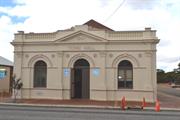
20 Parade St Pingelly
Pingelly
Wheatbelt
Constructed from 1907
| Type | Status | Date | Documents |
|---|---|---|---|
| (no listings) |
| Type | Status | Date | Documents |
|---|---|---|---|
| (no listings) |
| Type | Status | Date | Grading/Management | |
|---|---|---|---|---|
| Category | ||||
| Municipal Inventory | Adopted | 28 Nov 1996 | Category 2 | |
| Classified by the National Trust | Classified | 28 Jul 1983 | ||
| Register of the National Estate | Registered | 22 Jun 1993 | ||
| Register of the National Estate | Nominated | 28 Jul 1983 | ||
The place has aesthetic value for its use of decorative structural elements that are common features of the exuberance of the Federation Free Classical style, and as such makes a positive contribution to the streetscape. The place has landmark value on Parade Street. The place is a demonstration of the development that occurred in Pingelly around the turn-of-the-century as it became the service centre of the district.
The building is a single-storey civic building built to the street alignment in the Federation Free Classical style. The front elevation of the building is a symmetrical composition about a central doorway, with a double-hung sash window either side. The facade is divided into three bays by four slender pilasters each on a pedestal and base. The pilasters feature Corinthian capitals. The exterior walls of the building are in red brickwork laid in English bond on a rendered plinth. The front elevation is rendered with a highly decorative rendered parapet with Italianate balustrading. The openings are semi-circular arches with curved sashes. The windows have semi-circular fanlights with leaded, and stained glass. The lower sashes have been replaced with two-light casement sashes. The window frames are recessed behind the outer face of the building. The entrance doors are panelled (replacements) and the doorway has a semi-circular fanlight with leaded and stained glass. Each opening features moulded surrounds with pronounced keystones. Surmounting the entrance on the parapet is a triangular pediment which bears the date the building was constructed. The plain entablature bears the name of the building. The side elevations are strengthened with engaged piers. In 1935, the building was altered and extended. The works included the widening of the stage, extending the building to include a lesser hall at the rear of about half the size of the main hall, the addition of a kitchen, relining and ceiling the main hall and conservation work on the exterior. The works were carried out under the direction of Architects, Oldham Boas, Ednie-Brown. The lesser hall is built in brick to match the original building. The kitchen addition is also built in brick but has a hipped roof. Further alterations to the building have been carried out. The works included the replacement of doors, recovering the roof, re-newing the roof plumbing, new concrete and brick paving surround that partially covers the sub-floor vents on the exterior walls, and the bricking-up of a window opening on the south elevation. These works may have been included with the Works carried out in 1954. In the interior of the building, modern toilet facilities that are open to the public are off the entrance hall at the front of thé building. The floor of the toilets and entrance hall are tiled, and the walls are rendered. The ceiling of the entrance hall retains its pressed metal with decorative ceiling roses.
In May 1907, Messrs Naylor, J. S. Webb, members of the Agricultural Hall Committee and Mr E. C.. Monger, chairman of the trustees, visited Perth to interview the Minister for Works and ask that a grant should be given to enable the committee to build a new hall. The deputation was accompanied by Mr Horace Smith, MLA. The gentlemen stated that the present building was totally inadequate for the district's requirements, and was dilapidated and that it was dangerous to life. They states further that local residents would provide £500 towards the building. It was pointed out that during the past 12 months buildings to the value of £6,000 had been built and that 9,537 acres had been cleared and cultivated, making atotal of 27,000 acres. In reply, the Minister stated that if the deputation raised £500 in the district, the Government would advance them a similar amount, which was provided for in such cases. By 14 June 1907, tenders had been invited for the purchase and removal of the old town hall and by 28 June, tenders were invited for erection of the new Hall, to the design of Mr Geo Lavater - Architect and Engineer. On 23 August 1907, it was reported that the old agricultural hall had been levelled to the ground by a Mr Liverick, to whom the pulling down and brick cleaning contract had been let. The building of the new structure was let to builders, Nelson and Pearson. The laying of the foundation stone of the Pingelly Town Hall was described in some detail in the local press: "On Saturday [14th] the opening ceremony in connection with the above took place, Mr Price performing the work under singularly auspicious circumstances considering the state of the weather, which was the only drawback to the day's festivities. The old hall, which was built some 14 years ago, and was then regarded as more than ample for requirements, is now relegated to the past to make way for a structure of modern design, improvement and conveniences, and containing the necessary accommodation for Pingelly and its progressive and rising district. The architect, Mr Lavatar, has prepared plans of a very nice building and the contractors, Messrs Nelson and Pearson, who have had considerable experience throughout the State, will do justice to them ...At the appointed time, 3 pm., the Minister, accompanied by Mr Horace Smith, Messrs. Congreve, Monger, Web, Hughes, Naylor, and others attended the site of the new building, where there was a large concourse of people.... After which Mr Congreve, briefly introduced the Minister, who, he said had visited Pingelly in order to lay the foundation stone of the new building and had made a very good start. He hoped the residents would assist them to make a good finish. He then had much pleasure in presenting Mr Price with a silver trowel and mallet made by Mr B. Hughes (of Trugurtha and Hughes), out of curly jamwood, which was very neatly made." The Pingelly Town Hall was officially opened to the public with a dance, attended by the Minister for Works.Extensive alterations and improvements were carried out to the building in 1935. Full details of the work were featured in an article in the Pingelly-Brookton Leader in June: "The contract entailed the complete renovation of the frontage of the building and the interior of the auditorium, which was also lined with plaster and ceiled with 'Celite'. The stage always previously too small for the comfortable accommodation of relatively small parties has been given a further depth of 9 ft which will make a vast improvement. At the rear of the stage there is a Supper Room which will be invaluable to organisers of small dances, or for the conducting of meetings, parties and social gatherings. The size of this Lesser Hall is 21 feet x 42 feet 6 in, actually half the size of the main hall. The flooring is wejl set down and substantial walls constructed of brick, which is plastered on the inside. 'Celite' is again used for the ceiling...The architects for the Hall reconstruction were Messrs Oldham, Boas and Ednie Brown and the contractor was Mr C. H. Hoskins of Narrogin." Works were again carried out in 1954. These included new flooring, renewal of windows, extensions to the kitchen and improved kitchen facilities. Pingelly Road Board accepted the tender of £5,000 submitted by building contractors Messrs S. W. Hawkes & Sons of Narrogin.
High
Good
| Name | Type | Year From | Year To |
|---|---|---|---|
| G.G. Lavater & Oldham Boas, Ednie-Brown | Architect | - | - |
| Ref ID No | Ref Name | Ref Source | Ref Date |
|---|---|---|---|
| " Pingelly Leader and Cuballing Standard" p3 | Local Newspaper | 31/05/1907 | |
| "The Great Southern Leader" p3 | Local Newspaper | 23/09/1907 | |
| Apperly, R. Irving, R. Reynolds, P. "A Pictorial Guide to Identifying Australian Architecture, Styles and Terms from 1788 the the Present" p104-107 | Angus and Robertson NSW | 1989 | |
| "Pingelly-Brookton Leader" p 5 | Local Newspaper | 13/06/1935 |
| Ref Number | Description |
|---|---|
| 02248 | Heritage Place No. |
| 2248 | Database No. |
Individual Building or Group
| Epoch | General | Specific |
|---|---|---|
| Original Use | GOVERNMENTAL | Town, Shire or District Hall |
| Present Use | GOVERNMENTAL | Town, Shire or District Hall |
| Style |
|---|
| Federation Free Classical |
| Type | General | Specific |
|---|---|---|
| Wall | BRICK | Common Brick |
| Roof | METAL | Corrugated Iron |
| General | Specific |
|---|---|
| SOCIAL & CIVIC ACTIVITIES | Community services & utilities |
This information is provided voluntarily as a public service. The information provided is made available in good faith and is derived from sources believed to be reliable and accurate. However, the information is provided solely on the basis that readers will be responsible for making their own assessment of the matters discussed herein and are advised to verify all relevant representations, statements and information.