

Local Government
Pingelly
Region
Wheatbelt

23 Stratford St Pingelly
Pingelly
Wheatbelt
| Type | Status | Date | Documents | More information |
|---|---|---|---|---|
| (no listings) |
| Type | Status | Date | Documents |
|---|---|---|---|
| (no listings) |
| Type | Status | Date | Grading/Management | More information | |
|---|---|---|---|---|---|
| Category | Description | ||||
| Municipal Inventory | Adopted | 28 Nov 1996 | Category 3 |
Category 3 |
|
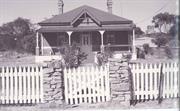
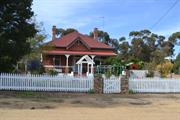
Kylin is a fine representative example of the Australian bungalow style of vernacular architecture, based on the English cottage plan.
The place, for its building form and characteristics of its class, makes a positive contribution to the streetscape and townscape of Pingelly.
Kylin is set well back from the street alignment. Random rubble stone piers frame the entry gate, and a path leads to the front entrance. A picket fence stretches across the front boundary of the property. The design of the building is based on the English cottage plan with a central passage and rooms either side. The chimneys are on internal walls with fireplaces back to back. The building has a high-pitched hipped roof with a flying gable in the centre of tliie facade. The gable is decorated with a finial. The roof also features tall, corbelled brick chimneys.
The facade is symmetrica] about a central doorway with a double-hung sash window either side. The exterior wall features a rendered band at window sill height. A raised verandah stretches across the facade covered with a lean-to verandah roof supported on timber posts on bases. The two inner posts have decorate brackets.
Pingelly began construction with materials which were readily available in the township - stone, mud and wood. The first buildings were wood that were later replaced by mud bat and stone houses with shingles cut from local trees or thatching made from blackby rushes for the roofing. With the advent of some local industries, a need for a more adequate building programme became evident. The buildings became more uniform with the use of locally made bricks and the extensive use of corrugated iron. To a certain extent the climate dictated the housing style. To overcome the heat of summer, a bungalow was developed with four main rooms and a central passage, all or part way through the middle, with wide verandah all around, where possible, part of which was allocated as bathroom and laundry and kitchen. As the family grew, it was common to add enclosed areas as sleepouts. However, often finance did not permit four main rooms so two large rooms and a lean-to at the back sufficed, with additions being added when possible. Wood - was used sparingly in Pingelly. It was economical and uncomplicated but due to the local brick industry it
was not used to its fullest potential. Masonry - brick, and to a much lesser extent stone, provided the bulk of the building construction. Stonework was
mainly used in the first houses of Pingelly along with mud bats. With the advent of locally made bricks, the use of stonework was diminished to only large buildings, especially the churches. Corrugated iron - cgi was used extensively for roofing. It was also used for wall cladding, lining of eaves and in some cases ceiling linings. The extensive use of cgi expressed the importance of it as a building element.
Moderate-High
Good
| Ref ID No | Ref Name | Ref Source | Ref Date |
|---|---|---|---|
| Boyd, R. "Australia's Home: Why Australians built the way they did" p 16-18 | Penguin Books Ltd, Second Edition | 1978 |
| Ref Number | Description |
|---|---|
| 05933 | Heritage Place No. |
Individual Building or Group
| Epoch | General | Specific |
|---|---|---|
| Present Use | RESIDENTIAL | Single storey residence |
| Original Use | RESIDENTIAL | Single storey residence |
| Type | General | Specific |
|---|---|---|
| Roof | METAL | Corrugated Iron |
| Wall | BRICK | Common Brick |
| General | Specific |
|---|---|
| DEMOGRAPHIC SETTLEMENT & MOBILITY | Settlements |
This information is provided voluntarily as a public service. The information provided is made available in good faith and is derived from sources believed to be reliable and accurate. However, the information is provided solely on the basis that readers will be responsible for making their own assessment of the matters discussed herein and are advised to verify all relevant representations, statements and information.