

Local Government
Harvey
Region
South West

12705 South Western Hwy Benger
off eastern side of South West Highway approx 400m south of intersection with Partridge Road
Harvey
South West
Constructed from 1889 to 1924
| Type | Status | Date | Documents | More information |
|---|---|---|---|---|
| (no listings) |
| Type | Status | Date | Documents |
|---|---|---|---|
| RHP - To be assessed | Current | 30 May 2003 |
| Type | Status | Date | Grading/Management | More information | |
|---|---|---|---|---|---|
| Category | Description | ||||
| Municipal Inventory | Adopted | 27 Oct 2015 | Category 2 |
Category 2 |
|
| Register of the National Estate | Nominated |
|
Heritage Council | ||
| Register of the National Estate | Indicative Place |
|
Heritage Council | ||
• The place has historic value for its association with the Partridge family who made a major contribution to the establishment and development of the district.
• The place has aesthetic value for its demonstration of the different styles of residences built on the property since 1889.
• The place has social value as it has been a landmark in the district, which through its longevity in the district has contributed to the community’s sense of place.
The homestead is an historically important frame property with buildings dating from a number of eras.
The main house was first constructed in 1889, however has been subject to a number of additions and modifications over the years. The dwelling incorporates a timber framed structure with the oldest remaining section containing pit-sawn timber cut by hand. The dwelling is built high off the ground on double height brick piers with an undercroft which has been partially enclosed as a garage and additional accommodation. The house is 'L' shaped in plan form with a steep corrugated iron roof incorporating a half timbered gable projecting over verandahs with timber balustrading. An imposing stone staircase curves down from the entry porch to spacious lawns and well kept gardens with fine trees.
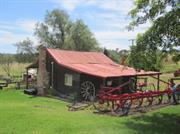
The small timber weatherboard cottage with a cast iron roof, brick chimney and lean-to verandah situated nearest the entrance gates is known as ‘Hockham Cottage’ and was constructed in 1891. It is presently used as a private museum. There is also an adjacent timber milking shed dating from the same era.
Adjacent to these buildings is the re-located Brunswick State School, which was originally located adajcent to the South Western Highway, north of the Brunswick townsite and later, the Brunswick Showgrounds before being re-located to its current location in circa 2000.
The buildings are also close to an outcrop of white granite rocks from which the place is named. There is a water catchment reservoir dating from the period of the cottage.
There is a further timber framed, weatherboard clad dwelling with iron roof to the east of the main homestead which was constructed in circa 1924.
The property also includes a new large metal agricultural shed housing a computerised rotary milking turntable and is claimed to be the largest automatic milking shed in the southern hemisphere.
This old dairy farming property is named for the distinctive outcrop of big white rocks visible from the South Western Highway.
John Partridge established 'White Rocks' on four hundred acres of land which he bought from Edward Clifton in 1887. A 'pit sawn timber' cottage was built on the site in 1889 and was known as the 'manager's residence'. Partridge married Elinor Ker in 1891, and a jarrah cottage was constructed at this time. The timber cottage is known as Hockham Cottage and is currently [2014] used as a private museum.
In 1894, stables and sheds constructed of wandoo poles were erected behind Hockham Cottage and a Moreton Bay Fig tree was planted on the site. A similar tree was planted at Shenfield Farm in the same year. A third residence was constructed on the site in 1924 and it continues to be used as a residence in 2014.
During World War II Italian POW's were accommodated and laboured on the farm. A cottage was constructed on the site at the rear of the property to accommodate the POW's. The POW's undertook a range of work at the farm and the surrounding district. A legacy of their time at 'White Rocks' is a substantial rock wall surrounding the tennis court.
The property is still owned and occupied by members of the Partridge family [2014].
High/ High
Excellent
Individual Building or Group
| Epoch | General | Specific |
|---|---|---|
| Present Use | EDUCATIONAL | Museum |
| Other Use | FARMING\PASTORAL | Cottage |
| Original Use | FARMING\PASTORAL | Homestead |
| Other Use | FARMING\PASTORAL | Shed or Barn |
| Present Use | FARMING\PASTORAL | Homestead |
| Style |
|---|
| Inter-War California Bungalow |
| Victorian Georgian |
| Type | General | Specific |
|---|---|---|
| Wall | METAL | Corrugated Iron |
| Wall | BRICK | Common Brick |
| General | Specific |
|---|---|
| OCCUPATIONS | Grazing, pastoralism & dairying |
This information is provided voluntarily as a public service. The information provided is made available in good faith and is derived from sources believed to be reliable and accurate. However, the information is provided solely on the basis that readers will be responsible for making their own assessment of the matters discussed herein and are advised to verify all relevant representations, statements and information.