

Local Government
Claremont
Region
Metropolitan

19 Agett Rd Claremont
Claremont
Metropolitan
Constructed from 1912
| Type | Status | Date | Documents | More information |
|---|---|---|---|---|
| Heritage List | Adopted | 27 Jun 2023 |
| Type | Status | Date | Documents |
|---|---|---|---|
| (no listings) |
| Type | Status | Date | Grading/Management | More information | |
|---|---|---|---|---|---|
| Category | Description | ||||
| Local Heritage Survey | Adopted | 27 Jun 2023 | HP - Category 2 |
HP - Category 2 |
|
| Municipal Inventory | Adopted | 31 Dec 1995 |
|
Heritage Council | |
19 Agett Road, Claremont, is of local historical, aesthetic and associative significance as a substantial early twentieth‑century residence constructed c.1912–13 during the formative period of Agett Road’s development. The place demonstrates the consolidation of Claremont as a desirable suburb for professional and senior public service residents in the early 1900s.
The dwelling is a fine and comparatively intact example of a Federation Bungalow residence with strong Queen Anne influences, expressed in its complex roofscape, dormer elements and decorative verandah detailing. It illustrates the evolution of domestic architecture in Western Australia during a transitional period from highly picturesque Federation forms to more cohesive bungalow design.
The place has additional significance for its association with the prominent architectural firm Wright, Powell & Cameron, reflecting the growing role of professionally designed housing for affluent clients in the early twentieth century. It is also associated with Henry Hartung, a senior public servant, and Gustav A. Mengler, a successful businessman and long-serving Mayor of Claremont, both of whom contributed to the civic and social development of the district. The place is further associated with Lucie (Lucy) Lina Mengler, who was active in community and civic life in Claremont.
Through its architectural qualities and associations with notable individuals, the place contributes to the understanding of the social, professional and civic character of Claremont’s early suburban development and remains an important element of the historic streetscape.
The interior of the place is not of heritage significance.
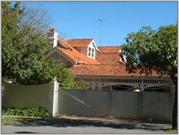
The dwelling at 19 Agett Road is a substantial single-storey Federation-era residence best described as a Federation Bungalow with strong Queen Anne influences, expressed in its complex roofscape and decorative detailing.
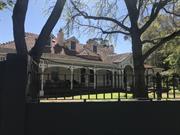
The house is set within a generous landscaped setting behind a low masonry wall and metal fence, contributing to the established early twentieth-century streetscape. The overall composition is asymmetrical, with a central core and projecting elements that create a picturesque quality.
The roof is a dominant feature, comprising intersecting pitched forms clad in terra-cotta tiles, incorporating multiple gables and dormer windows. These elements reflect Federation Queen Anne influence, introducing vertical accents and visual complexity. Rendered brick chimneys rise prominently above the roofline. Gable ends feature decorative timber infill and bargeboards, reinforcing the period character.
A full-width return verandah wraps the principal elevation and is integrated under the main roof, a key characteristic of the Federation Bungalow idiom. The verandah is supported by timber posts with decorative brackets and a continuous timber frieze incorporating circular cut-out motifs, representing a restrained but distinctive level of ornamentation.
Walls are constructed in rendered masonry or painted brickwork, contributing to a unified and relatively simplified surface treatment compared to the more texturally expressive finishes typical of high-style Queen Anne examples. Openings consist of timber-framed windows and glazed doors, arranged within the asymmetrical composition, with a centrally located entry accessed from the verandah.
Overall, the dwelling demonstrates a hybrid architectural character, combining the picturesque roof forms and decorative influences of Federation Queen Anne with the integrated verandah, solid massing and relative restraint of the Federation Bungalow style, reflecting the transitional nature of domestic architecture in Western Australia in the early 1910s.
19 Agett Road was designed in 1911 by architectural firm Wright, Powell & Cameron for Henry Hartung, a mining surveyor and senior public servant, although available evidence suggests construction was delayed and likely completed in 1912–13. The house forms part of the early twentieth‑century residential development of Agett Road, during a period when Claremont was consolidating as a desirable suburb for professionals and senior officials.
Wright, Powell & Cameron were a well‑regarded Perth architectural partnership active in the early twentieth century and known for a range of residential, commercial and institutional works. The firm’s involvement situates the house within the mainstream of professional architectural practice in Western Australia at the time and reflects the growing expectation among affluent clients for architect‑designed homes rather than speculative or pattern housing.
Hartung arrived in Western Australia in 1895 during the goldfields period, initially working in Coolgardie as a mining surveyor before entering the Department of Lands and Surveys by 1899. His commissioning of a professionally designed residence reflects his established status within the public service and aligns with the character of early Agett Road, which attracted residents of professional and administrative standing. Hartung remained a prominent figure in government service until his death in 1927.
By the early 1920s, the house was occupied by Gustav A. Mengler, a highly successful businessman and later long‑serving Mayor of Claremont. Mengler had built his fortune in the goldfields, particularly at Kalgoorlie, where he developed a prosperous dairy and produce business after purchasing and expanding a small firm in his late teens. His commercial success extended into pastoral and manufacturing interests, and after retiring from active business life he settled in Claremont.
Mengler became Mayor of Claremont in 1927, following service as a councillor and treasurer, and held the office for a record‑breaking consecutive term. His period of residence at 19 Agett Road corresponds with his prominence in civic life and further reinforces the association of the property with individuals of social, commercial and political significance.
Lucie (Lucy) Lina Mengler (1888–1938) was an active and well-regarded member of the Claremont community during her residence at 19 Agett Road. She played a prominent role in local civic and social life, supporting her husband’s public duties as Mayor while also pursuing her own interests. Lucie served as a past president of the Croquet Association of Western Australia and was a member of organisations including the Victoria League and the Myola Club. She was particularly noted for her interest in the welfare of children and for her charitable and community work, reflecting the important role of women in civic life in early twentieth-century suburban society.
Through its association with both Hartung and the Menglers, 19 Agett Road illustrates the professional and civic character of Claremont’s early residential development and contributes to an understanding of the suburb’s social history in the early twentieth century.
| Name | Type | Year From | Year To |
|---|---|---|---|
| Wright, Powell & Camercon | Architect | 1911 | 1913 |
| Ref ID No | Ref Name | Ref Source | Ref Date |
|---|---|---|---|
| Town of Claremont Thematic History |
Individual Building or Group
| Epoch | General | Specific |
|---|---|---|
| Present Use | RESIDENTIAL | Two storey residence |
| Original Use | RESIDENTIAL | Single storey residence |
| Style |
|---|
| Federation Queen Anne |
| Type | General | Specific |
|---|---|---|
| Wall | BRICK | Painted Brick |
| Roof | TILE | Faience Tile |
This information is provided voluntarily as a public service. The information provided is made available in good faith and is derived from sources believed to be reliable and accurate. However, the information is provided solely on the basis that readers will be responsible for making their own assessment of the matters discussed herein and are advised to verify all relevant representations, statements and information.