

Local Government
Busselton
Region
South West

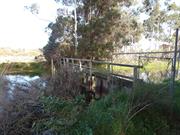
Layman Rd Wonnerup
Wonnerup Wetlands
Busselton
South West
Constructed from 1871 to 1895
| Type | Status | Date | Documents | More information |
|---|---|---|---|---|
| Heritage List | Adopted | 16 Oct 2024 | ||
| State Register | Registered | 03 Jun 2005 |
Register Entry Assessment Documentation |
Heritage Council |
| Type | Status | Date | Documents |
|---|---|---|---|
| (no listings) |
| Type | Status | Date | Grading/Management | More information | |
|---|---|---|---|---|---|
| Category | Description | ||||
| Aboriginal Heritage Sites Register | Interim |
|
Heritage Council | ||
| Aboriginal Heritage Sites Register | Permanent |
|
Heritage Council | ||
| Local Heritage Survey | YES | 16 Oct 2024 | Category 1 |
Category 1 |
|
• Vasse Floodgates and Wonnerup Floodgates were valued for their contribution to the natural landscape in which they were located. The formal structures of the floodgates and the remnants of the bridge created a visual counterpoint to the low-lying wetlands environment.
• Vasse Floodgates and Wonnerup Floodgates demonstrated the diversity of land use management in the region from the late nineteenth century.
• The former Ballarat Bridge was an important part of the infrastructure for the timber industry in Western Australia during the nineteenth and early twentieth centuries and, in 1871, was the first bridge constructed to carry a steam locomotive in the State.
• Vasse Floodgates & Wonnerup Floodgates demonstrated the technical evolution in floodgate design in Western Australia for the management of coastal wetland environments.
• The construction of Vasse Floodgates and Wonnerup Floodgates inadvertently created a freshwater wetland system which has become an important habitat for local and migratory birds. The area received international recognition in 1990 when it was listed under the Ramsar Convention.
• Vasse Floodgates & Wonnerup Floodgates demonstrated the way both coastal wetlands and agricultural areas can be managed through the mechanical control of water levels.
• The records of Ballarat Bridge, Vasse Floodgates & Wonnerup Floodgates made at the time of their removal have the potential to yield information about bridge construction during the latter part of the nineteenth and early twentieth centuries and the construction of the early weirs on the Vasse and Wonnerup Estuaries.
• Vasse Floodgates & Wonnerup Floodgates were important to the local community for the role they played in developing and maintaining viable farmland in the Busselton area, and the modern floodgates that replaced them continue to perform this function.
• The site of Ballarat Bridge is valued by the community for its associations with the Ballarat locomotive, the first locomotive used in Western Australia, now on display in Victoria Square, Busselton.
For a detailed description of the Floodgates refer to the assessment documentation for P16727 Site of Ballarat Bridge, Vasse Floodgates & Wonnerup Floodgates for the inclusion of this place in the State Register in 2005. The site previously comprised two sets of floodgates, Vasse Floodgates and Wonnerup Floodgates (1907/8, replaced
1929), located on the Vasse and Wonnerup estuaries, and remnants of Ballarat Bridge (1871, partly replaced or rebuilt c.1896, 1929) located next to Vasse Floodgate. The Floodgates were replaced in 2004 and Ballaarat Bridge removed
For a detailed description of the Floodgates refer to the assessment documentation for P16727 Site of Ballarat Bridge, Vasse Floodgates & Wonnerup Floodgates for the inclusion of this place in the State Register in 2005. The Ballaarat Bridge was built in 1871 by the West Australian Timber Company under the direction of John McNeil to
serve the milling and export of timber from the nearby forests. The construction of a railway line, jetty and mill to establish this industry was a significant investment from the private owners which was supported by the colonial administrators. The Vasse could boast that this was the first locomotive and railway line in the state. The line was officially opened on 23rd December 1871 and the imported locomotive the 'Ballaarat' was named in its city of origin, Ballaarat in Victoria. The bridge across the estuary at this site was part of the infrastructure needed for the project and it was named in recognition of the locomotive it would carry. In 1877, there were reports that the jetty was in a poor state of repair and the locomotive found to be in a dilapidated condition. Repairs were undertaken, but by the 1880s the rail line itself needed to be relaid with a ‘better class of rail’. By 1887, the WA Timber Company was in financial difficulties. In 1888, it was liquidated, the mills closed and the company assets auctioned in Melbourne. Because of difficulties relating to the transfer of the timber concession and bureaucratic red tape, the new owners chose not to reopen the mills and the railway was left to rust and the locomotive abandoned at Lockville. A Public Works Department plan drawing, dated 1896 and titled ‘Wonnerup Estuary (Old WA Timber Company’s) Bridge, Repairs’, indicates the rail bridge had been, or was being, converted into a traffic and pedestrian bridge. Prior to the installation of the floodgates, every summer and during storm events, the Vasse and Wonnerup estuaries
were subject to flooding with seawater. Apart from flooding, another issue was the unsatisfactory condition of the estuaries during the hot dry summer months when the water levels were much reduced. In 1905, a large number of fish had died in the lower reaches of the Vasse-Wonnerup estuaries causing an unbearable stench. In 1907, the
government finally acted to assist the farmers. Two weirs and floodgates were constructed, Vasse Floodgate stands a short distance upstream from the remnants of what is still referred to as the Ballarat Rail Bridge with a row of remnant
pylons standing between the two structures. Wonnerup Floodgate stands next to the Forrest Beach Road traffic bridge. By 1926, the floodgates were in poor condition and by 1929 they had been replaced. Various measures were undertaken to retain higher water levels in the estuaries over the drier summer months. During the 1930s, the bar at the mouth of the Wonnerup Inlet was closed at the end of winter, then in 1942, both sets
of floodgates were modified so that stop boards could be incorporated to help retain fresh water in the estuaries. This practice of installing boards continued up to and during the 1980s, in part to protect the nesting sites of the Black Swans. The Vasse-Wonnerup wetlands were listed as a Wetland of International Importance, under the Ramsar Convention, in June 1990. In 1991, major repairs were undertaken to both sets of floodgates in order to extend their use for another ten years. In 1996, Ballarat Bridge (listed as the Ballarat Railway Bridge), together with the adjacent Vasse Floodgate, was entered on the Shire of Busselton’s Municipal Heritage Inventory. While the bridge is associated with the rail bridge that carried the Ballarat locomotive, local memory of the bridge is its former use as a road and pedestrian bridge. Over several years of study and design development the floodgates were replaced in 2004 and the Ballaarat Bridge removed
Moderate/low
Good
| Ref Number | Description |
|---|---|
| PN118 | COB Reference |
| Library Id | Title | Medium | Year Of Publication |
|---|---|---|---|
| 7061 | Vasse/Wonnerup Floodgates & Ballarat Bridge (fmr) : heritage assessment. | Heritage Study {Other} | 2003 |
| 6869 | Vasse and Wonnerup Floodgates : photographic record. | Archival Record | 2004 |
| 7266 | Vasse and Wonnerup floodgates replacement : construction phase, selected photographs, heritage photo summary. | Heritage Study {Other} | 2004 |
Historic site
| Epoch | General | Specific |
|---|---|---|
| Present Use | Transport\Communications | Rail: Other |
| Original Use | GOVERNMENTAL | Reservoir or Dam |
| Original Use | Transport\Communications | Rail: Other |
| Present Use | Transport\Communications | Water: Other |
| Style |
|---|
| Other Style |
| Type | General | Specific |
|---|---|---|
| Other | TIMBER | Other Timber |
| Other | METAL | Other Metal |
| General | Specific |
|---|---|
| TRANSPORT & COMMUNICATIONS | Rail & light rail transport |
| DEMOGRAPHIC SETTLEMENT & MOBILITY | Environmental change |
This information is provided voluntarily as a public service. The information provided is made available in good faith and is derived from sources believed to be reliable and accurate. However, the information is provided solely on the basis that readers will be responsible for making their own assessment of the matters discussed herein and are advised to verify all relevant representations, statements and information.