

Local Government
Swan
Region
Metropolitan

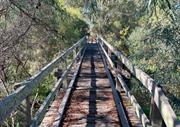
West Swan Rd Belhus
Municipal Inventory No: 638. The bridge stands on the site of a ford near Cruse's Mill (Henry Bull's Cottage/Belhus Estate P2536). The MI states it is Lot 30, 12571 West Swan Road, Ellenbrook.
Cruse's Mill, Belhus Estate
MRWA 915
Swan
Metropolitan
Constructed from 1896, Constructed from 1988
| Type | Status | Date | Documents | More information |
|---|---|---|---|---|
| Heritage List | Adopted | 08 Apr 2026 |
| Type | Status | Date | Documents |
|---|---|---|---|
| RHP - Does not warrant assessment | Current | 14 May 2021 |
| Type | Status | Date | Grading/Management | More information | |
|---|---|---|---|---|---|
| Category | Description | ||||
| Statewide Lge Timber Str Survey | Completed | 11 Dec 1998 |
|
Heritage Council | |
| Municipal Inventory | Adopted | 29 Jul 1998 | Significant |
Significant |
|
| Municipal Inventory | Adopted | 30 Aug 2017 | Category 3 |
Category 3 |
|
Ellen’s Brook Bridge has cultural heritage significance for the following reasons:
• The place is significant as an early crossing point of Ellen’s Brook, dating back to the earliest years of the
Swan River Colony.
• The place has historical significance for its associations with the early settlers and the convict labour force
which built the original bridge.
• The place has historical significance as one of the first colonial built bridges in the Swan River colony.
• The place has historical significance for its association with the original Ellen’s Brook Estate, William Cruse
and the original Cruse Mill built in 1837.
Ellen’s Brook Bridge is a timber footbridge that crosses Ellen Brook. The bridge is located at the western end of the former Cruse Road alignment, just south of Henry Bull’s Cottage. Originally built in the 1850s as a traffic bridge, it was rebuilt in 1988 as a pedestrian bridge.
The structure features timber log pylons with diagonal bracing and timber support beams. The deck is constructed with jarrah railway sleepers and includes a horizontal timber balustrade. During the 1980s reconstruction, the deck was made narrower than the original support structure, causing the beams and pile caps to extend about 500mm beyond each side of the deck.
The bridge is currently in poor condition, with many of the deck boards showing significant deterioration.
The timber bridge over Ellen Brook, was built by convicts and completed in 1851. It was 14.6 metres long, 2.7 metres high and 3.6 metres wide, built on a causeway of ironstone.1 The causeway was needed to provide a firm base over low-lying, muddy flats.
From the earliest days of the colony, the site where this bridge stands was used as a ford to cross Ellen’s Brook. It was chosen as further downstream the valley sides were too steep to allow carts and other vehicles to pass easily.
In the 1840’s a public road was surveyed on the west side of the Swan Valley leading to this point, however, no bridge was built until 1850-51, when convict labour was made available for public works.2
The bridge was built as part of a project that also included the Upper Swan Bridge and a road linking the two bridges. Their construction meant that farmers on the east side of the river could cart their wheat to Cruse’s Mill instead of transporting it all the way to Perth for milling.
In c.1906, the main road from Upper Swan to Perth was re-aligned, from what is now Cruse Road to the present-day alignment of West Swan Road. This included the construction of a new road bridge across Ellen Brook.3 As a result Cruse Road and the original convict-built Ellen’s Brook Bridge were un-gazetted as a public road. The road relocation aligned with William Cruse’s retirement and the subsequent closure of Cruse’s Mill. The Mill fell into disuse and was eventually destroyed by a fire.
Although ungazetted, the road was used by the public for many years after the re-alignment of the new West Swan Road. The present day Cruse Road still follows its original alignment.
In 1988, the Barrett-Lennards spent $25,000 ‘doing up’ the bridge - one of the Shire conditions for subdivision to proceed. The works altered the original structure and size of the bridge reducing it to a footbridge.4
Since 1988, it is unlikely any maintenance work has been undertaken on the bridge. The timber boards and posts are in poor condition and the bridge is unused.
Integrity - Moderate: The original traffic bridge was reduced and rebuilt as a footbridge in 1988. The bridge still retains original material from the 1851 bridge.
Authenticity - Moderate: The structure retains its function as a bridge however due to its poor condition it is no longer usable.
Poor: The bridge is in poor condition with termite and rot damage to many of the timber deck sleepers.
Historic site
| Epoch | General | Specific |
|---|---|---|
| Present Use | Transport\Communications | Road: Bridge |
| Original Use | Transport\Communications | Road: Bridge |
| Type | General | Specific |
|---|---|---|
| Other | TIMBER | Other Timber |
| General | Specific |
|---|---|
| OCCUPATIONS | Manufacturing & processing |
| DEMOGRAPHIC SETTLEMENT & MOBILITY | Settlements |
This information is provided voluntarily as a public service. The information provided is made available in good faith and is derived from sources believed to be reliable and accurate. However, the information is provided solely on the basis that readers will be responsible for making their own assessment of the matters discussed herein and are advised to verify all relevant representations, statements and information.