

Local Government
Wongan-Ballidu
Region
Wheatbelt

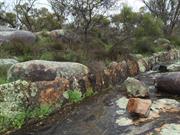
Northam-Pithara Rd Wongan Hills
Between Northam-Pithara Rd and Waddington-Wongan Hills Rd
Wongan-Ballidu
Wheatbelt
| Type | Status | Date | Documents | More information |
|---|---|---|---|---|
| (no listings) |
| Type | Status | Date | Documents |
|---|---|---|---|
| RHP - Does not warrant assessment | Current | 29 Mar 2019 |
| Type | Status | Date | Grading/Management | More information | |
|---|---|---|---|---|---|
| Category | Description | ||||
| (no listings) |
|
||||
• The place is a representative example of the use of rock catchment dam technology, originally developed for railways, later used for a rural water supply.
• The place is associated with the growth of regional infrastructure in the early twentieth century.
P260087 Wongan Hills Railway Dam Rock Catchment Scheme contains rock catchment dam infrastructure built on a series of low granite domes immediately north of the town of Wongan Hills. The low domes, collectively known as Christmas Rock, is approximately 800 m north-south by 250 m at its widest points and sits approximately 15-20 m higher than the surrounding area. The domes lie in a large bushland reserve with the town to the south, and the Wongan Hills Airport immediately east. The domes are bisected by the Northam-Pithara Road running southwest-northeast through the place.
The use of granite domes for water catchment was widely utilised by Aboriginal groups living in arid areas, who maintained and preserved the gnamma holes on granite domes that collected water after the rains. This use was noted by Charles C Hunt on his failed expeditions to establish a stock route into the state’s interior during 1864-1866, as his team was led from gnamma hole to gnamma hole by Aboriginal guides George Mundale and Tommy Windich. Aboriginal people also planted food species around the bases of the rocks to take advantage of run-off.
The use of the granite domes was later recognised by prospectors travelling into the state’s interior, and Engineer-in-Chief C Y O’Connor tasked Assistant Engineer William Shields with developing these domes to provide reliable water for the railway line that was slowly penetrating into the newly discovered Goldfields. Shields constructed a test dam in the Yilgarn (P10065 Moorine Rock Dam), designing a low ring wall of granite sourced off the rock, sealed with bitumen that channelled the water into a spillway and from there a puddle dam. The scheme was successful and multiple rock catchment dams were established along the Goldfields railway line.
From 1905 the state’s wheat belt rapidly expanded, fuelled by the demand for grain and sheep from the state’s booming population. As the cultivated areas extended into semi-arid regions, the rock catchment dam model was utilised by farmers to provide a reliable source of water in places such as Kulin. In addition to farming, the Public Works Department utilised the rock catchment dam model for town water supplies, which began in the 1920s and continued up until 1971.
Other Built Type
This information is provided voluntarily as a public service. The information provided is made available in good faith and is derived from sources believed to be reliable and accurate. However, the information is provided solely on the basis that readers will be responsible for making their own assessment of the matters discussed herein and are advised to verify all relevant representations, statements and information.