

Local Government
Bridgetown-Greenbushes
Region
South West

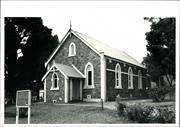
106 Roe St Bridgetown
MHI notes street number as 102
Bridgetown Uniting Church & Hall
Uniting Church
Wesleyan Church
Bridgetown-Greenbushes
South West
Constructed from 1898
| Type | Status | Date | Documents | More information |
|---|---|---|---|---|
| Heritage List | Adopted | 18 Mar 1983 | Shire of Bridgetown-Greenbushes | |
| Heritage List | Adopted | 28 Nov 2019 | Shire of Bridgetown-Greenbushes |
| Type | Status | Date | Documents |
|---|---|---|---|
| RHP - To be assessed | Current | 25 Jun 2004 |
| Type | Status | Date | Grading/Management | More information | |
|---|---|---|---|---|---|
| Category | Description | ||||
| Municipal Inventory | Adopted | 28 Jun 2001 | Category 2 |
Category 2 |
Shire of Bridgetown-Greenbushes |
| Municipal Inventory | Adopted | 29 Mar 2018 | Management Category B |
Management Category B |
Shire of Bridgetown-Greenbushes |
| Uniting Church Inventory | Completed | 01 Oct 1996 |
|
||
The place is a good example of Victorian Free Gothic architectural style church in a rural area.
The place contributes to the communities sense of place
The place is associated with the Uniting Church community and is significant as it used as a place of worship.
□ Single storey
□ Stone and render
□ Gabled iron roof
□ Rendered dressing around windows, base, corners and band pediment.
‘The first explorer into the area was Thomas Turner, an Augusta settler, who traced the Blackwood River upstream to the Arthur River in 1834. He was followed a decade later by Surveyor A. C. Gregory who first explored the area in 1845 and returned to carry out a survey in 1852. There is some argument over who was the first settler in the area with both E. G. Hester and John Blechynden (whose house is one of the town's major historical attractions) both arriving at around the same time in 1857.
Hester settled at Blackwood Park while Blechynden took up 4 000 ha on the southern side of the river and a small holding, on which his house Bridgedale now stands, on the northern side of the river. The government acquired some of Blechynden's land in 1868 and it is on this land that the town of Bridgedale now stands. The town was officially proclaimed on 4 June 1868 and named Bridgetown
The Shire of Bridgetown – Greenbushes Municipal Inventory states:
‘In 1888 tin was discovered nine miles to the north by DW Stinton. The town became a thriving tin mining centre by 1900. Churched played an important role in the community and a number of denominations including the Anglicans, Methodists, and Roman Catholics built Churches in Bridgetown at the period around the turn of the century (1898).’
High
Good
| Library Id | Title | Medium | Year Of Publication |
|---|---|---|---|
| 5706 | Bridgetown : a selection of historical buildings. | Report | 1989 |
Individual Building or Group
| Epoch | General | Specific |
|---|---|---|
| Present Use | RELIGIOUS | Church, Cathedral or Chapel |
| Original Use | RELIGIOUS | Church, Cathedral or Chapel |
| Style |
|---|
| Federation Gothic |
| Victorian Free Gothic |
| Type | General | Specific |
|---|---|---|
| Wall | STONE | Local Stone |
| Roof | METAL | Corrugated Iron |
| General | Specific |
|---|---|
| SOCIAL & CIVIC ACTIVITIES | Religion |
| SOCIAL & CIVIC ACTIVITIES | Cultural activities |
This information is provided voluntarily as a public service. The information provided is made available in good faith and is derived from sources believed to be reliable and accurate. However, the information is provided solely on the basis that readers will be responsible for making their own assessment of the matters discussed herein and are advised to verify all relevant representations, statements and information.