

Local Government
Albany
Region
Great Southern

Lot 7705 Cheyne Beach Road Cheynes
Waychinnicup Inlet, Waychinnicup National Park
Albany
Great Southern
Constructed from 1800
| Type | Status | Date | Documents | More information |
|---|---|---|---|---|
| Heritage List | Adopted | 27 Oct 2020 | ||
| State Register | Registered | 09 May 1997 |
Register Entry Assessment Documentation |
Heritage Council |
| Type | Status | Date | Documents |
|---|---|---|---|
| (no listings) |
| Type | Status | Date | Grading/Management | More information | |
|---|---|---|---|---|---|
| Category | Description | ||||
| Register of the National Estate | Permanent | 21 Mar 1978 |
|
Heritage Council | |
| Classified by the National Trust | Classified | 04 Apr 1977 |
|
Heritage Council | |
| Municipal Inventory | Adopted | 30 Jun 2001 | Category A+ |
Category A+ |
|
| Local Heritage Survey | Adopted | 27 Oct 2020 | Exceptional |
Exceptional |
|
Sealers’ Oven, a primitive bread oven of granite stones and pug, has cultural heritage significance for the following reasons:
It is evidence of the activities of sealers prior to the colonisation of Western Australia.
It is an extremely rare example of its kind on the Western Australian coast.
It is highly valued by the community as an important relic within Waychinicup National Park.
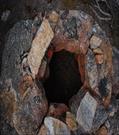
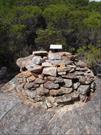
Sealers’ Oven is a small kiln structure of natural granite stone and pug that was used for baking bread. It is built on a granite outcrop, and is roughly circular in plan with a diameter of about 1.5m at the base. The walls curve inwards, giving it a beehive shape, and rise to a height of about 1m and diameter of about .75m. The oven has a central opening at the top in which the fuel and dough would have been inserted, and there are two smaller ventilation holes at the base. The granite stones were locally sourced and generally flat, broad and inherently stable.
Some of the notable features of this place include:
• Locally sourced stones
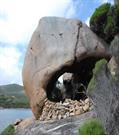
• The nearby cave (shelter)
Some obvious modifications include:
• Rounder stones at top indicate partial reconstruction
Sealers’ Oven is a relic from pre-European settlement in Western Australia, constructed by seal traders visiting the south coast around 1800. Commercial hunting of seals and whales began in Australia in 1790. Discovery of King George Sound in 1791 enabled sealing and whaling industries to establish stations along this stretch of coastline. The safe anchorage and abundant fresh water supply at Waychinicup Inlet became known to sealers operating along the coast. Sealers’ Oven was erected for the sealers who occasionally anchored in the inlet.
Due to the notable decline in the seal population, sealing in Western Australia ceased during 1840-1850.
In 1973, at the request of the National Trust, the Western Australian Government established a reserve of 12 square metres around the Sealers’ Oven to protect it. In 1977, the Sealers’ Oven was classified by the National Trust. In 1990, stage one of the Waychinnicup National Park was achieved and is now a high conservation area with scenic views and the Sealers’ Oven.
A hollowed cave, with a dry stone retaining wall at its entrance, is located in close proximity to the Sealers’ Oven and may well have been used as a shelter by the sealers.
Integrity: High
Authenticity: High/Moderate
Fair
| Ref ID No | Ref Name | Ref Source | Ref Date |
|---|---|---|---|
| Heritage Council of Western Australia assessment for entry on permanent basis | 1997 | ||
| Heritage TODAY Site visit and Assessment | 1999 |
| Library Id | Title | Medium | Year Of Publication |
|---|---|---|---|
| 4140 | Sealers' Oven Conservation Plan | Heritage Study {Cons'n Plan} | 1999 |
Individual Building or Group
| Epoch | General | Specific |
|---|---|---|
| Original Use | INDUSTRIAL\MANUFACTURING | Whalers or Sealers Oven |
| Present Use | INDUSTRIAL\MANUFACTURING | Whalers or Sealers Oven |
| Style |
|---|
| Other Style |
| Type | General | Specific |
|---|---|---|
| Wall | EARTH | Other Earth |
| Wall | STONE | Granite |
| General | Specific |
|---|---|
| OCCUPATIONS | Fishing & other maritime industry |
This information is provided voluntarily as a public service. The information provided is made available in good faith and is derived from sources believed to be reliable and accurate. However, the information is provided solely on the basis that readers will be responsible for making their own assessment of the matters discussed herein and are advised to verify all relevant representations, statements and information.