

Local Government
Yalgoo
Region
Midwest

Yalgoo-Ninghan Rd Paynes Find
Karara Rangeland Park
Yalgoo
Midwest
Constructed from 1910 to 1930, Constructed from 1980 to 2023
| Type | Status | Date | Documents | More information |
|---|---|---|---|---|
| (no listings) |
| Type | Status | Date | Documents |
|---|---|---|---|
| RHP - Does not warrant assessment | Current | 22 Oct 2024 |
| Type | Status | Date | Grading/Management | More information | |
|---|---|---|---|---|---|
| Category | Description | ||||
| (no listings) |
|
||||
Reids Ridge Abandoned Mine Site comprises a collection of mining infrastructure reflecting the nature of small-scale mining activities common through the twentieth and twenty-first century across the Midwest and Goldfields areas in Western Australia.
Reids Ridge Abandoned Mine Site retains some evidence of the four phases of operation prior to its abandonment, which reflect the cycle of growth and decline of mining (and subsequently mines, towns and businesses associated with the State's gold mining industry) throughout Western Australia’s recent history.
Reids Ridge Abandoned Mine Site has some archaeological potential to provide information on the isolated way of life for workers in small-scale mining operations in remote locations in regional Western Australia.
Reids Ridge Abandoned Mine Site, located within the Karara Rangeland Park, approximately 7km northwest of the Warriedar Homestead. Topography of the area is flat, and vegetation consists mainly of low scrub and grasses.
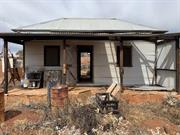
Abandoned mine site including - Abandoned mine shafts, wooden cottage re-purposed as a gold processing room, concrete water tank, and machinery of various ages. A 40-year-old metal headframe over the main shaft remains, while the majority of the remaining infrastructure is in a dilapidated state. Tailings and waste rock material are mainly confined to the south-east corner of the site. Other rubbish and debris is present across the site.
The land in Reids Ridge is located within the traditional lands of the Badimia people.
Sandalwood cutters were the earliest non-Indigenous residents in the Gascoyne and Murchison rangelands (c.1845) with the first pastoral leases being granted in the mid to late 1860s. After gold was discovered in the region in 1892, prospectors arrived in the region.
The Rose Marie Mine (at Reids Ridge Abandoned Mine Site) operated intermittently between 1936 and 1952. Exploration programs including aerial and ground surveying, rock chip sampling, and drilling occurred across the area from 1980. From 1982 the site, was named Reids Ridge Gold Mine by Reids Ridge Mining. Although production at Reids Ridge Gold Mine ceased in mid-1985, exploration programmes to establish gold ore reserves continued across the wider Reids Ridge area throughout the late 1980s and 1990s. A fourth phase of operations began at Reids Ridge in 2000, including continued exploration activities for both gold and iron ore. The headframe, shaft and ladder were repaired around 2003.
Between 1995 and 2007, the state government purchased six former pastoral leases, including the nearby Warriedar station, that now form Karara Rangeland Park. The mining tenement M59/117 was forfeited in 2015.
Historic site
| Epoch | General | Specific |
|---|---|---|
| Original Use | MINING | Other |
| Other Use | FARMING\PASTORAL | Other |
| Present Use | VACANT\UNUSED | Vacant\Unused |
| Type | General | Specific |
|---|---|---|
| Wall | TIMBER | Weatherboard |
| Roof | METAL | Other Metal |
| General | Specific |
|---|---|
| Economy | Mining and Mineral Resources |
| OCCUPATIONS | Mining {incl. mineral processing} |
This information is provided voluntarily as a public service. The information provided is made available in good faith and is derived from sources believed to be reliable and accurate. However, the information is provided solely on the basis that readers will be responsible for making their own assessment of the matters discussed herein and are advised to verify all relevant representations, statements and information.