

Local Government
Swan
Region
Metropolitan

12571 West Swan Rd Upper Swan
Swan
Metropolitan
Constructed from 1836
| Type | Status | Date | Documents | More information |
|---|---|---|---|---|
| Heritage List | Adopted | 08 Apr 2026 |
| Type | Status | Date | Documents |
|---|---|---|---|
| (no listings) |
| Type | Status | Date | Grading/Management | More information | |
|---|---|---|---|---|---|
| Category | Description | ||||
| Municipal Inventory | Adopted | 29 Jul 1998 | Significant |
Significant |
|
| Municipal Inventory | Adopted | 30 Aug 2017 | Category 3 |
Category 3 |
|
Ellen’s Brook Estate- Mill Dam and Mill Weir has cultural heritage significance for the following reasons:
• The place demonstrates the early nineteenth century European settlement of the Swan River Colony for agricultural purposes.
• The place has historical significance for its association with the original Ellen’s Brook Estate.
• The place has historical significance for its association with William Cruse and the original Cruse Mill built
in 1837.
• The place is an example of technical achievements at a time of economic struggle during the nineteenth
century.
• The place is important for its potential to reveal information contributing to the methods of milling flour in
the colony during the nineteenth century.
The site of the Mill Dam & Mill Weir is located near the intersection of Corona Way and Millhouse Road, at the northern end of the original Ellen’s Brook Estate. The historic site currently occupies a valley that spans from the dam in the north to Ellen’s Brook Bridge in the south.
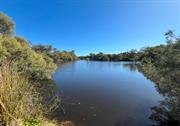
The tributary brook has been dammed with an earth wall, creating a weir surrounded by vegetation that provides a habitat for local birds and wildlife. A sluice gate to the southern dam wall regulates water flow into the millrace, which runs through the valley. At the base of the dam wall, a small concrete bridge and culvert allow access across the millrace.
The stream flows for approximately 500 metres before meeting the site of Cruse’s Mill. The mill was reconstructed following a fire but is no longer active.
A walking track runs through the area, accessible from Corona Park, and follows the eastern boundary of the Stockland Vale housing estate in Aveley.
The site of the Mill Dam and Mill Weir is situated on part of Swan Location 1 in the Upper Swan District. Swan Location 1 was a grant of some 15,000 acres made to George Leake, in 1829. Leake was a merchant who came out to the colony with £2,000 in cash and goods, as well as five indentured servants. In July 1831, he formed a partnership with Henry Bull in which Bull would improve Leake’s grant in return for half of it.
Henry Bull was a lieutenant in the navy, on half-pay, who had arrived in the colony in 1830. He worked Leake’s grant, known at that time as the ‘Ellen Brook Estate’, building a house for himself and farming the land.
One of Henry Bull’s servants, William Cruse, worked a flour mill on the property. The mill was built some time
between 1832 and 1834, and was originally operated by horse power. According to Irwin:
His [Bull’s] mill, which was constructed under his own direction, and is worked by horses, not only grinds the flour which is used in his own establishment, but returns him a considerable profit by what it grinds for other settlers.
In 1837, the mill dam, mill race, mill pond and waterwheel were completed and the mill was powered by water. A newspaper report in April 1837, stated:
We have a water mill at the head of the Swan just brought into operation. The construction of this mill owes its present state of forwardness to the ingenuity and perseverance of a man named William Cruize [sic], formerly
in the service of Mr Bull. It is erected on Mr Leake’s grant, where there is a fine stream of water, sufficient to drive 2 or 3 pair of stones.
In 1838, Leake transferred title of 7,443 acres to Bull, keeping for himself the southern portion of the grant on which were situated the house and the mill. The following year he surrendered some 5350 acres to the Crown, retaining 2904 acres.
William Cruse had been working the mill since the early 1830s and almost certainly had his own home nearby.
In November 1851, ‘Ellen Brook Estate’ passed to George Leake’s nephew, George Walpole Leake, on his marriage. In 1897, after his death, ‘Ellen Brook Estate’ was purchased by George Barrett-Lennard who renamed it ‘Belhus Estate’ after the family estate, Belhus Manor, in Essex, England.
According to George’s grandson, John Barrett-Lennard, his grandfather planted table grapes at ‘Belhus Estate’ watering them from the mill dam constructed by William Cruse. Before it burnt down, the mill building was used for the storage of wine.
As of 2025, the dam and weir remain full and continue to tribute water into Ellen Brook. Historical records indicate that two timber footbridges once crossed the mill race at the base of the dam wall. However, by 2025, this crossing is formed by a concrete bridge and culvert. It is possible that the original timber bridges were demolished and replaced by the current structure, although further research is needed to confirm this.
Integrity - High
Authenticity - High
Historic site
| Epoch | General | Specific |
|---|---|---|
| Original Use | GOVERNMENTAL | Reservoir or Dam |
| Present Use | FARMING\PASTORAL | Other |
| Original Use | FARMING\PASTORAL | Other |
| General | Specific |
|---|---|
| DEMOGRAPHIC SETTLEMENT & MOBILITY | Settlements |
This information is provided voluntarily as a public service. The information provided is made available in good faith and is derived from sources believed to be reliable and accurate. However, the information is provided solely on the basis that readers will be responsible for making their own assessment of the matters discussed herein and are advised to verify all relevant representations, statements and information.